| Bill and his Brother and their Love of the Sea |
| But one hears less about Wilhelm's love of boats and the water than that of his brother. Prince Heinrich of Prussia (1862–1929), was the third of eight children born to Prussian Crown Prince Friedrich (Emperor Friedrich III, the 99 Day King), and Victoria, daughter of British Queen Victoria. He was younger brother to Kaiser Wilhelm II by three years. A career naval officer, he held various commands in the Imperial German Navy and eventually rose to the rank of Grand Admiral. After attending the gymnasium in Kassel, in 1877, 15-year-old Heinrich entered the Imperial Navy cadet program and made a compulsory two-year voyage around the world from 1878 to 1880 before entering the German naval academy from 1884 to 1886. He quickly achieved command and in 1887, he commanded a torpedo boat and simultaneously the First Torpedo Boat Division. In 1888, he commanded the imperial yacht SMY Hohenzollern and from 1889–1890, the 2nd-class cruiser Irene, the armored coastal defense ship Beowulf, and the capital ships SMS Sachsen and SMS Wörth. Prince Heinrich commanded several naval task forces from 1897, including a squadron in East Asia, where due to his fine diplomatic skills, he became the first European potentate ever to be received at the Chinese imperial court. He also commanded a squadron present in Manila Bay in 1898. In 1903, Heinrich became commander of the Baltic Sea naval station and from 1906 to 1909, Heinrich was commander of the High Seas Fleet. In 1909, he was promoted to Grand Admiral. Heinrich was named Commander-in-Chief of the Baltic Fleet at the onset of World War One, and he succeeded in deterring Russia’s naval forces from attacking the German coast until the 1917 Revolution. After the end of hostilities with Russia, Heinrich left active duty, and at the end of war and the dissolution of the monarchy in Germany, he left the Navy. |
| A Royal Family Curse |
| Extremely popular, Heinrich had a reputation as being frank and humble and was much beloved in Northern Germany and by those under his command. On a trip to the USA in 1902, Heinrich befriended and impressed the American media and the large German-American population. Heinrich had a multitude of modern hobbies. He received one of the first pilot’s licenses in Germany and was also an avid yachtsman, becoming one of the first members of the "Marine-Regatta-Verein" (Regatta Union of the Navy). The Marine-Regatta-Verein was established by a group of naval officers in 1887. It specialized in yacht racing and Heinrich was its patron. In 1891, the club allowed civilians to be admitted. Emperor Wilhelm II was its commodore, bringing his own yacht Meteor I to the club's marina in Kiel. The same year the club changed its name to "Kaiserlicher Yacht Club". 455 members of the Kaiserlicher Yacht Club died in World War One. After the war, the club had difficulties and almost went bankrupt. The Kaiserlicher Yacht Club kept its name even after the Treaty of Versailles, and William II remained as honorary commodore of the club while he lived in exile. In 1937 the Kaiserlicher Yacht Club was merged with other yacht clubs and the commodore's title was taken former Kaiser. He popularized the Prinz-Heinrich-Mütze ("Prince Heinrich cap"), which is still occasionally worn by sailors. He also loved motor cars as well and invented a type of windshield wiper and a car horn. A forerunner to the German Grand Prix was named in his honor. He also was an early proponent of introducing submarines and airplanes, and he had a steamship converted into an early type of aircraft carrier for Baltic Sea operations. He received numerous honorary doctorates, both in Germany and abroad, including an honorary doctorate from Harvard University in 1902. After the German Revolution, Heinrich lived with his family in Schleswig-Holstein and continued with his hobbies of automobiles and sailing. Prince Heinrich died of throat cancer just as his father had, in Hemmelmark on April 20, 1929. |
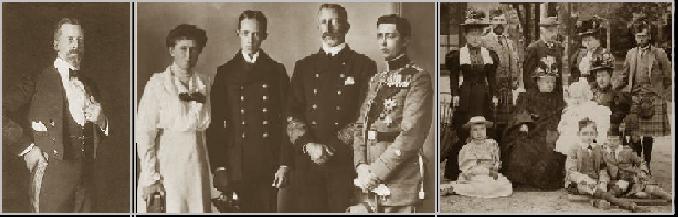
| Prince Heinrich with his wife, Princess Irene, and sons Sigismund and Waldemar (who later died because of the actions of American) in 1902 Heinrich and family with his grandmother Queen Victoria in 1895, His sons are seated on right |
| Heinrich's son, Prince Waldemar of Prussia, was a Haemophiliac, as were Waldemar's first cousin Tsarevich Alexei of Russia, his uncle Prince Friedrich of Hesse and his youngest brother. The gene for Haemophilia was passed down from British Queen Victoria through two of her five daughters, Princess Beatrice and Princess Alice, whose third daughter Irene became wife to Prince Heinrich, who was also Victoria's grandson. Waldemar was born March 20, 1889 at Kiel. Waldemar tried to live a normal life and even married, but he spent much of his life in the hospital. He and his wife, Princess Calixta of Lippe, had no children. Waldemar did not have a good end to his flawed life. He was 56 years old when the Russians advanced into German Silesia in 1945, and Calixta refused to leave her ill husband behind at the mercy of the Red Army. She arranged an arduous route of escape which took them to Prague and finally to Tutzing near Munich in Bavaria. Exhausted and incapacitated, Waldemar received his last blood transfusion there from his doctor. However, the area was overrun the next day by the US Army, who diverted all medical resources to work camp victims. They physically prevented Waldemar's doctor from treating him and this consequently killed him. He bled to death on May 2, 1945. As if that were not enough, the Americans also immediately put a ban on any excavation, refusing to allow Germans to dig private graves. The bereaved Princess Calixta, however, finally found a gravedigger to help her. As she dressed her husband's body for burial, a recently freed work camp inmate attacked her and forced her to give him Waldemar's burial clothes. After that adventure passed, she discovered to her horror that the coffin she had acquired did not fit her husband's body and his arms prevented the top from closing, so the coffin had to remain open. She located an old van to take the open coffin to the mortuary, and there she had to argue with American guards to allow her inside. When she finally did enter, she found that the place had just been plundered and badly vandalized by drunk American GIs. Because of the imposed curfew, she had to leave her husband there until morning. When she returned at daybreak with the hired van to take Waldemar to the cemetery, she had to break his arms to squeeze him in the coffin, and once again had to fight with Americans to allow her to enter the graveyard. Finally, she and her driver lowered Waldemar's casket into the ground together. |
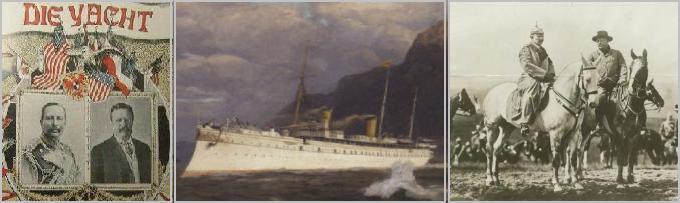
| Maybe it was the German blood, or maybe just the Baltic sea in his veins, but the Kaiser always loved the sea and he played an important role in the creation of yacht clubs and international regattas. SMY "Hohenzollern" (Seiner Majestät Yacht Hohenzollern) was the name of several Yachts named after their royal house and used by the German Emperors between 1878 and 1918. But Kaiser Wilhelm especially liked racing yachts. An arrangement was made in the summer of 1906 between the Kaiserlicher Yacht Club of Kiel, Germany, and the Eastern Yacht Club of Marblehead, Massachusetts for a series of races for the "Roosevelt Cup", given by the Eastern Yacht Club to be sailed in Marblehead in September. Wilhelm's luxurious racing yacht, the Meteor, was a star. The Imperial racing yacht was purchased as the "Thistle" and renamed "Meteor" by Wilhelm in 1891. It was launched on February 25, 1902 with two thousand guests present at the ceremonies, including President Theodore Roosevelt. In fact, it was Alice Roosevelt who broke the bottle and christened the ship. The headlines rang, "MISS ROOSEVELT NAMES KAISER WILHELM'S YACHT; Launching of the Meteor Effected Without a Hitch. A BRILLIANT SPECTACLE. Prince, President, and the Vessel's Sponsor Enthusiastically Cheered By a Vast Throng". However, Meteor’s racing record was not impressive and in 1909, she was sold. Below: Ted and Bill on the racing menu; the yacht Hohenzollern; Bill and Ted again |
| In 1915, Teddy Roosevelt said: "attempts to paint the Kaiser as a bloodthirsty devil are an absurdity. He and his family have given honorable proof that they possess the qualities that are characteristic of the German people. The Germans, from the highest to the lowest, have shown a splendid patriotism. They themselves are fighting, each man for his own hearthstone, for his own wife and children, and all for the future existence of the generations yet to come. The Germans are not merely brothers; they are largely ourselves." |