| Other Odds and Ends; Internment; Brain Washing; Camps on Home Soil |
| The story of America's civilian German Alien Internees during the war remains overshadowed by that of the Japanese. However, 11,000 persons, including many American-born children, were interned by the end of war by simple virtue of their German ancestry, leaving behind a legacy of ruined lives, lost fortunes, shattered families and even suicide. At least 53 military and INS facilities were used to house these mostly innocent civilian internees. Many were completely stunned by a home invasion by three to seven gun-slinging FBI agents, sometimes taking place in the middle of the night. The personal property left behind by some individuals was lost or stolen. Dragged off to various camps and a hasty hearing at a special Hearing Board, aliens deemed "potentially dangerous to the public peace and safety of the United States" were typically sent in a sealed off train with all windows shuttered to various camps. These civilians were viewed as Prisoners of War and forced to wear government issue uniforms. They were initially housed in tents or crude cabins with inadequate washing and toilet facilities and surrounded by barbed wire, warning signs and machine guns. Some were later sent on to family camps like Crystal City or Seagoville in Texas. Beginning in early 1942 and ending in May of 1945, there was also wholesale internment in the U.S. of thousands of Latin American Germans who were kidnapped from their homes and shipped in dark holds of ships to the USA, all under the guise of hemispherical security, and these unfortunate aliens were subsequently charged with illegal entry once the war was concluded! There was continued internment of a large group of internees until 1948 for no valid reason. Other Internees: the Columbus |
| As for German POWs kept on American soil from 1942-1945, most were shipped to and detained in about 500 camps in rural areas across the USA, mainly in the South and Southwest but also in the Great Plains and Midwest (12,000 POWs were held in camps in Nebraska alone). In spite of the Geneva Convention, specially trained prison officials set about molding the minds of the 380,000 German prisoners who filled numerous US camps from 1943 onward. Prisoners were expected to turn them into "US-style democrats" using coercion, brainwashing and threats. Behavioral scientists at the Pentagon directed a "reeducation" program using liberal arts professors who entered over 500 camps nationwide imposed a program that stressed only positive aspects of American society. German POW collaborators and American educators censored popular books and films as they feverishly promoted democratic humanism and condemned German "wartime heroics". Those who didn't comply were sent mainly to Camp Alva in Oklahoma, a maximum-security camp for those the military deemed "hardcore Nazis and Nazi sympathizers". At least forty-six captives died while in custody there. More than 7,000 German prisoners of war were brought to twelve different camps in Utah where hundreds of German prisoners had also been held during World War One, in fact, more than 500 German seamen captured on board the German cruiser SMS Cormoran at Guam and the SMS Geier at Hawaii when America declared war on Germany were interned at Fort Douglas between June 1917 and March 1918. Fort Douglas was also the prison for "enemy aliens", conscientious objectors, and others arrested for violations of wartime legislation. On May 7, 1945, there were 250 German prisoners of war still housed at a camp that had been set up at the end of Main Street in Salina, Utah awaiting repatriation back to their homeland. They were housed in 43 tents scattered across the camp grounds with guards towers looming above. On July 8, 1945, Private Clarence Bertucci began his midnight shift and soon took his .30-caliber machine gun and aimed at the tents where the prisoners were sleeping, methodically firing 250 rounds. He hit thirty tents in a fifteen-second rampage. He killed six prisoners and wounded twenty-two (of which three later died) before a corporal managed to disarm him. Bertucci had bragged in advance of what he intended and was completely unrepentant after the massacre. He was briefly placed in a hospital for a psychiatric assessment, and despite the absence of any evidence of mental impairment, Bertucci was declared insane by a military panel and sent to a New York mental hospital. There is little information available about how long he spent there, but he lived until 1969. His victims were buried at Fort Douglas Cemetery clad in U.S. military uniforms. In 1988, the German Air Force funded the refurbishment of the memorial statue at Fort Douglas Cemetery created by German-born stone carver and immigrant to Utah, Arlo Steineke in honor of 21 German prisoners from World War One who died there. Representatives from Germany rededicated the statue in honor of all the deceased prisoners, and included the phrase: "and all victims of despotic governments around the world". Of the tens of thousands of Germans POWs in the United States during World War II, only 2,222, less than 1 percent, tried to escape, By 1946, all prisoners had been returned to their homes.. if they had one left. |
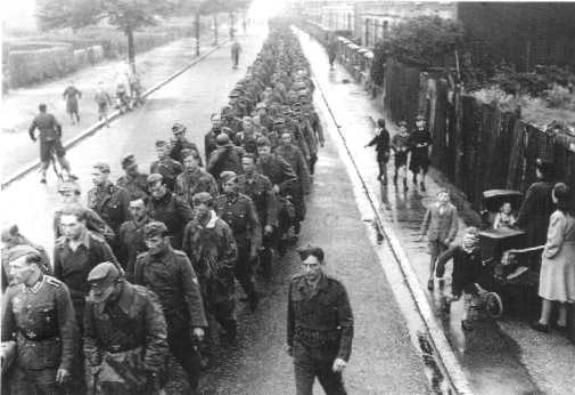
| At least most were not spit upon in England. Above: German prisoners parade down an English street after D-Day. A small amount of German prisoners were sent to British POW camps from 1939 to mid 1943, but it was not until their defeat in North Africa that the camps in Britain took in large numbers. Italian as well as German prisoners were interned in camps across England, Scotland and Wales. After 1942, most were shipped directly to New York and approximately 25,000 were sent on to two large camps in Canada. The British did not want large numbers of German POWs on their soil, and sent most elsewhere, some to distant parts of the British Empire. They did run camps in Great Britain, however, over 600 in all. In general the treatment of the average POW was decent. It was not good for those prisoners who were considered "hard core Nazis" and they were treated roughly, segregated from others and kept longer, often in the wilds of Scotland and other remote areas. There have also been cases of torture brought to light in recent years as well. German airmen were brutally interrogated in some cases to extract information. All were subjected to "re-education" before release. An organization called the Combined Services Detailed Interrogation Centre (CSDIC), a division of the British War Office, ran a secret prison at Bad Nenndorf following the British occupation of north-west Germany in 1945. One of their most notorious centers elsewhere was known as the London Cage, located in an exclusive neighbourhood of London. Official documents recently revealed that the London Cage was a secret torture centre where German prisoners who had been concealed from the Red Cross were beaten, deprived of sleep, and threatened with execution or with "unnecessary surgery". However, conditions at Bad Nenndorf, a small, once-elegant resort near Hanover, was far worse. Secret records recently opened and disclosed horrific torture and suffering of many of the 372 men and 44 women who passed through the center during the 22 months it operated before its closure in July 1947, not only former NS party members, but private German citizens. Several local citizens claimed that one could hear the prisoners' screams at night. Although it makes for uncomfortable reading, the concept of concentration camps was not a German invention and was a well-established system throughout the world long before wars with Germany. Just a scant few of British-run camps elsewhere are mentioned below. German, Italian and Japanese civilians were interned in camps Motuihe and Somes Islands in World War II, the same camps where German civilians living in New Zealand were interned in World War I. In British-India, British interned enemy nationals (mostly Germans) during both wars, including Germans who had acquired British citizenship in India. There were at least 11 interment facilities here in World War II. Most internees were then deported in late 1946. Germans shipped to Hamburg were sent to the former Neuengamme concentration camp for "de-Nazification". In 1940, German combatant prisoners went to Canada at the request of Britain. Between 1940 and 1944, over 40,000 German POW were kept on Canadian soil behind Canadian barbed wire in places like Kananaskis-Seebe, Lethbridge & Medicine Hat, Alberta and Kitchener, Bowmanville, Kingston & Gravenhurst, Ontario. 850 German Canadian civilians were accused of being spies for the Nazis, as well as subversives and saboteurs during WW Two. Many German Canadians interned in Camp Petawawa were from a nineteenth-century migration in 1876 who founded a farm villages called Germanicus in Ontario. Their original farm homesteads were expropriated by the federal government with no compensation and they were imprisoned behind barbed wire in the camp. The Foymount Air Force Base near Cormac and Eganville was built on this expropriated land. Notable was that not one of these homesteaders from 1876 or their grandchildren had ever visited Germany again after 1876, yet they were accused of being "German Nazi agents". 756 German sailors, mostly captured in East Asia, were also sent from Indian camps to Canada in June, 1941. Isle of Man: During World War II, about 8,000 people were interned in Britain, many being held in camps at Knockaloe and Douglas on the Isle of Man where the British had also interred Germans during WW One. The internees included enemy aliens from the Axis Powers, principally Germany and Italy. The British government rounded up 74,000 German, Austrian and Italian aliens. Within 6 months the 112 alien tribunals had individually summoned and examined 64,000 aliens, and the majority were released, having been found to be "friendly aliens" (mostly non-Germans). Eventually only 2,000 of the remainder were interned. Initially they were shipped overseas. The last internees were released late in 1945, though many were released in 1942. In Britain, internees were housed in camps and prisons. Some camps had tents rather than buildings with internees sleeping directly on the ground. Men and women were separated and most contact with the outside world was denied, conditions which drew criticism from a variety of sources. France certainly had its share of camps, most with horrible conditions as previously mentioned. Even the Netherlands did! Under Operation Black Tulip in the Netherlands, a plan to evict all Germans from the Netherlands, on September 10, 1946 Germans and their families in Amsterdam were pulled from their homes in the middle of the night and given one hour to collect fifty kilogrammes of luggage. They were allowed to take only one hundred Guilders. The rest of their possessions were confiscated by the state. They were taken to concentration camps near the German border, the biggest of which was Mariënbosch near Nijmegen. The operation ended in 1948 after 3,691 Germans (15% of German residents) were deported. In postwar Belgium, a tribunal until October, 1946 dealt with "war criminals" which included Belgian collaborators; They were sent to places such as Breendonk Concentration Camp. 4.357 were sentenced to death, with 111 executed. Collaborators were deprived of their right to vote and over 322,000 Belgians were affected. Belgium also took in Baltic soldiers who had understandably fought on the side of the Germans to protect their homeland from the communists. Nearly 25,000 Latvians, for example, were interned in Allied POW camps, initially those run by the British in Germany. In the fall of 1945 most of them, about 12,000, were transferred to POW Camp 2227 at the Zedelgem camp in Belgium (Camp 2226 was used for Germans). However, the Allies also transported the Baltic refugees to Swedish ports where they were shoved aboard freighters and deported together along with several hundred former German soldiers to the USSR, where they spend their lives in slave labor in Communist hellholes. In both situations, they often received beatings, and occasionally were even used for live target practice by the guards. They were released from Allied camps during 1946 when the Western Allies concurred that the Latvians were not Nazis despite their SS uniforms. When released, the Latvians had no home to return to, and they left Displaced Persons camps and forged new homes in Australia, Europe, Canada, South America, and the US. Their self help organization (which was and still is denounced by the Soviets as a Nazi front), Daugavas Vanagi, went with them. A similar situation played out in Sweden. In June 1945 the Swedish government, at the insistence of the US and Britain, signed an agreement with the Soviet Union to give them the approximately 3,000 German soldiers who were interned in Sweden at the time of German capitulation. The agreement was implemented (after a delay) on January 23, 1946, even though most of the Swedish press and public protested the inhumane decision of the Swedish government. Included with the German POWs were a number of Balts who had joined the German forces out of fear and hatred of the Soviets. The Lithuanians and other Baltic refugees present in Sweden reacted to this decision with despair, knowing the POWs would in many cases meet sudden death and most would not be seen or heard from again. But the US pressed the case, and in early 1946, an US military official published the following statement in German newspapers: "...most of the refugees from the Baltic States have fled to Germany only because of their sympathy for National Socialism. In addition, the refugees from the Baltic lands are most responsible for the crimes committed, which create hardships for the refugees of other nationalities as well, and cause disturbances among the inhabitants." The New York Times echoed this sentiment and presented Baltic refugees to the American public as "pro-Nazi collaborators" who had fled their lands willingly. In January 1946, Sweden handed over 146 Baltic and 2,364 German soldiers who had been interned in Swedish prison camps to the Soviet Union. Many preferred death to the horrible fate which awaited them at the hands of the vengeful communists and there was an attempted mass suicide. At least seven of the internees died during the process, but the number was possibly much higher and blocked by censorship. Below: Suicide in Sweden; Baltic and German soldiers being extradited from a prison camp in Eksjö. |
| In Merry Old... |
| Civilian Internees |
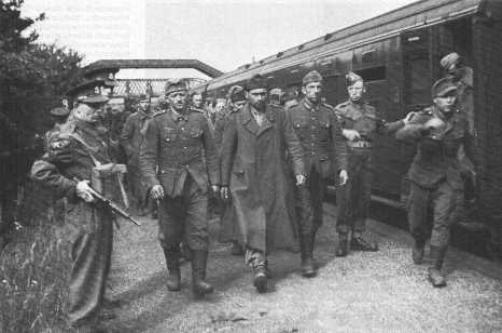
| Above: German prisoner disembark from a train under the watchful eye of British troops at Kempton Park Holding Camp where they would be interrogated and eventually be dispatched to other camps. |
LIST OF POW CAMPS IN BRITAIN
1. Grizedale Hall, Hawkshead, Ambleside, Lancashire
2. Toft Hall, Knutsford Cheshire
4. Scraptoft, Thurnby, Leicester & Gilling Camp, Richmond N. Yorkshire.
5. (Unknown Camp) Northern Ireland
6. (Unknown Camp) Northern Ireland & Long Marston Stratford-on-Avon Warwickshire &
Doncaster / W.Yorks
7. Winter Quarters, Ascot, Windsor Berks
8. Mile House, Owestry, Salop & Sheriffhales, Shinfal, Salop
9. Kempton Park Race Course, Sunbury on Thames, Middx & Quorn Loughborough, Leicester
10. Gosford Camp, Markethall, Armagh, Northern Ireland
11. Island Farm, Bridgend, Glamorgan & Trent Park Camp, Southgate, Middx
12. Elmfield Camp, Gilford, Portadown, Northern Ireland & Bury , Manchester, Lancashire
13. Shap Fells Hotel, Shap, Penrith, Wales
14. Bun Camp, Doonfoot, Ayr, Scotland
15. Donalsons School, West Coates, Edinburgh, Midlothian, Scotland
16. Gosford Camp, Aberlady, Longniddry, East Lothian, Scotland
17. Lodge Moor Camp, Sheffield, Yorkshire & London W2 (GPC), London
18. Featherstone Park, Haltwhistle, Northumbria
19. Happendon Camp, Douglas, Lanarkshire, Scotland
20. Bickham Camp, Yelverton, Tavistock, Devon
21. Comrie, Perth, Scotland
22. Pennylands Camp, Cummnock, Ayr Scotland.
23. The Marchent Camp, Devizes, Wiltshire & Sudbury, Derbyshire and Shrewsbury (GPC), Salop
24. Knutsford (MH) Cheshire
25. Lodge Farm, Farncombe, Down, Lambourn, Berkshire & Leamington (GPC), Warwickshire
26. Barton Field Camp, Ely, Cambridgeshire
27. Ledbury, Herefordshire & Nottingham (GPC)
28. Knighthorpe Camp, Ashby Road, Loughborough, Leicestershire
29. Royston Heath Camp, Royston, Hertfordshire. Ormskirk (GH) Lancashire & Abergavenny
(GPC), South Wales.
30. Carpenters Road, Stratford, East London E15 & Aldershot (GPC) Hanpshire
31. Ettington Park, Newbold Upon Stour, stratford-Upon-Avon
32. Wormwood Scrubs, Shepard's Bush, London, W12
33. Dancer's Hill, South Mimms, Barnet, Hertfordshire & Shorncliffe Camp, Folstone (GPC), Kent
35. Boughton Park, Boughton, Nuneaton, Northhamptonshire.
36. Hartwell Dog Track, Aylesbury, Buckinghamshire & Bridgewater (GPC), Somerset.
37. Sudeley Castle, Winchcombe, Cheltenham, Gloucester
38. Pool Park, Ruthin, Denbighs.
39. Castle Maxstoke, Coleshill, Warwickshire
40. Somerhill Camp, Tonbridge, Kent.
41. Ganger Camp, Romsey, Hampshire.
42. Exhibition Field Cp. Holsworthy, Devon
43. Harcourt Hill, North Ilnksey, Berkshire
44. Goathurst Camp, Bridgewater, Somerset.
45. Trumpington, Cambridgeshire
46. Kingsfold Camp, Billinghurst, West Sussex
47. Motcombe Park, Shaftsbury, Dorset.
48. Greenfield Farm, Presteigne, Radnor
49. Harrington Camp, Farndon Road, Market Harborough, Leicester
50. Garswood Park, Ashton-in-Markerfield, Wigan Lancashire
51. Allington, Grantham, Kesteven, Lincolnshire
52. Nether Headon Camp, Retford, Nottinghamshire
53. Sandbeds Camp, Brayton, Selby, Yorkshire
54. Longbridge Camp, Hampton Lovett, Droitwich, Worcester
55. Shalstone, Buckinghamshire
56. Dotesdale, Diss, East Suffolk.
57. Merrow Downs Camp, Guildford, Surrey
58. Belper, Derbyshire & Swanwick, Derbyshire
59. Wood Walton Lane, Sawtry
60. Oerdale Camp, Skipton, Yorkshire & Huddersfield, Bradford, Yorkshire
61. Wynolls Hill, Broadwell, Coleford, Gloucestershire
62. The MoorCamp, Thankerton, Lanarkshire, Scotland
63. Balhery Est. Camp, Alyth, Perth, Scotland
64. Castle Rakine, Denny, Stirling, Scotland
65. Setley Plain, Brokenhust, Hampshire & Preston (GPC) Lancashire.
66. Calvine, Blair Atholl, Perth, Scotland & Dundee, Angus, Scotland
67. Sandyhillock Camp, Craigellachie, Banff.
68. Halmuir Farm, Lockerbie, Dumfries, Scotland.
69. Darras Hall, Ponteland, Newcastle Upon Tyne.
70. Henllan Bridge Camp, Henllan, Llandyssul, Cardigan, Wales
71. Sheriffhales, Shinfal, Salop, Newmarket (GPC) West Suffolk.
72. Ducks Cross Camp, Colmworth, Bedfordshire
73. Storwood Camp, Melbourne, Yorkshire
74. Racecourse Camp, Tarporley, Cheshire
75. Northern Hill Camp, Laurencekirk, Kincardine
76. Merry Thought Camp, Calthwaite, Penrith, Cumberland.
77. Aunsmuir Camp, Ladybank, Fife, Scotland.
78. High Garret, Braintree, Essex,
79. Moorby, Revesby, Boston, Lindesy, Lincolnshire.
80. Horbling, Sleaford, Kesteven, Lincolnshire
81. Pingley Farm, Brigg, Lindsey, Lincolnshire
82. Hempton Green Camp, fakenham, Norfolk, & Aldborough, Norfol
83. Eden Camp, Old Malton, Malton, Yorkshire
84. Sheet Camp, Ludlow, Salop.
85. Victoria camp, Brandon Road, Mildenhall, Bury St. Edmunds, West Suffolk
86. Stanhope Camp, Ashford, Kent & Woodchurch, Ashford, Kent
87. Byfield Camp, Rugby, Warwickshire
88. Mortimer, reading, Berkshire
89. Easton Grey Camp, Malmesbury, wiltshire
90. Friday Bridge, Wisbach, Cambridgeshire
91. Post Hill Camp, Farnley, Leeds, Yorkshire
92. Bampton Road, Tiverton, Devon
93. Harperley Camp, Fir Tree, Crook, Co. Durham & Oaklands Emergancy Hospital, Bishop
Aukland, Co. Durham
94. Gaulby Road, Billesdon, Leicester
95. Batford Camp, Harpenden, Staffordshire
96. Wolseley Road, Rugley, Staffodshire
97. Birdinbury, Bourton, Rugby, Warwickshire
98. Little Addington, Kettering, Northamptonsire
99. shugborough Park, great Haywood (GH) Staffordshire
100. St. Martins, Owestry, Salop
101. Glandulas Camp, Newton, Montgomery
102. Llanddarog, Camarthen
103. Moota Camp, Cockermouth, Northumbria
104. Beela River, Milnthorpe, Westmorland
105. Brewery Road, Wooler, Northumbria & Colinton Camp, Edinburgh (GPC) Midlothian
106. Stamford, Kesteven, Lincolnshire
107. Penleigh Camp, Wookey Hole, Wells, Somerset.
108. Thirkleby, Thirsk, Yorks
109. Brahan Castle, Dingwall, Ross and County
110. Stuartfield, Mintlaw, Aberdeen
111. Deer Park Camp, Moneymusk, Aberdeen
112. Kingendengh Camp, Mauchline Ayr, Scotland & Doonfoot, Ayr
113. Holm Park Camp, Newton Stewart, Wigtown.
114. Eden Vale Camp, Westbury Wiltshire
115. White Cross Camp, St. Columb Major Cornwall
116. Mill Lane, Hatfield Heath, Bishops Stortford, Essex
117. Waiderslade camp, Chatham, Kent
118. Mardy, Abergavenny, Wales
119. Pabo Hall Camp, llandudno Junction, Caernarvon
120. Sunlaws Camp, Kelso, Roxburgh
121. Racecourse Camp, Ripon, Yorkshire & Knaresborough Yorkshire
122. Raynor's Lane, Harrow-on-the-Hill, Middx & Hatch End, Harrow-on-the Hill, Middlesex.
123. Dalmahoy Camp, Kirkwenton, Midlothian, Scotland.
124. Wapley Camp, Yate, Bristol
125. Newland House, Tooting Bec. Road, Tooting Bec Common, London SW17.
126. Mellands Camp, Gorton, Manchester, Lancashire
127. Potters Hill, HighGreen, Sheffield, Yorkshire.
128. Meesden, Buntingford, Hertfordshire
129. Ashford Lodge Camp, Halstead, Essex
130. West Fen Militia, Ely, Cambridge.
131. Uplands Camp, Diss, Norfolk
134. Loxley Hall, Utoxeter, Staffordshire
135. Stanbury House, Spencers Wood, Reading, Berkshire
136. High Hall, Bishop Burton, Beverly, Yorkshire
137. Hazeldene Camp, Elburton, Plymouth, Devon
138. The Rectory Camp, Bassingham, Kesteven, Lincolnshire
139. Wolviston Hall, Wolviston, Billingham, Durham
140. Racecourse Camp, Warwick, Warwickshire
141. Beeson House, St. Neots
142. Gloucester, Gloucestershire
143. Carlton Hall, Carlton, Worksop, Nottinghamshire
144. Ruskin Avenue, Kew, Richmond Surrey
145. Normanhurst Camp, Battle, East Sussex
146. Newton Camp, Preston, Lancashire
147. Boar's Head, Walgherton, Nantwich, Cheshire
148. Castlethorpe Hall Camp, Castlethorpe, Brigg, Lindley, Lincolnshire
151. Pendeford hall, Codsall, Wolverhampton, Staffordshire & Coven, Wolverhampton,
Staffordshire & Halfpenny Green, Wolverhampton, Staffordshire
152. Old Liberal Club, Charnwood Road, Shepshed, Loughborough
153. Fulney Park Camp, Spalding, Lincolnshire
154. Minister of Works Camp,swanscombe, Dartford, Kent.
155. Hornby Hall Camp, Penrith, Scotland
156. The Heath Camp, Wellingore, Kesteven Lincolnshire
157. Bourton Camp, Bourton-on-the-Hill, Moreton-in-Marsh, Gloucestershire
159. Butterwick, Yorkshire
160. Lydiard Park, Purton, Swindon, Wiltshire
161. Grangefield, Gloucester (MH) Belfast, Northern Ireland.
162. Naeburn (MH) Yorkshire
1. Grizedale Hall, Hawkshead, Ambleside, Lancashire
2. Toft Hall, Knutsford Cheshire
4. Scraptoft, Thurnby, Leicester & Gilling Camp, Richmond N. Yorkshire.
5. (Unknown Camp) Northern Ireland
6. (Unknown Camp) Northern Ireland & Long Marston Stratford-on-Avon Warwickshire &
Doncaster / W.Yorks
7. Winter Quarters, Ascot, Windsor Berks
8. Mile House, Owestry, Salop & Sheriffhales, Shinfal, Salop
9. Kempton Park Race Course, Sunbury on Thames, Middx & Quorn Loughborough, Leicester
10. Gosford Camp, Markethall, Armagh, Northern Ireland
11. Island Farm, Bridgend, Glamorgan & Trent Park Camp, Southgate, Middx
12. Elmfield Camp, Gilford, Portadown, Northern Ireland & Bury , Manchester, Lancashire
13. Shap Fells Hotel, Shap, Penrith, Wales
14. Bun Camp, Doonfoot, Ayr, Scotland
15. Donalsons School, West Coates, Edinburgh, Midlothian, Scotland
16. Gosford Camp, Aberlady, Longniddry, East Lothian, Scotland
17. Lodge Moor Camp, Sheffield, Yorkshire & London W2 (GPC), London
18. Featherstone Park, Haltwhistle, Northumbria
19. Happendon Camp, Douglas, Lanarkshire, Scotland
20. Bickham Camp, Yelverton, Tavistock, Devon
21. Comrie, Perth, Scotland
22. Pennylands Camp, Cummnock, Ayr Scotland.
23. The Marchent Camp, Devizes, Wiltshire & Sudbury, Derbyshire and Shrewsbury (GPC), Salop
24. Knutsford (MH) Cheshire
25. Lodge Farm, Farncombe, Down, Lambourn, Berkshire & Leamington (GPC), Warwickshire
26. Barton Field Camp, Ely, Cambridgeshire
27. Ledbury, Herefordshire & Nottingham (GPC)
28. Knighthorpe Camp, Ashby Road, Loughborough, Leicestershire
29. Royston Heath Camp, Royston, Hertfordshire. Ormskirk (GH) Lancashire & Abergavenny
(GPC), South Wales.
30. Carpenters Road, Stratford, East London E15 & Aldershot (GPC) Hanpshire
31. Ettington Park, Newbold Upon Stour, stratford-Upon-Avon
32. Wormwood Scrubs, Shepard's Bush, London, W12
33. Dancer's Hill, South Mimms, Barnet, Hertfordshire & Shorncliffe Camp, Folstone (GPC), Kent
35. Boughton Park, Boughton, Nuneaton, Northhamptonshire.
36. Hartwell Dog Track, Aylesbury, Buckinghamshire & Bridgewater (GPC), Somerset.
37. Sudeley Castle, Winchcombe, Cheltenham, Gloucester
38. Pool Park, Ruthin, Denbighs.
39. Castle Maxstoke, Coleshill, Warwickshire
40. Somerhill Camp, Tonbridge, Kent.
41. Ganger Camp, Romsey, Hampshire.
42. Exhibition Field Cp. Holsworthy, Devon
43. Harcourt Hill, North Ilnksey, Berkshire
44. Goathurst Camp, Bridgewater, Somerset.
45. Trumpington, Cambridgeshire
46. Kingsfold Camp, Billinghurst, West Sussex
47. Motcombe Park, Shaftsbury, Dorset.
48. Greenfield Farm, Presteigne, Radnor
49. Harrington Camp, Farndon Road, Market Harborough, Leicester
50. Garswood Park, Ashton-in-Markerfield, Wigan Lancashire
51. Allington, Grantham, Kesteven, Lincolnshire
52. Nether Headon Camp, Retford, Nottinghamshire
53. Sandbeds Camp, Brayton, Selby, Yorkshire
54. Longbridge Camp, Hampton Lovett, Droitwich, Worcester
55. Shalstone, Buckinghamshire
56. Dotesdale, Diss, East Suffolk.
57. Merrow Downs Camp, Guildford, Surrey
58. Belper, Derbyshire & Swanwick, Derbyshire
59. Wood Walton Lane, Sawtry
60. Oerdale Camp, Skipton, Yorkshire & Huddersfield, Bradford, Yorkshire
61. Wynolls Hill, Broadwell, Coleford, Gloucestershire
62. The MoorCamp, Thankerton, Lanarkshire, Scotland
63. Balhery Est. Camp, Alyth, Perth, Scotland
64. Castle Rakine, Denny, Stirling, Scotland
65. Setley Plain, Brokenhust, Hampshire & Preston (GPC) Lancashire.
66. Calvine, Blair Atholl, Perth, Scotland & Dundee, Angus, Scotland
67. Sandyhillock Camp, Craigellachie, Banff.
68. Halmuir Farm, Lockerbie, Dumfries, Scotland.
69. Darras Hall, Ponteland, Newcastle Upon Tyne.
70. Henllan Bridge Camp, Henllan, Llandyssul, Cardigan, Wales
71. Sheriffhales, Shinfal, Salop, Newmarket (GPC) West Suffolk.
72. Ducks Cross Camp, Colmworth, Bedfordshire
73. Storwood Camp, Melbourne, Yorkshire
74. Racecourse Camp, Tarporley, Cheshire
75. Northern Hill Camp, Laurencekirk, Kincardine
76. Merry Thought Camp, Calthwaite, Penrith, Cumberland.
77. Aunsmuir Camp, Ladybank, Fife, Scotland.
78. High Garret, Braintree, Essex,
79. Moorby, Revesby, Boston, Lindesy, Lincolnshire.
80. Horbling, Sleaford, Kesteven, Lincolnshire
81. Pingley Farm, Brigg, Lindsey, Lincolnshire
82. Hempton Green Camp, fakenham, Norfolk, & Aldborough, Norfol
83. Eden Camp, Old Malton, Malton, Yorkshire
84. Sheet Camp, Ludlow, Salop.
85. Victoria camp, Brandon Road, Mildenhall, Bury St. Edmunds, West Suffolk
86. Stanhope Camp, Ashford, Kent & Woodchurch, Ashford, Kent
87. Byfield Camp, Rugby, Warwickshire
88. Mortimer, reading, Berkshire
89. Easton Grey Camp, Malmesbury, wiltshire
90. Friday Bridge, Wisbach, Cambridgeshire
91. Post Hill Camp, Farnley, Leeds, Yorkshire
92. Bampton Road, Tiverton, Devon
93. Harperley Camp, Fir Tree, Crook, Co. Durham & Oaklands Emergancy Hospital, Bishop
Aukland, Co. Durham
94. Gaulby Road, Billesdon, Leicester
95. Batford Camp, Harpenden, Staffordshire
96. Wolseley Road, Rugley, Staffodshire
97. Birdinbury, Bourton, Rugby, Warwickshire
98. Little Addington, Kettering, Northamptonsire
99. shugborough Park, great Haywood (GH) Staffordshire
100. St. Martins, Owestry, Salop
101. Glandulas Camp, Newton, Montgomery
102. Llanddarog, Camarthen
103. Moota Camp, Cockermouth, Northumbria
104. Beela River, Milnthorpe, Westmorland
105. Brewery Road, Wooler, Northumbria & Colinton Camp, Edinburgh (GPC) Midlothian
106. Stamford, Kesteven, Lincolnshire
107. Penleigh Camp, Wookey Hole, Wells, Somerset.
108. Thirkleby, Thirsk, Yorks
109. Brahan Castle, Dingwall, Ross and County
110. Stuartfield, Mintlaw, Aberdeen
111. Deer Park Camp, Moneymusk, Aberdeen
112. Kingendengh Camp, Mauchline Ayr, Scotland & Doonfoot, Ayr
113. Holm Park Camp, Newton Stewart, Wigtown.
114. Eden Vale Camp, Westbury Wiltshire
115. White Cross Camp, St. Columb Major Cornwall
116. Mill Lane, Hatfield Heath, Bishops Stortford, Essex
117. Waiderslade camp, Chatham, Kent
118. Mardy, Abergavenny, Wales
119. Pabo Hall Camp, llandudno Junction, Caernarvon
120. Sunlaws Camp, Kelso, Roxburgh
121. Racecourse Camp, Ripon, Yorkshire & Knaresborough Yorkshire
122. Raynor's Lane, Harrow-on-the-Hill, Middx & Hatch End, Harrow-on-the Hill, Middlesex.
123. Dalmahoy Camp, Kirkwenton, Midlothian, Scotland.
124. Wapley Camp, Yate, Bristol
125. Newland House, Tooting Bec. Road, Tooting Bec Common, London SW17.
126. Mellands Camp, Gorton, Manchester, Lancashire
127. Potters Hill, HighGreen, Sheffield, Yorkshire.
128. Meesden, Buntingford, Hertfordshire
129. Ashford Lodge Camp, Halstead, Essex
130. West Fen Militia, Ely, Cambridge.
131. Uplands Camp, Diss, Norfolk
134. Loxley Hall, Utoxeter, Staffordshire
135. Stanbury House, Spencers Wood, Reading, Berkshire
136. High Hall, Bishop Burton, Beverly, Yorkshire
137. Hazeldene Camp, Elburton, Plymouth, Devon
138. The Rectory Camp, Bassingham, Kesteven, Lincolnshire
139. Wolviston Hall, Wolviston, Billingham, Durham
140. Racecourse Camp, Warwick, Warwickshire
141. Beeson House, St. Neots
142. Gloucester, Gloucestershire
143. Carlton Hall, Carlton, Worksop, Nottinghamshire
144. Ruskin Avenue, Kew, Richmond Surrey
145. Normanhurst Camp, Battle, East Sussex
146. Newton Camp, Preston, Lancashire
147. Boar's Head, Walgherton, Nantwich, Cheshire
148. Castlethorpe Hall Camp, Castlethorpe, Brigg, Lindley, Lincolnshire
151. Pendeford hall, Codsall, Wolverhampton, Staffordshire & Coven, Wolverhampton,
Staffordshire & Halfpenny Green, Wolverhampton, Staffordshire
152. Old Liberal Club, Charnwood Road, Shepshed, Loughborough
153. Fulney Park Camp, Spalding, Lincolnshire
154. Minister of Works Camp,swanscombe, Dartford, Kent.
155. Hornby Hall Camp, Penrith, Scotland
156. The Heath Camp, Wellingore, Kesteven Lincolnshire
157. Bourton Camp, Bourton-on-the-Hill, Moreton-in-Marsh, Gloucestershire
159. Butterwick, Yorkshire
160. Lydiard Park, Purton, Swindon, Wiltshire
161. Grangefield, Gloucester (MH) Belfast, Northern Ireland.
162. Naeburn (MH) Yorkshire