| Hidden Motives: An Exotic Railroad and a rapidly expanding Global Oil Economy |
| One of the least publicized motives for World War One arose with the planned German construction of a Baghdad to Berlin Railway in the dying Ottoman Empire in the late 19th and early 20th century. The French had already connected Istanbul to Paris and London with their Orient Express. The Baghdad Railway would connect Berlin and other major cities in Europe with a Constantinople- Baghdad line. Engineered in 1872 by Wilhelm von Pressel, in 1888 Sultan Abdul Hamid II. asked Deutsche Bank, a leader in electrical development, for financing. Germany was the earliest country to make a practical application of electric traction to railway work. England had come up with the steam locomotive and Germany responded with the electric locomotive, and in 1879 the world saw its first electric train using current from a conductor rail. This pioneer electric passenger train, evolved by Siemens and Halske, carried people on a narrow-gauge line at a Berlin exhibition. Four wheels carried the tiny electric locomotive and the motorman sat on it bicycle fashion. It actually worked on a passenger-carrying railway. Meanwhile, in 1885 a German engineer, Gottleib Daimler, had developed the world's first workable petroleum motor to drive a road vehicle. The economic potentials of the petroleum era were starting to be more broadly realized. The tremendous growth of the German economy had been partially enabled by clever innovations of the German banking system, especially Deutsche Bank, who had formed finance and holding companies which issued bonded loans and shares for the construction of power plants, electric railways, trams and municipal lighting systems. By 1897, the bank had 750 power plants located across Germany, a power plant in Argentina and investments in the Edison General Electric Company in the US. These banks not only controlled credit but also dominated the capital market. International bankers in both London and New York also recognized the future need for petroleum, and control over that necessary fuel would be key to great profit and political power. The Berlin- Baghdad railway would have linked Germany with her new African colonies, and the trade of goods and agricultural products would benefit from a port on the Persian Gulf. This in turn could provide direct access to Middle East oil, and the new German railway would bypass the Suez Canal which opened in 1869. This plan stepped on some big toes: an 1875 loan to the British from the Rothschild banking family put the British in line for eventual major control of the Canal and all of its anticipated profits. The Railway project was a threat to Britain's financial system at a time when Britain was lagging behind Germany in energy sources, technology, agriculture and industry. Increasingly, a revolution in the technology of naval power was required if the Royal Navy was to continue its unchallenged hegemony of the seas, and that was in the shift from coal to oil power. By the time Winston Churchill was First Lord of the Admiralty, the conversion of the British Navy to oil was strongly advocated, and since England had abundant coal but no known oil, but it soon became a national security priority to secure large oil reserves outside Britain. The Baghdad rail link was increasingly seen in London as a threat to that future oil security and the British response to growing German power was to craft a series of alliances, both public and secret, with its former rivals of France (who was still furious at Germany and wanted revenge not competition) and with Russia. By 1888, Germany had received permission from the Turks to begin work on the Anatolian Railway Company, and by 1896, they had completed the railway line from Angora to Konya. These lines were the first two sections of the anticipated Baghdad Railway. The Germans then engineered other lines, but at a very high cost. In 1901, Germany reported on vast supplies of petroleum around the Tigris and Euphrates, and in 1902 the Ottoman government granted a German firm the concession to lay new track eastward from Ankara to Baghdad. However, financial maneuvering and physical problems tunneling through the Taurus Mountains made progress slow. The building of the line from Konya to Mosul and Baghdad and Basra continued, but at 200 rugged, expensive kilometers at a time. When the Ottoman Government gave permission to Germany for the railway line from Konya to Baghdad in 1903, Russia, France, and Britain all regarded a Baghdad to Berlin Railway a threat to their dominance. Russia, who had by then acquired major influence in Central Asia and half of Persia (Iran), would have suffered economically from increased German trade into and beyond these areas. France, having established a foothold in northern Africa as early as the 17th Century and an influence in Algeria and Tunis in 1881, was determined to keep Germany out of the picture entirely. Britain had taken Napoleon's old domain of Egypt in 1882 and through it found a way to rule Sudan in 1897. She held another portion of Persia and administered Egypt, Cyprus, and Aden on the Red Sea, and had major influence in Afghanistan. Therefore, she had already committed herself at a great cost to maintaining a choke hold on her possessions, and she and France, made a deal as early as 1904 which gave England a free hand in Egypt in exchange for France maintaining authority in Morocco. While on the surface Great Britain initially supported the German railway, shrewdly watching as the Germans poured money into the project and footed the bill for laying the rails, she was also keenly aware that it would one day compete with British trade in Mesopotamia and bypass British tariffs in the process. Therefore, Britain was eyeing eventual free access by sea to the oil fields of Persia and fast access by rail along the Gulf coast. She was also picking up more investors in her interests. In 1911, the railway company proposed a branch line to Alexandretta from Aleppo which would have spiked trade with Northern Syria and the Northern Mesopotamian valley. The Young Turkish government, however, could not offer further railway concessions without raising customs duties by at least a very small amount, from 11 to 14 percent. Such a raise required the agreement of all the powers, and this gave Britain an excuse to pull the plug on the Germans. The German plan was vetoed by Great Britain's vested financial interests. Sir Edward Grey summed it up in the House of Commons: "If the money is to be used to promote railways which may be a source of doubtful advantage to British trade ... I say it will be impossible for us to agree to that increase." The main British commercial interest that the British Government was "protecting" was that of the James Lyle Mackay (Baron Inchcape of Strathnaver) the foremost shipping magnate of the British Empire and a director of the Anglo-Persian Oil Company and of the D'Arcy Exploration Company. A contract was signed in London between Lord Inchcape and the Baghdad Railway Company. Meanwhile, Britain was bankrupt by January 1914, and when Bank of England notes consequently became emergency legal tender, all gold was removed from circulation and England’s gold reserves went to the Rothschild's Bank of England to use for upcoming profit-producing warfare. First Lord of the Admiralty Winston Churchill “anticipated” a future war using oil-powered ships, and on June 17, 1914, just days before war, he urged the British government to spend £2 million to buy a majority interest of Anglo-Persian Oil Company, financed in part by his father's old friends at the Rothschild Bank. The London Petroleum Review published a map on May 23, 1914 of Mesopotamia showing the oil fields that Britain hoped to eventually obtain. The interests of Britain and the Anglo-Persian Oil Company became inseparable, and British foreign policy and Rothschild foreign policy therefore became one and the same. As war loomed, the military alliances, already forged to create a “balance of power” tipped in Britain's favor, were based in good measure on banker’s loans and investments. In March, 1914, the German government was forced to concede that those areas would remain exclusively under British financial control and was obliged to recognize southern Mesopotamia and central and southern Persia as the exclusive field of operations of the Anglo-Persian Company. The Germans, who had spent a fortune by now, perhaps in vain, were also required to have two British members sit on the Baghdad Railway Company board and had to agree not to extend the railroad past Basra or establish a port or railway terminus anywhere along the Gulf without British approval. |
| While many contentious economic and colonial issues between the French, German and British governments, such as the financing of the railway, appeared a"resolved" before the outbreak of war, an undercurrent of major diplomatic tensions, scheming and plotting bubbled. The Baghdad railway was soon disingenuously portrayed as a "threat of German domination" in Asia Minor at the same time there was a wave of anti-British and pro-German feelings among the Egyptian middle class who had developed passionate interests in German success. Kaiser Wilhelm became "Hacı Wilhelm" in some circles and was thought of as a "great protector of Islam", while the Turks were guessing that Moslems of India and Egypt were hopefully about to revolt and overthrow their despised English masters. By 1915, the railway was in four sections and had big gaps of some 300 miles between the various railroad lines as well as incomplete tunnels. British books such as "Twenty Years In Baghdad and Syria Showing Germany's Bid for the Mastery of the East" written by English Canon JT Parfit ("Chaplain of Jerusalem") started to appear and spread dark anti-German propaganda, as seen by the titles of his chapters: 'Britain on the Alert'; 'Prowling of the Prussians'; 'Germany's Alliance with the 40 Thieves'; 'Germany's Darkest Plot'. The German railway was now described as a "scheme" (and sometimes still is). The American ambassador in Constantinople from 1913 to 1919 was investor and businessman Henry Morgenthau who had ties to the major banking houses involved in the project. He also spread many false and frightening claims, including the "fact" that the Turkish Sultan had a plan for the "assassination and extermination of all Christians except those of German nationality." German interests in the region were now presented as "imperialistic" and "expansionist" by those who did not want anybody having a "place in the sun" (or petroleum in the tank).....but themselves. Morgenthau was also a huge contributor to Woodrow Wilson's election campaign in 1912 and was made financial chairman of the democratic party in 1912 and again in 1916. Morgenthau was also the originator of one of the most celebrated anti-German propaganda myths of WWI, the fictitious "Crown Council" story. Morgenthau told the media that he had proof that the Kaiser had called together a "Crown Council" of leading German government officials, bankers and ambassadors on July 5,1914, confiding to them that he planned to start a European war. The bankers responded by demanding two weeks in which to call in loans and sell securities. The Kaiser then went on a cruise, pretending nothing was up, so that England, France and Russia would be lulled into a "false sense of security" and taken by surprise by the conniving Germans. This devious lie inflamed public opinion. |
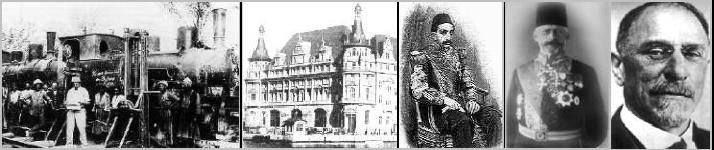
| Above: Turkey's magnificent neo-renaissance railway station, Haydarpasa, with its façade carved by German and Italian stone masons, designed by German architects and inaugurated in 1908 as a gift to the Sultan from Kaiser Wilhelm II. Built by the Anatolia-Baghdad Corporation between 1906 and 1908, its foundation consists of 1100 wooden piles which were driven almost 70 feet into the water bed by steam hammers. Its German engineers and workers established a small German neighborhood in the Yeldeğirmeni quarter of Kadıköy. Heinrich August Meissner is at the right of Sultan Abdul Hamid II. He was a Leipzig engineer on the Baghdad Railroad, and later a railway farmer and a chair at the Technical University of Istanbul for railway design. He became a pasha and died in Turkey. Henry Morganthau, Sr., far right. |
| In the end, Germany would end up with nothing for her work on the Berlin-Baghdad Railway. British forces would secure the entire oilfields of Mesopotamia after Versailles in a new League Protectorate called Iraq. |