| The Emergence of Otto von Bismarck: The Iron Chancellor |
| The Revolutions of 1848 |
| With Prussia's extensive new lands, Prussian King Friedrich Wilhelm had turned all of his territories into a single customs-free zone in 1818 to bind together his somewhat disjointed extended kingdom and to benefit trade between neighbouring regions. By 1834, the Zollverein (customs union) covered almost the whole of Germany. Friedrich Wilhelm III of Prussia died in 1840, and when France poised itself to invade the Rhineland, a wave of anti-French sentiment gave birth to German nationalism. Patriotic Rheinland poems and songs such as the Deutschlandlied were composed. With Denmark's declaration that it would invade Schleswig-Holstein, feelings intensified. Poor living conditions, harvest failures in 1846 and 1847 and a deadly widespread Cholera epidemic in Prussia, coupled with significant population growth, all played their part in evoking a spirit of revolution. Overbearing governmental regulations, heavy taxation and political censorship were wearing thin on the public. Instead of a federal council being representative of only German monarchs, there were demands for a parliament representing German citizens. There was also a desire for reorganization of the universities and other political reform. In February of 1848, when King Louis-Phillipe of France abdicated the throne, revolutions swept from Paris across all of Europe, especially to the 39 loosely bound German states of the "German Confederation". In the south and west of Germany, large popular assemblies and mass demonstrations took place, triggering the "March Revolution". A Mannheim assembly adopted a resolution on February 27 demanding a bill of rights. Such resolutions were adopted in Hesse- Darmstadt, Württemberg, Nassau, and other states. Some rulers were forced to cede to many of the demands of Märzforderungen without much resistance. However, in Baden, the disorders led by republican agitators continued, and governmental efforts to suppress them with the aid of federal troops led to an armed insurrection. The insurgents, led by Friedrich Hecker, were defeated on April 20th. Revolutions of 1848 in the Habsburg areas led Austrian chancellor Metternich, who had dominated the German Confederation from 1815 until 1848, to flee to London and Emperor Ferdinand to appoint new liberal ministers. Prussian King Friedrich Wilhelm IV yielded to the rebels' demands: a constitution, freedom of the press and parliamentary elections, but on March 18, two shots were fired by soldiers at a large demonstration and this led to an escalation of tension and a bloody battle which killed hundreds. The “fighters fallen for liberty” were paraded through the city of Berlin with their wounds exposed, and with revolutionaries serving as pallbearers. Afterward, a repentant King Friedrich Wilhelm IV agreed to convene a Prussian National Parliament by announcing the unity of the German nation. A Declaration "To My People and to the German Nation" was issued summing up his stand: "Germany is in ferment within, and exposed from without to danger from more than one side. Deliverance from this danger can come only from the most intimate union of the German princes and people under a single leadership... I have taken this leadership upon me for the hour of peril... I have today assumed the old German colors, and placed myself under the venerable banner of the German Empire. Prussia henceforth is merged in Germany." On March 21, to reassure the public, the King and some of his ministers and generals paraded through the streets of Berlin to the cemetery where the victims had been buried. The king wore an arm band in the black, red, and gold colors of the revolution as he appeared on horseback to pay tribute to the “March dead”. The citizens of Berlin cheered the King, but his brother and successor, Prince Wilhelm (who would later be the first German Kaiser) was more defiant and had no intention of transforming his monarchy into a republic or having Prussia absorbed into a unified Germany. As early as November 1848, there were attempts at a coup carried out mainly by the military, against the liberal parliament. During the course of these attempts, revolutionaries were either imprisoned or fled. In Saxony, from May 3-9, 1849, many people, including Richard Wagner, took to the streets in Dresden to ask King Friedrich Augustus II of Saxony for reform. It was unsuccessful, and together with the leaders of the uprising, Wagner left Dresden for Switzerland on May 9 to avoid the warrant for his arrest. In 1849, other natives of Saxony left for the USA. In Bavaria, a new liberal government called the "March ministry" was installed as King Ludwig I was forced to abdicate. On March 5, 1848 at Heidelberg in Baden, a group of German liberals formulated plans for an election to a German national assembly. Its members called for free elections for all of Germany and the German states agreed. Finally, on May 18, 1848, the National Assembly opened its session in St. Paul's Church. Most of the 586 delegates of the first freely elected German parliament were educators and it was called a "professors' parliament" ("Professorenparlament"). In December, 1848, 'equal rights for all citizens before the law' was proclaimed. On March 28, 1849, the draft of the Paulskirche constitution was finally passed. The new Germany was to be a constitutional monarchy, and the office of head of state ("Emperor of the Germans") was to be hereditary and held by the King of Prussia. The latter proposal was carried by a mere 290 votes in favor, with 248 abstentions. The constitution was recognized by 29 smaller states but not by Austria, Prussia, Bavaria, Hanover and Saxony. Prussian aristocrats, including Otto von Bismarck, regained power in Berlin by late 1848, and King Friedrich Wilhelm IV immediately rejoined the old forces. In November, he dissolved the new Prussian parliament and presented his own constitution based upon the work of the assembly, yet maintaining the king's ultimate authority. The constitution eventually provided for an upper house (Herrenhaus), and a lower house (Landtag), chosen by universal suffrage but under a three-class system of voting: representation was proportional to taxes paid, so that more than 80 % of the electorate controlled only one-third of the seats. On April 2, 1849, a delegation of the National Assembly met with the King Friedrich Wilhelm IV and offered him the crown of the Emperor under this new constitution which he refused. Austria and Prussia withdrew their delegates from the Assembly, and the Assembly itself slowly disintegrated. Its most radical members were arrested and the few armed uprisings in support of the constitution, especially in Saxony, the Palatinate and Baden, were squelched by the local military. Captured crusaders and participants were executed or sentenced to long prison terms. The achievements of the revolutionaries of March 1848 were reversed in all of the German states. Many disappointed German patriots, known as the Forty-Eighters, went to the United States. |
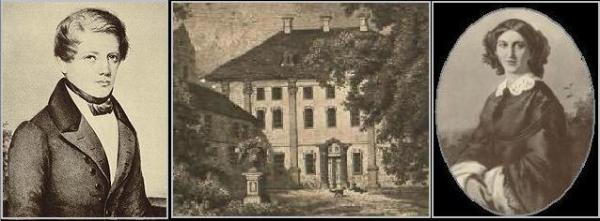
| The Confederation of the Rhine and the German states now consisted of thirty-five monarchies and four free cities: Bremen, Hamburg, Lübeck and Frankfurt. 1815 was a pivotal year, after Napoleon was defeated at Waterloo, a Deutscher Bund was organized. A body with no legislative powers, it was mainly a diplomatic assembly of rulers or their representatives in which even the British king had a place as King of Hanover, as did the Danish Duke of Holstein. The Bundestag in Frankfurt replaced the Reichstag of the defunct Holy Roman Empire. Austria and Prussia were its most powerful members. Also in 1815, Otto von Bismarck, considered the founder of the great German Empire, was born. One of the most significant political figures of the 19th century, he took Germany from a disjointed mass of weak little principalities into a powerful empire that dominated Europe by the end of the 19th century. He shaped the fortunes of Germany for nearly three decades as prime minister of Prussia and as Germany's first Chancellor. He descended from Prussian aristocrats and held the noble title Graf from his birth. His father, Ferdinand von Bismarck, was a former military officer; his mother, Wilhelmine Mencken, belonged to a rich, but common family. Otto and his siblings grew up on the family estate. Bismarck was no angel in his youth. He entered Prussian service after reading law at the Universities of Göttingen and Berlin, where he filled his days with non-academic pleasures such as fencing, riding, gambling and ladies. It was said that he had a prodigious appetite and could eat dozens of oysters at one sitting. In Aachen, he became a judicial administrator in 1837 at age 22, but was dismissed from his job after he gallivanted around Germany for months without permission following his first couple of loves, two wealthy English girls. This experience and his travels in England helped make him an ardent Anglophile, which in great part contributed to his lifelong inspiration to unite the German states into a similar empire. Upon his mother's death in 1839, Bismarck took over management of his family's Pomeranian estate and was involved in some wild capers, earning him the title of “the mad squire.” However, at Schönhausen, he became engaged in local politics, settled down, became a Pietist Lutheran and married noblewoman Johanna von Puttkamer in 1847. |