| Danzig, Darmstadt, Datteln, Dessau, Dillenburg, Dollbergen, Donauwörth, Dorsten, Dortmund, Duisberg, Dülmen, Düren, Düsseldorf, Dresden, (click on images) |
| Dorsten (click image) |
| Dortmund (click on images) |
| Duisberg (click on image) |
| Düren |
| Düsseldorf |
| Darmundestat first appears near the end of the 11th century and was chartered as a city by Ludwig the Bavarian in 1330. From 1567 to 1806, it was ruled by descendants of Philip the Magnanimous, a leading figure in the German Reformation. Its population grew in the 19th century and Darmstadt was a center for Jugenstil, or Art Nouveau in the early 20th century. Hesse-Darmstadt joined the German Empire in 1871, but continued under its own dynasty until 1918. Darmstadt produced less than two-tenths of one percent of Germany's total war production, yet a minimum of ten percent of Darmstadt's civilian population died from the intentionally created firestorm that utterly destroyed the city. More on Darmstadt Hurdy-Gurdy Girls |
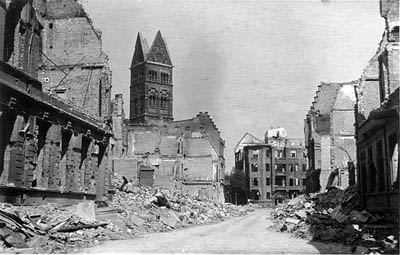
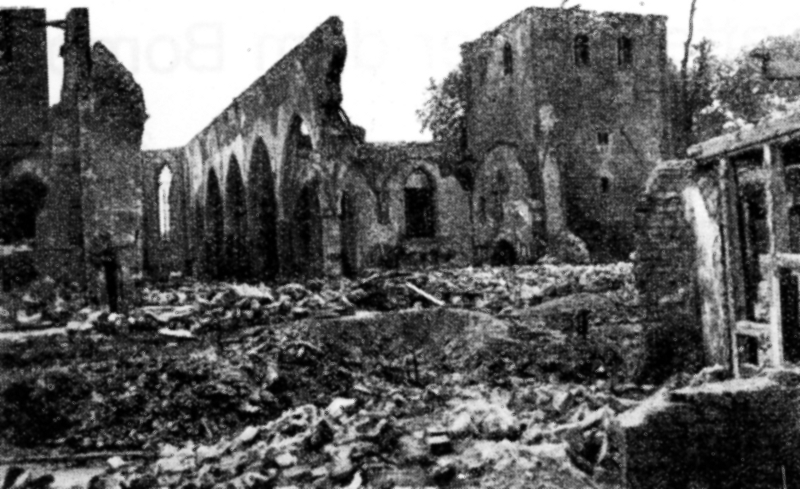
| Items from the Neolithic and Bronze Age were found near Dorsten, where Romans once built a large camp. Around the year 500, a settlement spelled Durstinon grew up on the south side of Lippe river. It later became a Carolingian estate. In 1647, left (click)When merchant shipping improved on the Lippe in the 15th century, Dorsten became member of the Hanseatic League. Apart from the trade, the timber economy and ship building once flowered in prosperous little Dorsten, but after the 30 Years War, Dorsten never regained her significance. Approximately 5,600 Allied bombs in March 1945 destroyed the town by 80%: St. Agatha Church, parts of which dated to 1170, the Franciscan Monastery of St. Anna from 1488, Magdalene Chapel from 1488, the Ursuline convent founded in Cologne in 1699, Ursulinenkirche from 1707, the Dorsten Rathaus, the Siechenkapelle (with hospital) from the 14th century, and hundreds of timber- framed buildings. 2,959 buildings were lost. It took 3 years, until 1948, to clear the debris. |
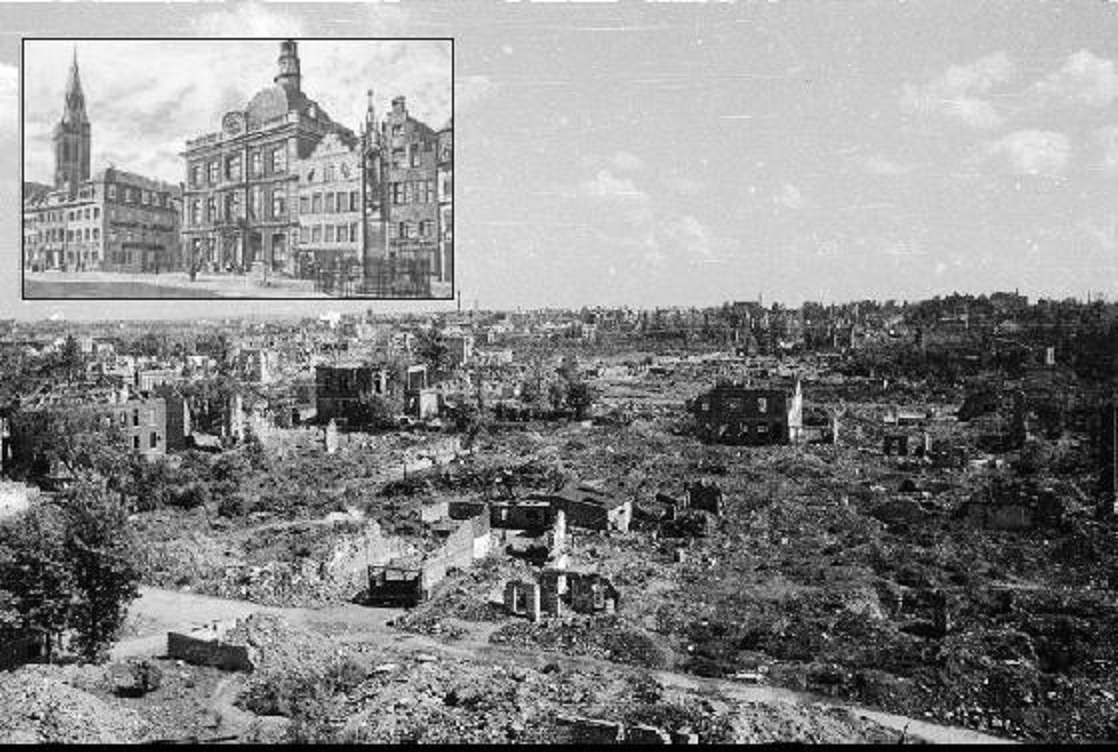
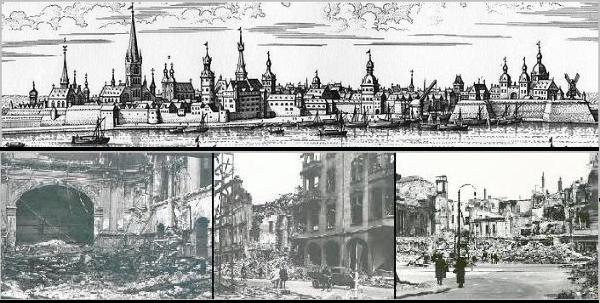
| Düsseldorf was first mentioned in 1135. Barbarossa's small settlement of Kaiserswerth at the site of today's Dusseldorf became a fortified outpost of the Empire. It was granted city rights in 1288, and a market square sprang up. By 1380 Düsseldorf was capital of the Duchy of Berg. The collegiate church of St. Lambertus dated back to this period. An imposing castle and Rathaus were built in the 16th century. Under Elector Johann Wilhelm II, Düsseldorf grew and thrived, becoming a cultural and trade center, but when Elector Carl Theodor, 1742-1799, decided to move his court to Munich, Düsseldorf lost much importance. The Seven Years War and the Napoleonic Wars caused destruction and poverty. The French occupied the city and burned it to the ground. Prussia acquired it in 1815, and designed magnificent gardens and elaborately landscaped boulevards. In the early 19th century, at the Kunstakademie, the Düsseldorf School of Art gained a worldwide reputation. Round the clock air attacks and a 2,000 ton raid reduced Düsseldorf to rubble. Starting from May 1940 there were numerous air raids, but without substantial casualties. In 1942, attacks increased and whole bomber fleets were set on the city. Large-scale attacks took place on July 31 and August 1, 1942 leaving 290 dead over 1,000 missing. The old city center was attacked on November 10, 1942, leaving 132 dead and 550 injured. Image: Düsseldorf 1647 and 1945. Further large-scale attacks on January 27, 1943, June 12, 1943, April 22, 1944 and April 24, 1944 killed around 1,000 people. 243 attacks were counted in total, killing 6,000 civilians and destroying over 176,000 dwellings, all three Rhine bridges, numerous roads, as well as the drainage system, leaving behind 10 million cubic meters of rubble. Only 10% of buildings were undamaged. The number of inhabitants plummeted from 540,000 in 1939 to approximately 235,000 in 1945. |
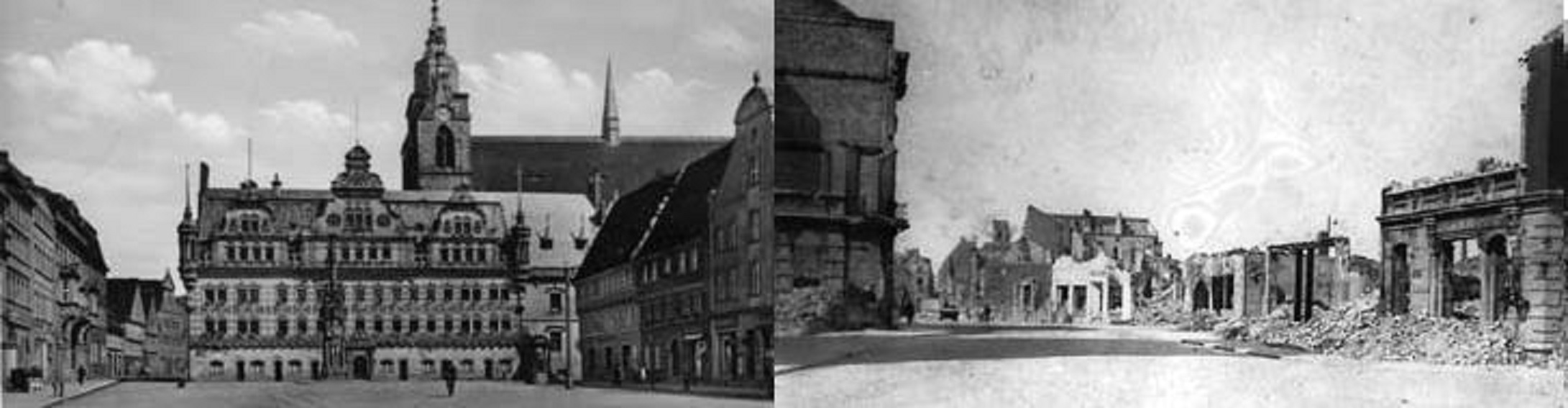
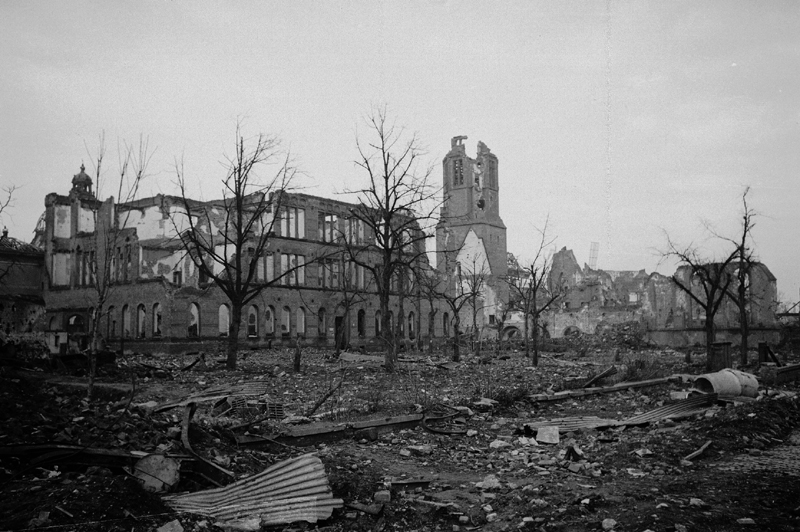
| A Frankish settlement first mentioned in 748, Düren (more images) grew from the Villa Duria of Frankish King Pippin the Short. Under Charlemagne, it was subsequently the seat of diets and synods and the base for several of his Saxon campaigns. In about 1242, it was destroyed in a war between Wilhelm V of Jülich and the Holy Roman emperor Karl V in 1543 and then rebuilt. In the industrial age, Düren's prosperity increased. By 1900, Düren was among Germany's richest cities with 42 millionaires and 93 factories. It's population had grown from 5,000 in 1800 to 27,168. On November 16, 1944, the sky over Duren filled with bombers overloaded with incendiaries and high explosive bombs as part of a lethal joint British-American operation called "Operation Queen".A few quick snaps and the town was engulfed in a tower of fire, houses collapsed into rubble, and the tar on the roads became so hot that the soles of shoes stuck to it. 1,204 heavy US bombers joined 498 British bombers, and within two hours dropped over 9,000 tons of bombs on the ancient town. The idyllic city life as well as the beautiful, old buildings were obliterated. Of 45,000 humans who lived there, 3,127 who didn't evacuate in time were painfully extinguished. The aerial mines sucked off rooftops, opening the houses up for total destruction from within and without by the heavy pounding of heavy, high-explosives bombs, which brought the houses to their helpless collapse and broke water, sewer and gas pipelines, while smaller high-explosives bombs spread panic and forced people into cellars. Afterward, the release of heavy liquid incendiary bombs created fire towers and suffocated those who fled below ground. Burning phosphorus, which turned people into living candles, blanketed any area of possible escape. Duren had 6,431 houses before the assault, and only 131 after. The whole medieval core of town was totally destroyed. There is no building in Duren today which dates from before 1945/46. Above: Duren marketplace, before, after Sainte Anne became the patron of Düren. Never-the-less, the prominent structures of Annakirche, Marienkirche and Christuskirche as well as 97% of the city was destroyed by bombing in 1944. Also destroyed or damaged during this operation were several surrounding towns and villages. The 8th U.S. Air Force hit the three towns of Eschweiler, Weisweiler and Langerwehe with 4,120 bombs. 339 fighter bombers of the 9th U.S. Air Force attacked Hamich, Hürtgen and Gey with 200 tons of bombs. Gey was a town located at the outskirts of the beautiful Hürtgen forest, situated in a valley through which all roads leading from the forest intersect. The forest is about twenty miles long and ten miles wide, just a few miles from Aachen and Düren. It is accented with steep gorges and winding slopes covered with thick layers of evergreens and firs. There was heavy fighting in the war here after it was bombed during "Operation Queen". Among the many towns also bombed in "Operation Queen" was Aldenhoven whose history goes back 4,000 years before the birth of Christ. The still well-preserved castles in the towns and Dürboslar Engelsdorf date from 898 and 1080. There was a 12th century church (only parts of it stand today) and in the neighboring village of Siersdorf was one of the most important branches of the Teutonic Order. This incredibly destructive and yet militarily ineffective bombing operation destroyed the ancient city of Jülich as well because of faulty information. |
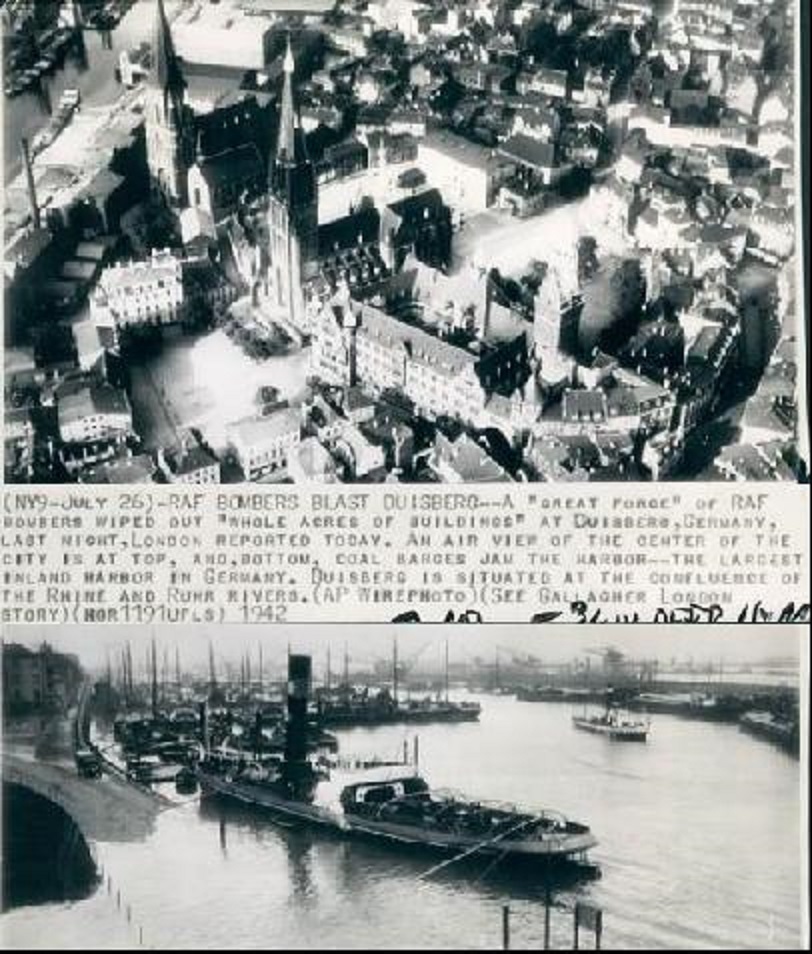
| Archaeological studies show that nearby Duisburg had a market-place already in use in the before the birth of Christ. A major central trading place of the city since the 5th century, the city was located at an important medieval trade route, the "Helwig," a ford across the Rhine once guarded by Romans. Like the rest of the Ruhr, Duisburg's industries made it a primary target of Allied bombers, but the residential areas were attacked with equal vengeance. Starting in 1941, there were daily bombing raids as British bombers drop a total of 445 tons of bombs. In July of 1942, another attack took place (click left). 1,599 more tons were dropped in 1943. By then, 96,000 people were homeless. Another 2,000 tons were dropped in 1944, and then doubled to 4,000 tons again in 1944. In one massive assault, 2,000 bombers attacked at once, dropping 9,000 bombs and killing 3.000 more civilians. Attacked repeatedly, the city was under constant barrage until April 3,1945. A grand total of 299 bombing raids had all but completely destroyed the historic cityscape. 80% of all residential buildings were lost. |


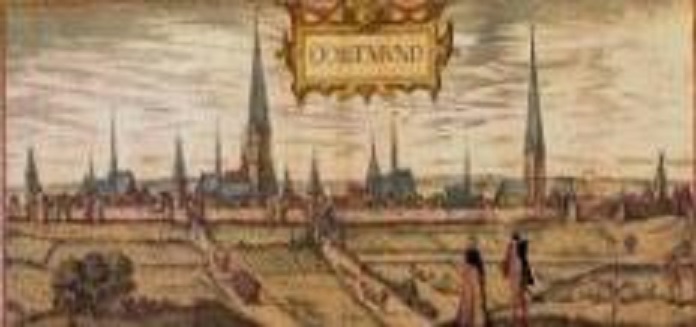
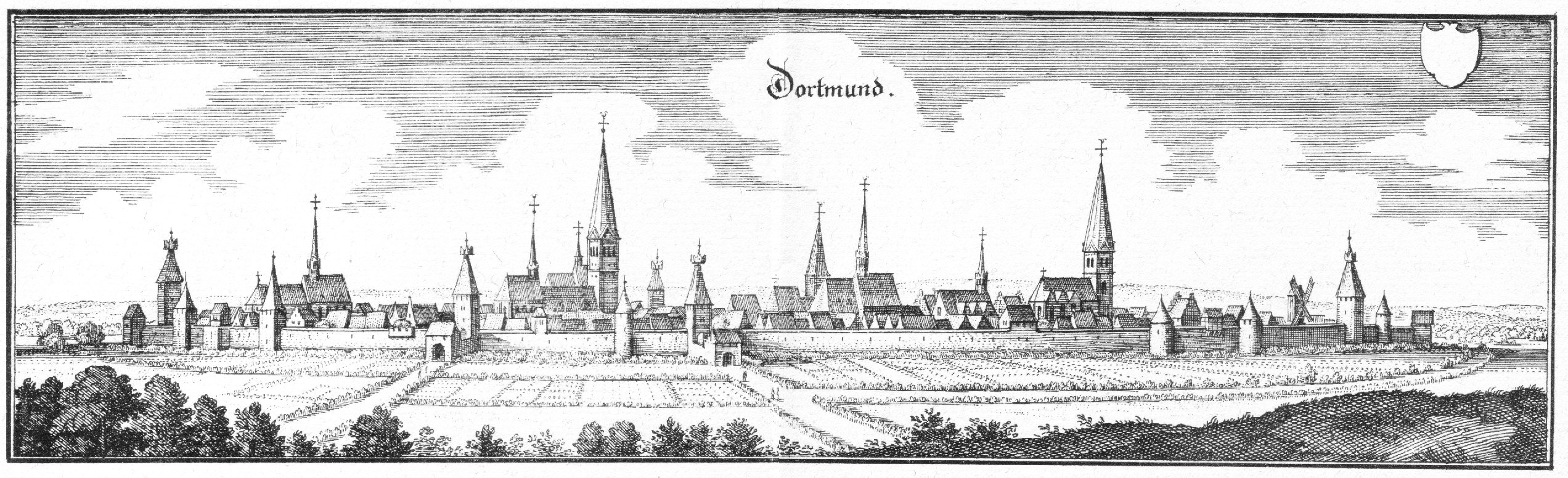
| Karl der Große was often in battle with the unruly Saxons in the area of today's Dortmund, and he built a large road for his troops with food supplies along the way which developed into small towns. It is first mentioned in history as Throtmani. In 1152, Barbarossa made it his residence for two years.By the 13th century it had become one of the wealthiest, most important towns of the Hanseatic League. In 1808, it came under French rule and became part of the Grand Duchy of Berg. Dortmund sided with Prussia against Napoleon, and French occupation ended in 1813. The railroad and the Dortmund-Ems canal which opened between 1892 and 1899 made Dortmund the largest and most important industrial town of the Ruhr. Dortmund's Destruction |
| Darmstadt |
| Dessau |
| Danzig |
| Dülmen (see under Wuppertal) |
| Dillenburg |
| Dillenburg, a town in Hesse, was first mentioned in 1254. It was the ancestral seat of the Orange branch of the House of Nassau. Dillenburg Castle was build on top of the peak now called the Schlossberg in the late 13th or early 14th century. In World War Two, Dillenburg became a target of Allied attacks with its now closed marshalling yard. |
| Dollbergen |
| Dollbergen, about 30 kilometers east of Hanover, was first mentioned in 1226 as "Dolberg". The quiet, timber framed Saxon village was plundered by Danish soldiers during the Thirty-Years war, rebuilt and became a farming community famous for its potatoes. In 1871, Dollbergen's railway line was opened and in 1918, the first oil refinery was built. From 1940 to 1945 numerous Allied bombing raids took place on the village of only 1,400 inhabitants because of the nearby oil refinery, killing 12 civilians and several foreign farm workers. There is a Memorial in the village and several of their graves. At the War Memorials there are 28 names of native sons lost in World War One and 49 from the Second World War. The town was first occupied by the Americans, then the British. |
| Donauwörth (click image below) |
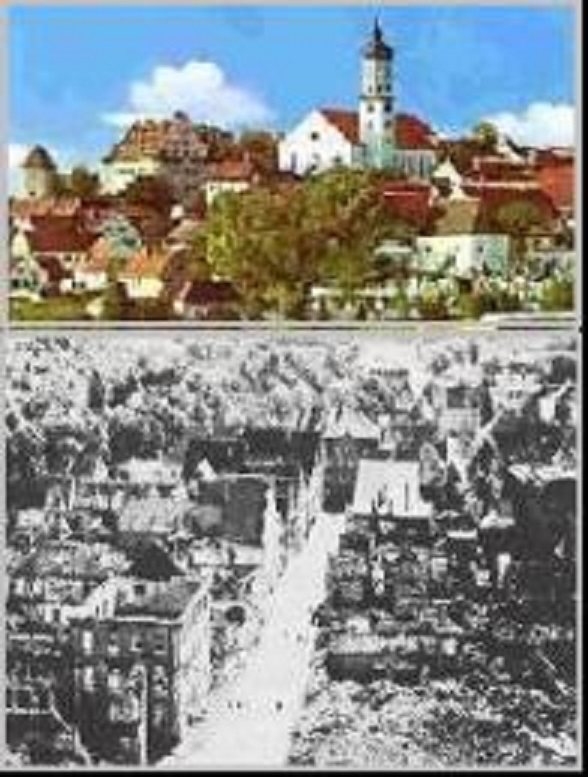
| Donauwörth is a Bavarian town said to have been founded by fisherman where the Danube and Wörnitz rivers meet. It is the site of one of the incidents which led to the Thirty Years' War. In 1606, the Lutheran majority barred the Catholic residents of the town from holding a procession, causing a riot to break out. It was later the scene of the Battle of Schellenberg (or Donauwörth) on July 2,1704, during the War of the Spanish Succession (1702-1713). Here, the Duke of Marlborough was marching from Flanders to Bavaria and came to the Danube river. The French decided to make a crossing of the Danube here when they were surprised by Marlborough's troops and pulled back after heavy fighting. This let Marlborough across the river and 5,000 French troops were drowned trying to escape. His progeny forgot this when on April 11 and 19, just weeks before the end of the war in 1945, a last minute inane attacks took place on an unprepared population. Donauwörth was attacked and 75% of the town was utterly destroyed. |
| Datteln |
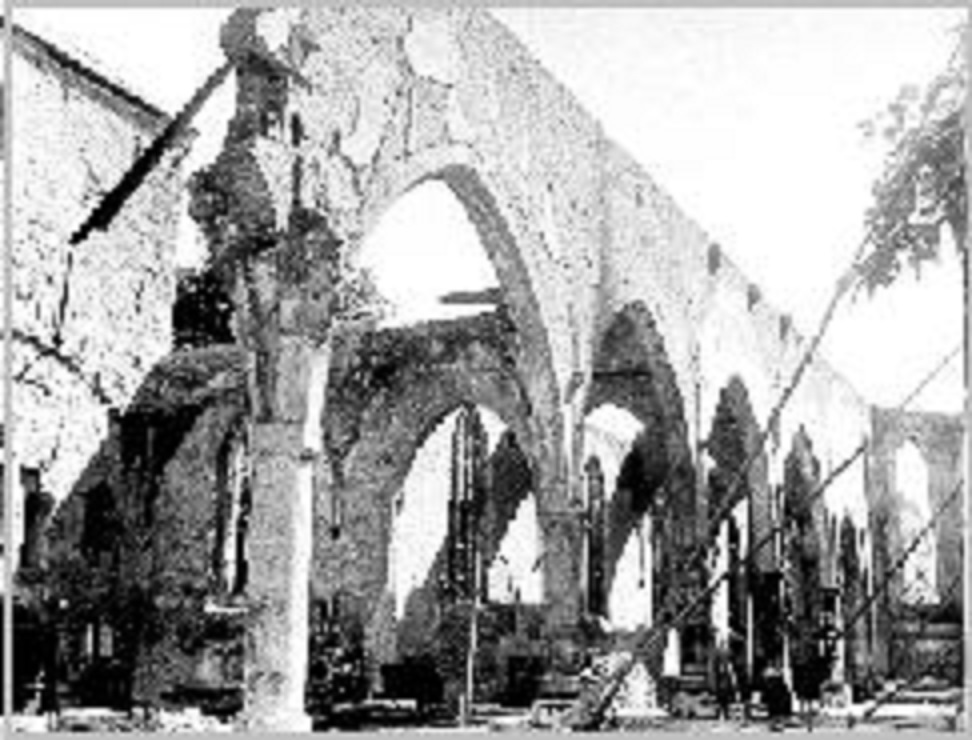
| Datteln is a town in the district of Recklinghausen, North Rhine-Westphalia which was first mentioned in a 1147. The nucleus of the town was the old Church of St. Amandus. Allied air attacks heavily destroyed Datteln's residential area. The worst attack was on March 9, 1944 by 77 RAF Halifax Bombers. They destroyed the churches, including St. Amanduskirche, 3 schools, several buildings of the local mine and 12% of the houses. 64% of the remaining homes were gravely damaged. There were a number of dead civilians who were buried in a mass grave. All of the bridges were blown up by Allied troops |
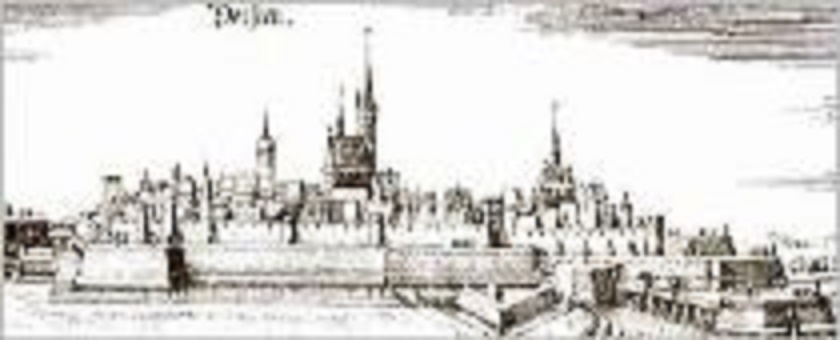
| Dessau in Saxony-Anhalt was first mentioned in 1213 and became an important center in 1570 when the principality of Anhalt was founded. Dessau became the capital of this state within the Holy Roman Empire. Anhalt was dissolved in 1603, but Dessau remained a prosperous town. Between 1940 and 1945, Dessau had 20 Allied air attacks beginning in 1940, but the bombing on March 7, 1945 sent it into rubble and ash. Out of the red sky, from the mouths of 520 Royal Air Force Lancasters and 5 Mosquitos, fell 1,693 tons of bombs, of which about 800 were high explosives and 600,000 were incendiary bombs dropped by in 3 waves of attack, all intended to assist the Red Army. Dessau was 84% destroyed and 1,136 civilians lost their lives. Near by Zerbst is located about halfway between Magdeburg and Dessau in the district of Anhalt. The town is first mentioned in the chronicle of Thietmar of Merseburg in 1018 and after the Reformation, from 1582 to 1798, it became a center of Calvinism in Germany. It is best known for Princess Sophie Auguste Friederike von Anhalt-Zerbst who became known as Catharine the Great of Russia and her manor home was in Zerbst. On April 16, 1945, mere weeks before the final surrender of Germany, eighty percent of Zerbst was destroyed by Allied bombing. Zerbst was pummeled by four or five waves of 20 to 60 aircraft each for an estimated 40 minutes. The city was teeming with refugees fleeing from the east and wounded soldiers. 574 people were killed by bombing. The Americans were the first to occupy the city and handed it over to the Russians the following month. Only a few historical structures being preserved. Construction of Zerbst Palace was first begun in the year 1196 and it was expanded and improved in 1681 by Prince Karl Wilhelm of House of Anhalt-Zerbst. In the bombing of April 16, 1945, the castle was bombed and burned out completely destroying the precious interior as well as the exhibits in the museum and the documents held in the State Archives. Reconstructing the palace would have been possible, but this option was rejected by the communists for ideological reasons. (click below) |
click
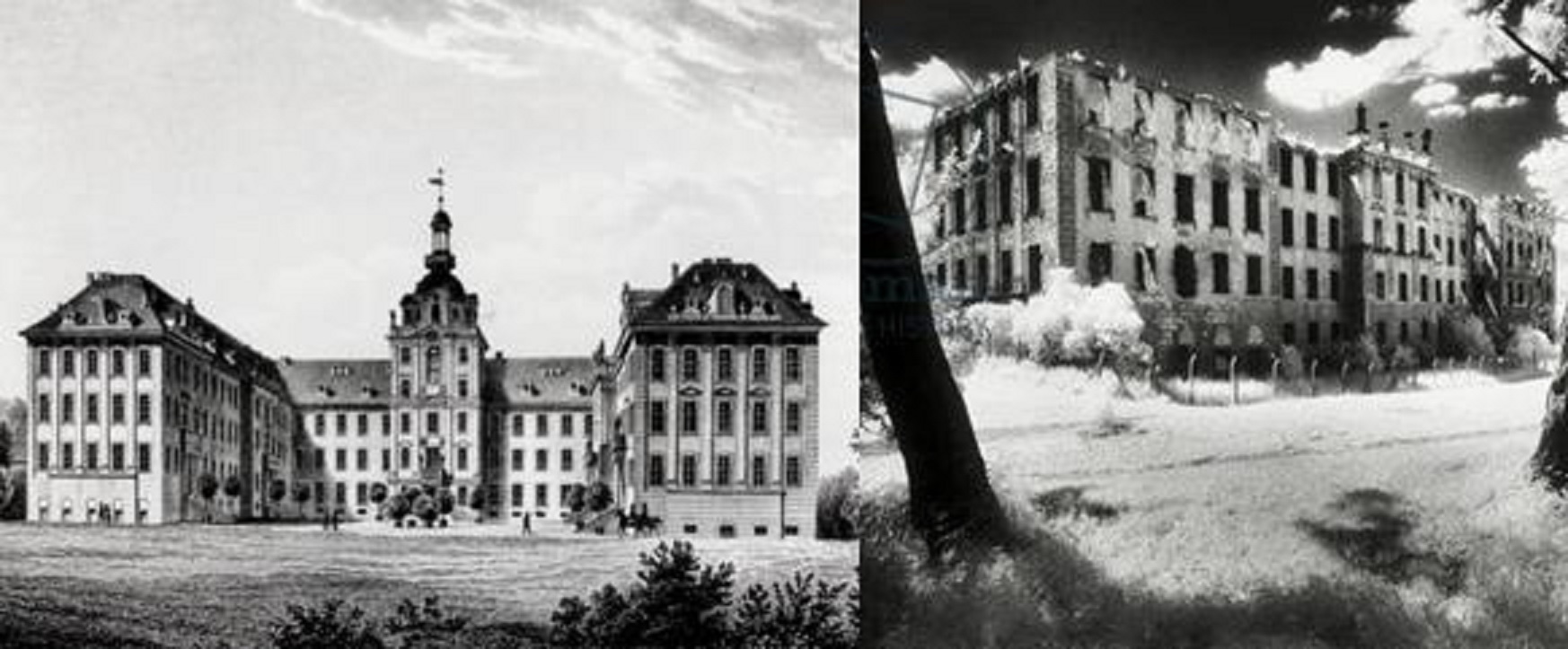
Dessau
Zerbst Palace
click