| Frankfurt am Maine, Frankfurt on the Oder, Freiberg, Freiburg, Freudenstädt, Friederichshafen, Fulda, Geilenkirchen, Gelsenkirchen, Gera, Gey, Gladbach, Gotha, Göttingen, Graz, Grötzingen, Gubin, Hagen, Halberstadt, Halle and Hamburg |
| Frankfurt |
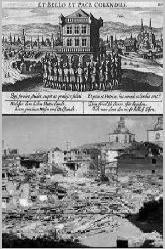
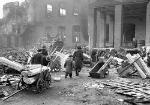
| Frankfurt am Main, a Roman town founded in the 1st century AD., became a royal residence under Charlemagne, and was the capital of the kingdom of the Eastern Franks for a whole. From 1240, it held great annual fairs. In 1356, Frankfurt became the seat of imperial elections. On March 22, 1944, on the same month and day of its famous native son Goethe's death, ancient Frankfurt was all but blown off the map. Frankfurt before & after |
| Freiburg im Breisgau |
| Fulda |
| Fulda is probably the birthplace of Catholic Christianity in Germany. At a Benedictine abbey founded here in 744, a pupil of St. Boniface's named Sturmius the Missionary spread the word throughout central Germany. Ruled by the abbots of Fulda from the 13th century, Fulda and its surrounding area grew, and in 1752, the abbots were raised to the rank of Prince Bishops. From its foundation on the abbey, Fulda was a sovereign principality subject only to the German emperor. Fulda was secularized in 1802 under Napoleonic rule and most of it passed to Hesse-Kassel in 1816. Since 1829, Fulda has been an Episcopal See with a theological seminary. The majestic basilica towers of Fulda, high above the city, looked up to the skies raining death and destruction on July 20, 1944. Eighty people were killed and the cathedral damaged. On August 5th, 30 incendiary bombs fell. On September 11th, bombers appeared again and covered the city, killing 341 people. On the next night, Fulda was again the target of 444 bombs, all dropped within 5 minutes. The few noteworthy buildings which remain are a couple of churches and the cathedral. See Fulda Germans in Serbia Banat |
| Gera |
| The 750 year old, small town of Gera in the east of Thuringia had, over the centuries, developed into a textile production center. The Weisse Elster River winds its way through Gera and nearby forests. Bach stayed here in 1724, having inspected two recently installed organs in local churches. Although the military targets in Gera such as the railway facilities and industrial companies had already been destroyed in 1944 bombings, at the tail end of the war the antique spinning mills, the city museum, 300 homes and 153 people were destroyed by an American terror bombing on April 6, 1945, shortly before they handed it over to their Soviet. |
| Gladbach |
| Mönchengladbach existed before the time of Charlemagne, and a Benedictine monastery was founded nearby in 793. The abbey and adjoining villages became a town in the 14th century. It was suppressed under Napoleon in 1802, and in 1815 it came to Prussia as a chief manufacturing town. The first openly stated intentional British attack on German residential areas began on the night May 1, 1940 with a raid on the town of Moenchengladbach. By the end of the War, the historical part of the city and its immediate area was 60 % to 90 % destroyed. |
| Graz |
| Graz was originally the site of a Roman fort on the Mur river. The name 'Graz' was first used in 1128, while under Babenberg rule. The town was an important commercial center. When Graz came under the rule of the Habsburgs, it gained special privileges from King Rudoph I in 1281. In the 14th century, Graz became the city of residence of the Inner Austrian line of Habsburgs. Count Ernst Rüdiger von Starhemberg Kepler The first documented air raid in Austria in World War Two was the attack by 3 Yugoslav airplanes on Graz on April 6,1941. During the War, historic Graz was attacked by 58 air raids. |
| April 24-25, 1944 was the date that Karlsruhe was slated to be completely destroyed. 666 Allied bombers loaded with 4 tons of heavy high-explosives bombs and 373,206 incendiary bombs had Karlruhe in their scopes. The fate of the city seemed sealed. But things went wrong. Briefly after midnight, as the planes almost reached their target, a violent thunderstorm caused complete disorder, driving the pilots markings off. The bombers piloted eastward and blindly unloaded their bomb loads. Karlsruhe was temporarily saved. However, for the countryside to the east of Karlsruhe, particularly the pretty tourist triangle of Rintheim-Hagsfeld-Grötzingen, hell was unleashed. Approximately 300 aerial mines and high-explosives bombs and ten thousand incendiary bombs alone rained down on quiet Grötzingen, a picturesque hamlet settled for 2,000 years. For 40 minutes the bombs pummeled the earth, igniting at least 400 fires. Over 1,000 unsuspecting and unprepared people were murdered and a quarter of the village completely destroyed. The school, festival hall, savings bank and most of the old tourist hotels were destroyed. 58 houses disappeared and 426 were damaged. In addition, hundreds of stables, barns and sheds (with animals) were destroyed. |
| Grötzingen |
| Guben developed around 1200 as a marketplace on the roads between between Leipzig, Görlitz and Frankfurt (Oder). Guben received the municipal law by the Wettin Mark count Heinrich III. of Meissen in 1235. A cloister of Benedictine nuns began developing on the western shore of the river. Until 1815, Guben belonged to the Margravate of Lower Lusatia, which between 1367 and 1635 belonged to Bohemia. In 1635, Elector Johann Georg I of Saxony received Lower Lusatia and Guben. In 1815, the Margravate of Lower Lusatia was replaced with the district system and Guben became the capital of a district within the Province of Brandenburg. Guben's textile industry began to develop in the 16th century, and it became a center of hatmaking. Guben became a rail connection between Frankfurt/Oder and Breslau in 1846 and between Cottbus and Crossen an der Oder in 1871. At the end of the war, Guben was 90 % destroyed by Allied Bombing and because Guben was on the Lusatian Neisse, the city was separated into German Guben and Polish Gubin. The German residents of the Polish part of Guben were forcibly "evacuated" in 1945. Because the historical center of Guben became Gubin, the western suburbs which grew from the cloister remained in Guben. |
| Guben |
| Halberstadt |
| The Bishopric of Halberstadt was founded by Charlemagne in 814 as an outpost intended to missionize the Saxons, and it was a Catholic city until around 1542, when it became Protestant. From 1387 to 1518, Halberstadt was member of the Hanseatic League, and by 1648, it was secularized under the treaty of Westphalia as the Principality of Halberstadt. The city was devastated during the Thirty Years War, but prospered with the arrival of Huguenots in 1685. Halberstadt was one of the most beautiful medieval German framework cities. George Mueller Its Ruin Halberstadt's timber frames medieval homes would prove hazardous during brutal Allied bombing, the worst of which took place on April 8, 1945 in the very last days of the war as was the case in so many German cities. Over 900 years of history were wiped out within minutes in a violent raid on the old Cathedral city. 218 bombers dropped 550 tons of high explosive and incendiary bombs, destroying all but one fifth of the city and killing 2,500 civilians. The ancient churches were tortured, the narrow historic roads a heap of rubble, and 676 medieval half-timbered houses disappeared. |
| Halle |
| The first evidence of occupation at Halle, comes from artifacts of the Upper Paleolithic period. Salt deposits in a nearby valley were mined and there is evidence of salt trade in the area as far back as the Bronze age. First mentioned in 806 AD as a fortress, Halle was first part of the archbishopric of Magdeburg in 968, and chartered by the Emperor Otto II in 981. Halle maintained its liberty as a member of the Hanseatic League from 1281 until 1478, and accepted Protestantism in 1522. It passed to Brandenburg in 1648. Martin Luther University of Halle-Wittenberg was founded in 1694. Noble Halle, the seat of intellectual church life for generations, was not totally destroyed by bombs. Although there were 553 air alarms, Halle suffered only two attacks, both shortly before Americans took the town on April 17,1945. Non-military targets such as the national theater and the old Rathaus were ruined. The enormous bell and clock tower called the Roter Turm (red tower) stood on the marketplace in Halle as a landmark. 84 meters high, its construction began in 1506. In April, 1945 the tower was hit by American shells. Handel |
| Hamburg |


| Frankfort on the Oder owes its origin and name to a settlement of Franconian merchants in the I3th century. In late medieval times, the town dominated the trade on the river between the formerly German cities of Breslau and Stettin. In 1430, Frankfurt joined the Hanseatic League, but for only a short time. The Elector of Brandenburg founded a university here. Frankfurt decayed under Communist occupation, its bomb damage unrepaired. Ancient Marienkirche had been destroyed and its red brick tower rebuilt in white concrete, the stained glass windows removed and shipped to museums in Moscow. Once located on both sides of the Oder River, it was cut in two by the new border, and its other half is in Poland and goes by the name of Słubice. |
| Frankfort on the Oder |
| Gotha |
| Gotha was attacked several times by American and English bombers. 542 civilians were killed. |
| Founded by Charlemagne for protection against marauding Slavs in 808, Hamburg was home to the beginning of the Christianization of Northern Europe. An Archbishop was installed here in 834. Hamburg had to be rebuilt over and over because of repeated looting and burning by the Danes and Slavs, and this slowed down its commercial growth until the 12th century. The city was granted franchises and fishing rights on the Elbe by Friedrich I. Lübeck and Hamburg formed the Hanseatic League early in the 13th century. Hamburg was proclaimed a free imperial city of the Holy Roman Empire in 1510 by Maximilian I, and thrived. Hamburg was occupied by pillaging French troops after Napoleon won the battle of Lübeck in 1810, and there was plundering and heavy taxation. The population shrank from 100,000 to 50,000, but after the French left, the city blossomed... until... |
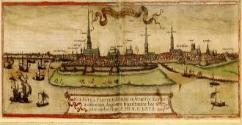
| Friedrichshafen is on the northern side of Bodensee (Lake Constance) in southern Germany near the borders with Switzerland and Austria. It is famous for Count Ferdinand von Zeppelin. During "Operation Bellicose" in the latter part of the war, the town lost most of its historical center. When the war began in 1939, 25,041 people lived in Friedrichshafen and almost half wisely evacuated. The British and the USAAF both attacked Friedrichshafen in March and April 1944, the worst air raid being on the night of April 27-28, 1944, when the RAF killed 850 civilians. |
| Friederichshafen |
| Gelsenkirchen |
| Gelsenkirchen was first documented in 1150, but it remained a tiny village until the 19th century, when the Industrial Revolution led to its growth. In 1840, when coal mining began, 6000 inhabitants lived in Gelsenkirchen; in 1900 the population had increased to 138,000. On the night of June 25, 1943, 473 RAF bombers attacked the city. The next major attack came on the night of July 9, 1943 by 418 bombers. The city was three fourths destroyed.. |
| Hagen (See under Essen) |
| Freudenstädt |
| Protestant religious refugees from Austria settled in lands ruled by Duke Friedrich I of Württemberg in 1599. The Duke dreamed of a new city in the middle of his duchy and the hard working religious exiles obliged him. The old city was nearly totally detroyed by bombing and its citizens raped, robbed and looted by Allied troops afterward. More on Freudenstädt |
| Geilenkirchen is north of Aachen near the Dutch border. Its name was first mentioned in the 12th century. On November 16, 1944, the city was largely destroyed by Allied bombing, its Gothic and Romanesque churches either levelled or severely damaged. During rubble removal, a Roman street was discovered. |
| Geilenkirchen |
| As Hamburg burned from the bombings, artificially created volcanic flames five times the height of New York’s Empire State Building and winds in excess of 150 miles per hour swallowed everything in their path... |
| Freiberg/Saxony |
| Freiberg/Saxony is an old mountain town in the middle of Saxony between Dresden and Chemnitz. The city was founded in 1186, and has been a center of the mining industry in the Ore Mountains for centuries. The Technische Universität Bergakademie Freiberg (Mining Academy) was established in 1765 as the oldest university of mining and metallurgy in the world. Freiberg is the home of four famous Gottfried Silbermann organs. The river, Freiberger Mulde, flows through the town. On October 7,1944, 521 US bombers set out to attack oil refineries in the east but were hampered by bad weather and looked for a secondary target. A a group of three bomber squadrons with 24 B17s dumped 60 tons of bombs on Freiberg, destroying hundreds of homes and killing 172 civilians. |
| Freiburg im Breisgau, founded in 1120, hides away near the Rhine River at the edge of the Black Forest. It passed with the rest of the Breisgau to the Hapsburgs in 1368. Bavarians and Austrians were defeated here in the Thirty Years War by the French, who held Freiburg from 1677 to 1697 and again from 1744–48..A benign university town, Freiburg had an intelligent past. Freiburg in Ruins The Man who named Amerika Freiburg had almost no industrial or military targets and was considered a military hospital town. It was attacked on the pretext that it was a "railway target". During "Operation Tigerfish", on Nov. 27, 1944, around 441 British Lancaster bombers, some loaded with deadly phosphorus, flew up from the west and for 25 minutes unloaded approximately 1,900 tons of 14,000 high-explosive and incendiary bombs, igniting a firestorm. The high-explosive bombs destroyed all the windows and the air pressure caused tiles to fly from the rooftops. The water pipes were broken and the roads were blocked by rubble instantly. People tried to fight the fires with wine barrels from the local wineries, but 80% of the historic old town was destroyed and the famous medieval University of Freiburg was devastated. In December, 1944 there was another major attack to add to the destruction of Freiburg. 3000 civilians were killed, 10,000 injured and 858 lost. There would have been more, but legend has it that the drakes in the park became raucously noisy and seemed to announce the approaching bomber stream, causing many citizens of Freiburg who lived around the city park near the cathedral to run to the air raid shelter. Photographs show that no railway targets were not hit in this attack. |
| Gey ( see under Düren ) |
| Göttingen |
| The origins of Göttingen, a university town in Lower Saxony began in a village called Gutingi which was first mentioned in 953. A city was founded between 1150 and 1200 to the northwest of this village adopted its name. In medieval times the city was a member of the Hanseatic League and hence a wealthy town. Göttingen's old university ("Georg-August-Universität") was founded in 1737 by George II of England in his capacity as Elector of Hanover, and it became the most visited university of Europe. In 1837, seven professors protested against the absolute sovereignty of the kings of Hanover and lost their positions. They became known as the "Göttingen Seven" and included the brothers Grimm. Bismarck studied in Göttingen in 1833 and had to live in a small separate house because of his rowdiness. More: To Kill and Kill Again |