| The Plight of the Exiles |
| Excerpts from An account of the Exile's plight in letters of Charles and John Wesley |
| Late at night, when the city gates were shut, about eight hundred Protestant exiles of Salzburg, of both sexes, arrived here, under the guidance of a Bavarian messenger. They had been driven out of their native country for the sake of their religion, and forced to leave their all behind them. A report was spread that they had themselves desired to be conducted hither; but, upon inquiry, they solemnly protested that they had not known whither they were to go; and that all they desired was, to be admitted into some Protestant town, for the spiritual comfort of their souls. After the arrival of these poor people, (who were very meanly clothed, and were for the most part labouring people and servants, and had brought a few children with them,) they patiently waited without the city-gates for admission, (which they had earnestly solicited by about forty of their deputies, who arrived just before the gates were shut,) singing, with great devotion, Luther's hymn, ' God is our Refuge in distress,' &c.Orders were soon given for their reception; and some of them had lodgings assigned them in the Protestant inns, whilst many were received into private houses, not without many tears. They were as hospitably entertained as the smallness of the place would admit of, and provided with spiritual and temporal food till the 30th of December. On Innocents' day they heard, for the first time, the morning sermon; and at noon they attended a sermon suited to their present circumstances, at which they expressed an uncommon desire and zeal for the word of God. Their behaviour among us was as became true Christians. They were modest, humble, peaceable, contented with, and thankful for, whatever was given them; and expressed the greatest delight in praying, singing psalms, and reading good books. As they had been expelled their country on a sudden, and not permitted to furnish themselves with necessaries for their journey, our Protestant citizens have testified their charity to them, by furnishing them with useful books, and better clothing for this cold season, and with food and money. Several of them have been taken into service in the town; some of the children put out apprentices, and to school; and their sick and weak provided for in the hospital. When the Roman Catholic members of our Magistracy had complained in form of the stay of these poor people, and other circumstances had intervened which rendered their further entertainment here very difficult, (especially since nineteen thousand more were to make their pilgrimage through these parts,) we came to this resolution, that all who could not be provided for here, should be sent through three different roads to Memmingen, Augsburg, and Kempten, under the conduct of some of our Protestant citizens. The necessary passports, with the money collected at the church-door towards defraylng the expenses of their journey, were delivered to the deputies that went to conduct them; and four waggons were provided for carrying the old weak people and the children, with the few things they had brought with them. On the day of their departure, after they had heard the morning sermon, and had taken necessary refreshment, they repaired to our Trinity church, at noon, where they heard a farewell discourse, with many tears, and a hearty affection for the word of God, and, concluded with the hymn, ' God is our Refuge in distress,' which was sung only by themselves. After this, the deputies led them, two by two, between the Mayor and Aldermen, on one side of the church door, and the reverend Ministry on the other. Being dismissed by the citizens with innumerable blessings, they took their several roads in God's name, like so many flocks of sheep, with great patience and humility. "Although we could not imagine that the quiet march of these poor exiles would be anywhere obstructed, yet they that were ordered to go to Kempten found that not one of their number could be permitted to pass that way. The deputy went to lodge them in Ober Beuern, a village belonging to this city, till further orders. But the Roman Catholics of that place opposed their entrance in so violent a manner, that all their lives had been in danger if they had not retired. They therefore came back to this city, and were lodged at the Golden Crown. |
Kauffbeyern; St. John's day, 1731
| SALZBURG EXILES |
| The next day, being the 31st of December, they were sent to Memmingen, where they met with a joyful reception. AUGSBURG. On the 30th of December, 1731, the Protestant Magistracy of Augsburg, having had notice given them, by the Magistracy and Ministry of Kauffbeyern, that eight hundred exiles of Salzburg had arrived there, and intended to march thither, earnestly desiring, for the sake of Christ, that they would receive them; the same was immediately communicated by the reverend Ministry of this city to the congregation at the cathedral church of St.Anne. As soon as the sermon was ended, the Protestant Senate met, with our head Almoner and Recorder; and, having resolved to make a collection on New-Year's day, for the benefit of these poor people, they desired the senior Rectors to draw up an account of them, to be read after the noon and evening sermons. But When the Protestant part of the Senate acquainted the Roman Catholic part, that many Salzburg exiles were expected, and should be divided among the Protestants, without the least molestation to the Roman Catholics, the Roman Catholics opposed their admission, under several pretexts, insomuch that nothing could be effected; but we were obliged to quarter them among the Protestants of the suburbs, some in inns, others in silver and copper mills, in sawing mills, the hospital, and garden-houses. To all this the inhabitants expressed so great a readiness, that they who were not able to 'receive any, lamented it as their misfortune. So great was the charity of all ranks of people, that they had not patience to wait for their coming; but, some on foot, some on horseback, and some in coaches, went to meet them several miles out of the town. Two hundred of them, with their deputed Commissary of Kauffbeyern, arrived that evening, and marched two by two over the fields, amidst some thousands of people, both Papists and Protestants, some of whom distributed money among them. Every Protestant was desirous to comfort and relieve these distressed brethren. Several tradesmen and merchants were not ashamed to call them brethren and sisters in the fields. They are generally of good courage, and, notwithstanding all the misery they have gone through, of a cheerful temper. There appears so much honesty and fidelity in their countenances, that one may almost affirm they are without guile. They are, for the most part, of a robust constitution, and from twenty to thirty-six years of age; though some few of them are from forty to sixty. These people behave themselves not only very thankfully, contentedly, meekly, and patiently, but, when they have an occasion of mentioning their afflictions, they do it without the least bitterness or murmuring against their former superiors: and they incessantly pray, with many tears, for their relations whom they have left behind, not knowing what sufferings they may have to undergo. The next day the Rev. Rector Frick preached a sermon upon Gen. xii. 1, 2. As this discourse was chiefly applied to the Salzburgers, it is impossible to express with what attention they heard the word of God. They stood like people who have had no food for a great while, and therefore wait with greater eagerness to receive some to satisfy their hunger. Being averse to nothing more than idleness, and ready to undertake the hardest labour, many have already found a subsistence.... In their own country, at first, all pains were taken to dissuade them from the Protestant religion, by arguments from worldly interest; and when that would not do, their books, which they had been many years in collecting, were seized in several places; and it is reported of the Dean of Werffen, that he burned them. After they were thus deprived of the word of God, their enemies proceeded to more violent means. Many were apprehended, particuarly those who were suspected to be leaders, and sent in fetters, dressed in derision with white caps, which hung down to their breasts, into the deepest dungeons in Salzburg; and others have been sent away, their relations not knowing whither. When this would not do, the Papists threatened them with beheading, drowning, the galleys, and the like. To all this these poor people made only the following reply: ' In God's name; in God's name.' When it was found that they could not be brought by any of these means to love their lives and fortunes more than God and His truth, they were on a sudden ordered to leave the country; and these orders were immediately executed with all imaginable rigour. Some were taken from the field; others were dragged naked out of their beds. All had a sudden summons to depart; and very few were permitted to sell their goods, or take anything necessary with them. Many have been obliged to leave their wives and substance behind them, and to go away deprived of all they had in the world. And what increased their calamity was, that they were forced to begin their journey in the depth of winter, when the cold is most severe. The first eight hundred spent five whole weeks in their journey, and that in the most bitter cold and stormy weather; and were a fortnight in wandering over mountains and hills, not knowing whither they went. This fatigued and emacerated them so much, that they were almost starved, having been in want of bread for three days together. This is the case of these poor exiles, whose number will be considerably augmented by those that are yet to come. AUGSBURG. Jan. 26th, 1732, there arrived in our neighbourhood five hundred more exiles of Salzburg, besides their women and children. One of our Protestant Aldermen was immediately sent to meet them, who read their passports, registered them, and provided a dinner for the whole company. After which they were divided into parties; so that one hundred in one place, eighty in another, sixty in a third, and fifty in a fourth, might be quartered for this first day without the city; and, when they were arrived in their lodgings, they sang hymns and prayed with great devotion. There were with them three waggons full of women, new-born children, and old people, who were taken to the hospital. It was a signal mercy that they did not all perish with cold; considering that they came in a severe frost, being poor, and many of them very bare. Indeed, some did fall sick by the hardships they endured; among whom was an old man, since dead, who, being asked whether he was not sorry for having left his native country, answered, 'No: I die with joy, and in a hope of a better life.' |
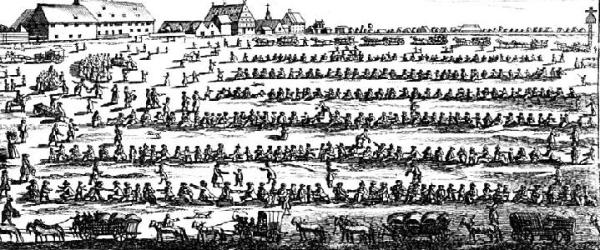
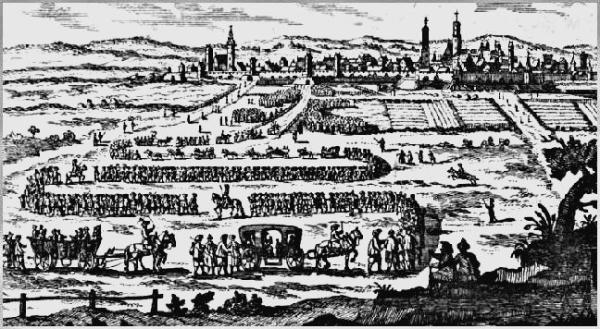
Exiles at Memmingen