| The Ansbach-Bayreuth Army in America |
| There were nearly 300 sovereignties and over 1,400 estates of Imperial Knights in Germany in the late 1600's to the early 1700's. Every one had its own financial, commercial and manufacturing systems and its own regulations and laws, and they were all governed by their own duke or prince who, with the privileged classes, his court and his army, ruled supreme. A map of the era would show the Kingdom of Prussia on one end, Austrian lands on the other, and hundreds of duchies, free cities, landgraves, principalities, electorates and bishoprics between and around. In the 16th century, Henry VIII of England officially hired German Landesknechts for his campaigns in France and Scotland. From the Middle Ages to the English Civil War, mercenaries were hired and incorporated into the English Army. The English hired Hessian soldiers during the War of the League of Augsburg, the War of the Spanish Succession, the War of the Austrian Succession and the Seven Years' War. Again, in 1745 during the Scots Rebellion, 7,000 Hessians were hired to help garrison England and Scotland. With American rebellion, England once again turned to the German princes, dukes and margraves who were hungry for a few extra bucks and anxious to sell or rent their soldiers The Hessian regiments sent to America remained in their own units with their own unit commanders, and often in their own brigades. King George III of England hired units from the German states of Braunschweig, Hesse Hanau, Waldeck, Anhalt- Zerbst and Hesse-Cassel, all commonly all called "Hessians", to assist with bringing the colonist's rebellion to order and he needed even more. At the time of the American revolution, the territories of Ansbach and Bayreuth contained about four hundred thousand people, and the financially troubled Margrave of Ansbach-Bayreuth, Christian Friedrich Karl Alexander, jumped at the English king's offer and committed 1160 of his troops, receiving £100,000 sterling for renting out his army. It was difficult, if not impossible, for the troops to avoid this service. Below: Ansbach-Bayreuth troops leaving for Amerika |
| In Anspach's territories, no subject could leave the country or marry without permission. Drunks, debtors, political trouble makers and rebels were forced into the ranks along with peasant farm boys if not more than sixty years old and "of fair health and stature." About 18,000 "Hessian" troops arrived in North America in 1776, including the small and often unwilling army of Anspach-Bayreuth. The Margrave's uncle, Friedrich the Great, was adamantly opposed to sending German soldiers abroad in this manner. Friedrich expressed his disgust at the practise in a letter to Voltaire regarding the Landgrave of Hesse: "Had the Landgrave come out of my school, he would not have sold his subjects to the English as one sells cattle to be dragged to the shambles. This is unbecoming in the character of a prince who sets himself up as a teacher of rulers. Such conduct is caused by nothing but selfishness. I pity the poor Hessians who end their lives unhappily and uselessly in America." Friedrich was also quite sympathetic to the ideals of the American Revolution. The army of Anspach-Bayreuth had been hired by a treaty signed on February 1, 1777 to assist the British Army. On March 7, 1777 all troop units in Ansbach had been gathered and were solemnly addressed by the Margrave. The soldiers got a big send-off from the local people, as one of the soldiers later stated "under cordial sighs with much crying, regret and pain, then with congratulations on our imminent adventure." The Two regiments of Anspach and Bayreuth who had marched from Anspach were embarked at a town named Ochsenfurth on the Main about a hundred miles above Hanau. Many of the soldiers were mere farm boys from the countryside, and being unused to the crowded quarters felt cold and sick with their first pangs of homesickness. Quite a few expressed the feeling that they would rather be fighting on the side of the Americans for liberty! At daybreak, some of the soldiers of the Anspach regiment disembarked and refused to leave land. They were sent food and wood to keep warm, and when sympathetic villagers from Ochsenfurth brought them liquor they grew even more rebellious. Some gunfire was exchanged and a few soldiers were wounded while others escaped. 40 men of the Ansbach-Bayreuth regiment actually defected in this small mutiny, and only a few could be later caught and punished. The Margrave at Anspach was informed by messenger and, since he had already been paid for the soldiers, he rode quickly through the night to Ochsenfurth. Things calmed down and the soldiers were re-embarked and taken down the Main River, accompanied for a time by the Margrave who supposedly sat there with a cocked pistol. Each regiment received a present of 100 ducats from the Margrave and extra rations during the journey. Carl Alexander said good-bye to his subjects on March 26, 1777 and returned to Ansbach. Two days later, the soldiers reached Dordrecht at the Dutch coast. In Holland, they were then mustered into English service and forced to swear an oath to the British King. Lord Suffolk, after the examination of the Frankish troops, said: "Such magnificent chaps, young and well- built, a small but wonderful corps. I was afraid they would not swear the oath of loyalty, but the presence of the Margrave had prevented further unrest." Here, they were crammed aboard nine English three masted mast ships bound for North America, four for the two infantry regiments and one for the Jäger company. A total of 1,285 officers and men left Ansbach on March 7 and arrived at Staten Island, New York around June 3,1777. Most were sent to Sandy Hook,N.J. where Gen. Howe placed 17,000 soldiers in 265 ships, the largest Armada ever assembled in America, and they embarked on a difficult six week journey to the head of the Elk River in Maryland where they arrived on July 3, 1777. They were held there until August 25, 1777. Later, in 1778, reinforcements were sent to America which raised their number of troops in British service to somewhere between 1,644 and 2,353 officers and men. Like the Hessian regiments sent to America, they remained in their own units with their own unit commanders and often in their own brigades. The infantry regiments were one battalion strong, composed of four musketeer companies and one grenadier. The infantry regiments were named after their commanding officers. Colonel von Voit initially commanded the infantry regiment from Bayreuth and later took command of the Ansbach infantry regiment. Major von Seybothen, company commander in the Bayreuth infantry regiment, became its new commanding officer. The Jägercorps had four companies, one of which sailed with the first Anspach-Bayreuth contingent. A typical Jäger serving with the German Forces in North American was by trade a foresters or gamekeeper and a crack shot with a Jäger rifle which had better accuracy and range than a regular infantry musket. Jägers were trained to act individually or in small groups and they could be trusted not to desert. When the Anspach- Bayreuth infantry regiments mutinied at Ochsenfurth, the Feld-Jäger company under a Capitain von Cramon was employed to bring the infantry back into line. By 1781, there were 821 Jägers from Hesse-Cassel and 245 from Anspach in the British Army in New York alone. |
| Among the mercenary soldiers stationed in Canada was the German poet J. G. Seume, who had been kidnapped by recruiting officers and forced into foreign military service against his will. Seume’s autobiography, "Mein Leben," records his experiences in America closing with 1784, and many of his best poems dating from this period. He described his experiences on shipboard with the Hessians: "The men were packed like herring. A tall man could not stand upright between decks, nor sit up straight in his berth. To every such berth six men were allotted, but as there was room for only four, the last two had to squeeze in as best they might. This was not cool in warm weather. Thus the men lay in "spoon fashion," and when they were tired on one side, the man on the right would call "about face," and the whole file would turn over at once; then, when they were tired again, the man on the left would give the same order, and they would turn back on to the first side. The food was on a par with the lodging. Pork and pease were the chief of their diet. The pork seemed to be four or five years old. It was streaked with black towards the outside, and was yellow farther in, with a little white in the middle. The salt beef was in much the same condition. The ship biscuit was often full of maggots. This biscuit was so hard that they sometimes broke it up with a cannon-ball, and the story ran that it had been taken from the French in the Seven Years' War, and lain in Portsmouth ever since. Sometimes they had groats and barley, or, by way of a treat, a pudding made of flour mixed half with salt water and half with fresh water, and with old, old mutton fat. The water was all spoiled. It was thick with filaments as long as your finger, and they had to filter it through a cloth before they could drink it. They held their noses strong while they drank, and yet it was so scarce that they fought to get it. Rum, and sometimes a little beer, completed their fare. Thus crowded together, with close air, bad food, and foul water, many of them insufficiently clothed, these boys and old men, students, shopkeepers, and peasants tossed for months on the Atlantic." |
| The regiments were generally allowed six female camp followers, none of whom were unattached women, and all of whom had a duty, either paid or unpaid, such as cooking, cleaning, laundry or hospital work. They received 1/2 of a man's ration and the children received 1/4 ration. If they were wives and their husband died, they generally had to either remarry within an allotted time or return home. When the 236 men of the 1782 Ansbach-Bayreuth replacement recruits came to the colony they had 9 women with them, all of whom eventually returned to Germany and took their children home with them. These were not camp followers engaged in promiscuity, but "honorable women of sound moral character". They were in several Battles, and by 1778 were fighting the French by sea and the American by land. They endured seasikcness and severe storms at sea, and exhaustion and freezing conditions on land. When General John Sullivan's forces besieged Newport,R.I., for example, the British & German soldiers were exhausted and crowded together in the town like caged cattle . The Frankonian contingent was present at the Siege of Yorktown in October of 1781. Many of the infantry were captured when a detachment of 400 men from Lafayette's Light Infantry Division under the command of Colonel Alexander Hamilton took Redoubt No.10 by night assault on October 14. The remainder of the Franconian troops went into captivity when Cornwallis surrendered the Yorktown garrison five days later, on October 19, 1781. The Frankonian troops were exchanged and released from captivity in May 1783 to be shipped home. George Washington himself made it a point to inform people to treat the Hessians kindly because they were "brought to fight against their will". By the end of the war in 1783, 17,313 of the total "Hessians" returned to their homelands. Of those who did not, about 7,700 died: 1,200 of whom were killed in action and 6,354 from illness or accidents. About 5,000 total Hessians settled in North America, both in the United States and Canada, with 1,170 from the army of Anspach-Bayreuth who did not return to their fatherland. Many Anspach-Bayreuth soldiers fell in battle or died from diseases they contracted in the war, but a large number of Frankonians simply preferred to settle in the New World, many around Reading and Lancaster, Pa. and Frederick, MD. Germans had constituted about one-third of all the land forces fighting for the king in North America. The sale of his troops into foreign service, and the hardship endured by the soldiers as well as their families back home, caused a deep rift between the Margrave of Ansbach and his people and helped spur demise of the margraveship. |
| What was the fate of a Hessian deserter when he was caught? Severe mistreatment. 75% of the prisoners aboard British prison ships: patriots, Hessian deserters and even some of their women and children, died agonizing deaths from starvation, disease, flogging and other punishment. The ships which once ferried horses and supplies were converted to these prisons, their portholes nailed closed and covered with iron bars, leaving only small peepholes for air. Each six men received the ration equivalent to one man. The water they were given was contaminated and provided to them in large, filthy "troughs" and the men soon raged with thirst. Their clothing was inadequate, there was no bedding and they were either frozen in cold weather or parched and feverish in the heat. The ships were infested with insects and rats, and dysentery, pox and yellow fever spread wildly, taking a horrible toll. The abuse was so bad it is said that on one occasion the prisoners set fire to their own prison ship, preferring a quicker death to the torture and starvation inflicted upon them by the British. More Americans died on British prison ships in New York Harbor than in all the battles of the War, and there were at least 16 of these horrible hell holes anchored in the waters around New York City, the most notorious being the Jersey which held more than a thousand men. Captured officers were put in a former gun room on the ship, sailors were kept in two compartments below the main deck and Hessian deserters, French and Spanish prisoners got stuck in the hellish hold. They died with such regularity that when the British jailers opened the hatches in the morning, they yelled down: "Rebels, turn out your dead!" The estimated 8,000 dead bodies were pulled ashore in clumps and later dumped into shallow pits only 1 or 2 feet deep together. "Their sickly countenances and ghastly looks were truly horrible," ship escapee Robert Sheffield later wrote. "Some swearing and blaspheming; some crying, praying, and wringing their hands, and stalking about like ghosts; others delirious, raving, and storming; some groaning and dying - all panting for breath; some dead and corrupting - air so foul at times that a lamp could not be kept burning, by reason of which the boys were not missed till they had been dead ten days." At the war's end in 1782, the bitter and defeated British took it out on a crew of one such ship and, when the prisoners began cheering and celebrating victory, the guards came below and mercilessly hacked at, stabbed, cut, and wounded every one of the weakened prisoners within their reach, then ran up and closed down the hatches so the prisoners would bake in the heat without any water. These floating British death camps killed around 13,000 prisoners, triple the number of Americans who died in all the battles of the entire revolution. |
| Left: Inside a prison ship; Old Monument. |
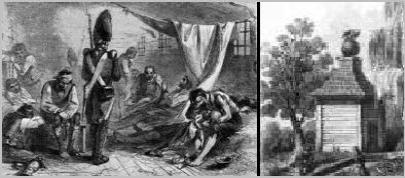
| There is a Prison Ship Martyrs' Monument designed by Stanford White in New York City which was built shortly before World War One and dedicated to the 11,000 prisoners who died aboard the British prison ships that once anchored nearby in the Wallabout during the Revolutionary War. For years, the prisoners' bones would surface from their shallow dumps around the Wallabout and regularly wash up along the shores of Brooklyn and Long Island. They were collected by various New Yorkers in hopes someday to honor the sacrifice made by the unfortunate prisoners. The first monument was erected in the early 1800s by the Tammany Society of New York and located near the Brooklyn Navy Yard waterfront. In 1873, the old monument was in disrepair, and a large stone crypt was constructed in the heart of what is now Fort Greene Park and the bones were re-interred in the crypt with a small monument erected on the hill above it. But the architectural firm of McKim, Meade and White was commissioned to design a grander 148 foot tower which stands, albeit in relative obscurity, today. It was unveiled in 1908 with President Taft present at a grand ribbon-cutting ceremony. It's popularity soon diminished when pro-British sentiment was drummed up by those pushing for American involvement in World War One. By World War Two, the monument's importance took an even greater backwards leap. While it once housed a staircase and elevator to an observation deck which featured a beacon of light which could be seen for miles, by now it was pretty much ignored. One of the best known burial grounds of Hessian soldiers from the American Revolution is in Runnemede, New Jersey, where some 40 to 50 Hessians who died of wounds received at Fort Mercer are buried. Another grave, nearer to the fort held an equal or greater number. When World War One anti-German hysteria seized a few locals, they unearthed the remains in the graves and dumped them into the Delaware River. |

Atwood, Rodney The Hessians: Mercenaries from Hessen-Kassel in the American Revolution 1980
Burgoyne, Bruce E. (translator and editor); von Feilitzsch, Heinrich Carl Philipp; Bartholomai,
Christian Friedrich Diaries of Two Ansbach Jaegers (1997).
Eelking, Max von The German Allied Troops in the North American War of Independence, 1776–
1783. Translated (1893)
Burgoyne, Bruce E. (translator and editor); von Feilitzsch, Heinrich Carl Philipp; Bartholomai,
Christian Friedrich Diaries of Two Ansbach Jaegers (1997).
Eelking, Max von The German Allied Troops in the North American War of Independence, 1776–
1783. Translated (1893)