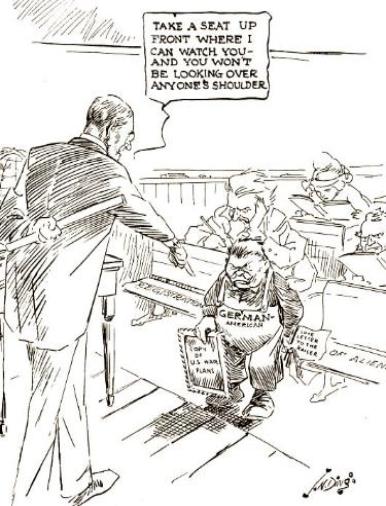
| "Where he can be kept out of mischief?" (click). This 1917 Iowa cartoon shows the sneaky, ugly German-American. Cartoons like this one fostered violent assaults on the innocent. Jay Norwood “Ding” Darling worked in Iowa before moving to New York and working for the government doodlers via the New York Globe and the New York Herald Tribune. He was published in newspapers across the USA and rode the anti-German hate wave, winning him Pulitzer Prizes. He was later made head of the Bureau of Biological Survey. Cartoons like this one fostered suspicion and hatred, yet even today they draw no scorn. |
| During the War, the title of the innocent Hearst comic strip the 'Katzenjammer Kids' became to 'The Shenanigan Kids', and its German-American boys Hans and Fritz were replaced by Mike and Aleck of a Dutch background. After the war, the Katzenjammers returned. |
| The Cartoon Bureau not only worked with its own US government, it regurgitated British cartoons. One cartoon book told the story of Germans boiling down corpses for fat, deliberately mistranslating the word "kadaver" as "corpse" to circulate the story of German corpse factories. Invented in Britain in 1917, the story was not exposed as false until a 1925 debate in the House of Commons. Even then, it was so effective that it, along with other tall tales such as the human soap and lampshade myths, were easily resurrected during the next war. Working for the government propagandists often paved paths for new careers and offered lucrative futuress for otherwise mediocre unknowns. |
| ANTI-GERMAN HYSTERIA, FUNNIES? |