| Frauenkirche: A Church Story In Dresden Allied Bombing Hell |
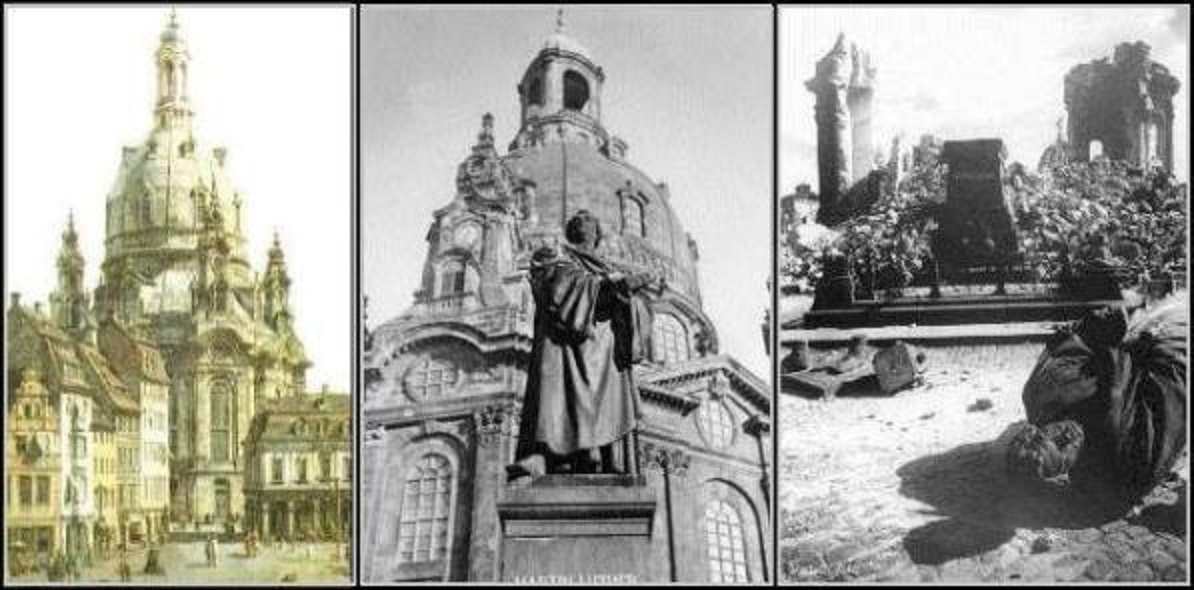
| Lutheran burghers of Dresden were shocked when Saxony’s Elector Augustus the Strong decided to convert from Lutheranism to Catholicism to fulfill his political ambitions and assume the title of King of Poland. When he began to build a pretentious Catholic cathedral across from his palace, the burghers decided to erect a Protestant church which would rival the St. Peter’s Basilica in Rome. The Elector did make 28,000 Taler available to the new church from a collection for the Salzburger emigrants who passed on through to Prussian lands. The magnificent "Frauenkirche" was built in Dresden beginning in 1726 on the site of an old, existing church by that name. Architect George Bähr (1666-1738) was commissioned by the council to design the church. It could accommodate 3,500 worshipers and towered nearly 350 feet over the city, assuming the nickname "die Steinerne Glocke" or "the stone bell". Bähr, one of the greatest masters of German Baroque, did not live to see the completion of his greatest work. It was the most important example of protestant church architecture in the world and it stood as a monument to the steadfast faith of the Reformation for over two hundred years. Dresden was always city of great music in a land of great music. Among many other musicians who visited or lived in Dresden was Handel who visited in 1719. The acoustics in the domed structure of the Frauenkirche with its 3,200 seats are said to have been very good. In 1733, when Bach was music director in Leipzig, the old Elector of Saxony died. The new elector, Friedrich August II was to take his place in Dresden, and Bach took this opportunity to obtain the favor of the new court and perhaps be granted the title of court composer. He presented the new elector with a new composition, a setting of the Missa containing a Kyrie and Gloria later used as the first major section of his famous Mass in B-minor. The Missa was performed here in 1733, and on December 1, 1736, Bach gave the first organ concert in the Frauenkirche on the newly constructed Gottfried Silbermann organ with its 48 registers and 2,667 organ pipes. It attracted much attention. Bach was granted the title of "Hofkoponist". On the morning of April 15,1945, in the aftermath of the bombing of Dresden by both the British and Americans, the dome collapsed and the church was gone. The beautiful bronze Luther Monument by Ernst Rietschel at the church was thrown violently from its pedestal. The post war Communist E. German government plunked the damaged Luther in front of the rubble and refused to allow reconstruction of the church. It lay untouched for 45 years. |
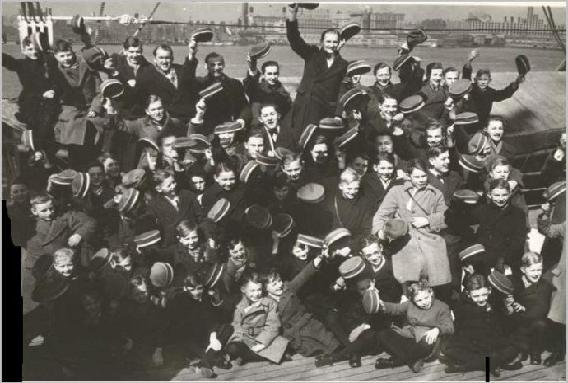
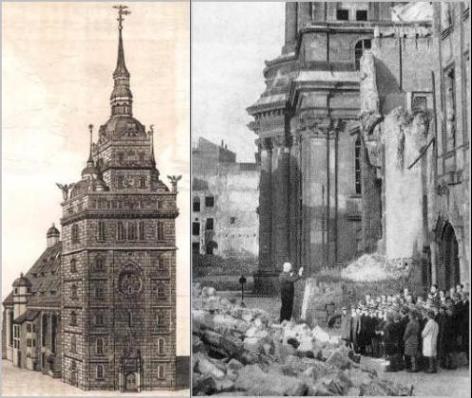
| Of course, there were other churches in Dresden that receive less attention. The Austrian wife of Henry the Illustrious brought a piece of the true cross with her as a gift to Dresden in the year 1234. It was initially kept in the Church of St. Nicholas, the oldest church within Dresden's city walls, in a "chapel of the holy cross" which was built for the occasion. Later, the entire church was named for the chapel, ‘zum heiligen Kreuz.’ It was officially dedicated on June 10, 1388. Since 1491, it has burned down five times: once in 1491, then in a city fire in 1669, again during the Seven Years' War in 1760, again in 1897, and in 1945. The Kreuzkirche is the largest church in Saxony, and home to the Dresdner Kreuzchor boy choir.A boarding and music school for boys was founded around the year 1300. By the 17th century, in conjunction with musicians of the Saxon court, their choir performed at the court opera house. Until the end of the 19th century, the Kreuzchor also took part in services in both the Sophienkirche and the Frauenkirche and they were pictured in various works of art and sculpture. Both the Kreuzkirche, its academy, the Kreuzschule, as well as 11 boys fell victim to the bombing of Dresden. Other boys. both former and current members, died in the line of duty as soldiers serving their country. Below left: the Choir on a trip to New York City in 1939; left: the church in 1600s; The first postwar vespers in front of the ruined church on August 4, 1945. The choir had no home for 10 years (click) Added to the terrible loss of its choristers, the famous choir also lost its Neogothic choir school on the Georgplatz, its music/archive library and the ancient church itself. Only the tower and exterior walls of this, yet another, German architectural masterpiece were saved. |