| Erkelenz is today a town in the district of Heinsberg. Erkelenz was first mentioned in a document in 966 as Herclinze, and as Erkelenze in 1118. It received town rights from the count of Guelders in 1326. The area of Erkelenz was an enclave of the duchy of Guelders in the old duchy of Jülich. |
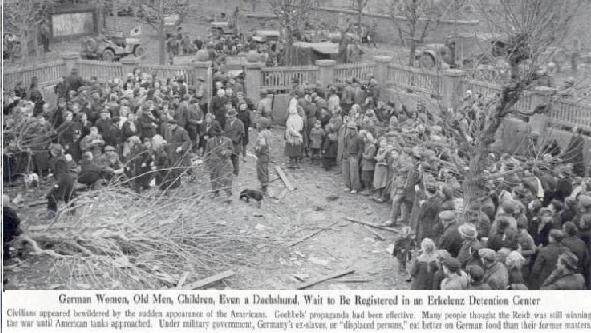
| US Military photo of German women, old men and children waiting to be registered at the Erkelenz Detention Center. The caption sarcastically notes that "under military government, Germany's ex-slaves, or 'displaced persons', eat better on German food than their former masters." Indeed. During the war, Erkelenz was gradually evacuated like many other towns in the Aachen area. By the end of March 1945, there were about 25 residents left in Erkelenz, mostly older people who were not mobile or folks with nowhere else to go. During the invasion of Allied troops, the few remaining residents of Erkelenz-Hetzerath and the surrounding villages were forced out their homes. The U.S. Army then freed the prisoners of war, mainly Russians, in March 1945 and they were allowed to go into the small, empty village where up to 7,000 people, men, women and children had called home. An American guard was stationed in one of the houses, but nothing was done to stop the prisoners from looting. They also robbed the inhabitants remaining in the surrounding villages and some German civilians were shot dead. In early May 1945, the US concentrated the returning villagers in the former work camp while their home were plundered, demolished and in many cases lit on fire. Those villagers deemed by the Allies to be NS and/or collaborators were conscripted to remove rubble and clean up the city. But the other people, especially farmers and the youth helped rebuild their destroyed city. It was not until 1947 that civilians here received extra food and care packages, mostly from German-Americans. Besides the gradually returning displaced residents, expellees from the German eastern territories came in the 1950s. It was not until 1956 and 1957 that the population began normalizing as its POWs were finally released from captivity. |
| Erkelenz-Hetzerath |