| Creating War: Events Leading to the War |
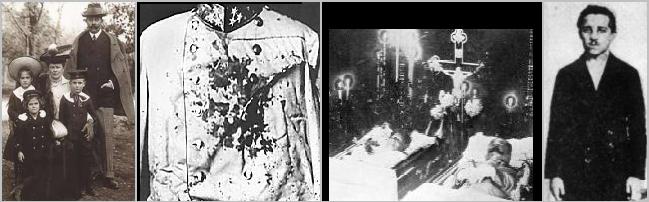
Below: Franz and his family, Franz's bloodied tunic, Franz and Sophie in state and the killer Princip
| The cards were being stacked for war. All that was needed was an excuse which would be palatable to the public. After various machinations and intrigues, a pretext finally emerged when the heir apparent to the throne of Austria-Hungary was murdered in cold blood by a nationalist Serb. In response, Austria- Hungary declared war on Serbia on July 8, 1914. The list of possible Habsburg successors had grown shorter and shorter. After the death of his only son and his brother, the succession passed to Franz Josef's other brother, Karl Ludwig, and after his death in 1896, it passed to his brother's eldest son, the decent and popular Archduke Franz Ferdinand Karl Ludwig Josef von Habsburg-Lothringen, born in 1863 in Graz, Austria. After the typically strict education, Franz Ferdinand entered the army with the rank of third lieutenant. His greatest passion was hunting and it is estimated that he shot more than 5,000 deer in his lifetime. He was also an avid traveler. He became the heir-apparent following the death of Crown Prince Rudolf in 1889 and that of his father in 1896. Franz Ferdinand was, through a series of inheritances, one of the wealthiest men in Austria and very well-liked among the people. In 1899, with a reluctant nod of approval by Emperor Franz Joseph, he wed Sophie Chotek von Chotkova, a Slav who was not of royal birth, after a two year secret relationship. He was permitted to marry her only on the condition that their descendants would not have succession rights to the throne. The Emperor was not enthused and did not even attend the wedding. Sophie was not expected to be a prominent wife, but she and Franz Ferdinand were happy in their marriage and he was a devoted father to their three children. Just shy of their fourteenth wedding anniversary on June 28th, 1914, Franz and his wife were invited to visit Sarajevo. Sharing an open-topped limousine with Bosnia's military governor, they were riding in a motorcade through generally warm and welcoming crowds in Sarajevo unaware that they were targeted for death by seven tuberculosis infected assassins who were part of a Serb-Bosnian nationalist/terrorist organization called "Mlada Bosnia". The men had been given pistols and bombs by another nationalist Serb group, the Black Hand. The first gunman didn't get a clear shot of the motorcade and ran off. The next assassin threw a bomb which hit and destroyed the next vehicle, wounding the passengers. This assassin jumped into a river but was captured. Ferdinand and the rest of the procession reached the town hall and after attending the reception rushed to see how the wounded party was doing. Unfortunately, they took the wrong route, one which took them directly in the path of assassin Gavrilo Princip who was sitting in a nearby café. Seeing his opportunity, he rushed up to the car and shot twice, hitting the Archduke in the jugular and Sophie in the abdomen. As he was struck, Franz Ferdinand begged Sophie to live, uttering “think of the children!” They were taken to the governor's residence but quickly died of their wounds. The whole Empire was in a state of shock and disbelief at the despicable act of cowardice. Austria's declaration of war against Serbia would normally have been regarded as a valid reaction. But Russia, claiming to be "bound by treaty" to Serbia, eagerly announced mobilization of its huge army squarely in Serbia's defence. Again, this would normally be construed as an act of war, and it caused Germany, allied to Austria-Hungary by treaty, to declare war on Russia on August 1st. While Russia had been mobilizing, the Russian War Minister gave his word of honor it was not. The Kaiser, meanwhile, begged his cousin the Czar to halt mobilization and Wilhelm reminded him of his pledge to his dying grandfather to keep peace with Russia. He also reminded his cousin "Nicky" that Germany had consistently helped Russia, and of their personal friendship. It was in vain. France, who was historically hostile to Germany, claimed she was "bound by treaty" to Russia and responded by announcing war against Germany and, by extension, on Austria-Hungary on August 3. After Belgium refused to allow Germany's free and safe passage, Germany responded by invading "neutral" Belgium on August 4th so as to reach Paris by the shortest possible route should her defence require it. The Germans had valid arguments justifying what most modern historians consider an invasion of Belgium: that Belgium's neutrality was first violated by France; Since Belgium's neutrality had been guaranteed in an 1839 treaty by France, Britain, Prussia, Russia, and Austria, Belgium behaved unneutrally by cooperating with the British and by not planning a defense against a French invasion. Nor did it reach a neutrality agreement with Germany. Germany had in its possession a cache of documents from the Belgian Defense Ministry which referred to 1906 meetings between the British military attaché and Belgian officers to discuss British intervention in Belgium in the event of a Franco-German war, plans which Germany interpreted to mean Britain had plans to violate Belgian neutrality herself, not to mention the fact that France had guns and troops in Belgium by July 30 and the British had landed in Ostend the same day, facts which went unreported in most American papers. Japan, "honoring a military agreement with Britain", declared war on Germany on August 23, 1914. Two days later Austria-Hungary responded by declaring war on Japan. Italy, having nothing to do with anything, although allied to both Germany and Austria-Hungary, found a cop-out clause and declared neutrality until May 1915, when she finally sided with the Allies against her two former allies. The United States had absolutely no logical reason to become involved at all and did not, and except for the few who stood to profit from war, almost her entire population joined in this attitude. |
| Marching to Prevaricate: The Hate Mill Starts Spinning Faster |
| Immediately upon the outbreak of War, the British government set up a War Propaganda Bureau (WPB) at Wellington House and Lloyd George appointed fellow Liberal MP Charles Masterman to head the shadowy organization created to fan the long simering war fever even more in Britain. In September, 1914, Masterman invited twenty-five leading British authors to discuss ways of best promoting Britain's interests during the war. Those who attended included Arthur Conan Doyle, Arnold Bennett, John Masefield, Ford Madox Ford, William Archer, G. K. Chesterton, Sir Henry Newbolt, John Galsworthy, Thomas Hardy, Gilbert Parker, G. M. Trevelyan, H. G. Wells and of course, Rudyard Kipling, inveterate Hun-hater and infamous apologist of the (British) colonial enterprise. All of the writers present at the conference were sworn to secrecy, and it was not until 1935 that their full activities became known to the public. Most had already been working for war. There were estimated to be 60,000 Austro-Hungarians, Germans and Turks in the country as well as 8,000 other citizens of "enemy birth". Inflamed by the intense propaganda, Germanophobia swept across Britain like a firestorm and mobs attacked German shops, homes and churches. 57 German civilians were killed during anti-German riots in Peterborough, London, Keighley, Newcastle, Liverpool, Manchester and elsewhere and the riots continued until the nation-wide riots in May, 1915. Rioting in London actually resulted in a local shortage of bread after so many German bakeries were vandalized, with bags of flour dumped and loaves of bread smashed. In some cities, naturalized Germans were pressured into signing statements stating their desire to see "Britain win and Germany crushed". Some newspapers called for the government to deport all German or Austrian citizens and many faced internment. The hate even extended to names which simply sounded German. One mob smashed all of the windows of a pub because they thought the Scottish landlord's name "Strachan" might be German. It was likewise in Britain's crown dominions. Germans were stripped of their civil rights, fired from their jobs, jailed as spies or deported. Their churches and schools were closed down and they were cheated out of their real estate and businesses. Wellington House relied mainly on pamphlets in the first part of the war. Although it used the press more extensively later, pamphlets were still prioritized because it was hard to disguise the official nature of a press article. There was even a small charge for the pamphlets because, as one modern writer observes, "people do not like to think they would buy propaganda." They published over 1160 inflammatory pamphlets and books between 1914 and 1918 including: 'To Arms!' ( Doyle), 'The Barbarism in Berlin' (Chesterton), 'The New Army' (Kipling), 'The Two Maps of Europe' (Belloc), 'Liberty, A Statement of the British Case' and 'War Scenes on the Western Front' (Bennett), 'Is England Apathetic?' (Parker), 'Gallipoli and the Old Front Line' (Masefield), 'The Battle of Jutland' and 'The Battle of the Somme' (Buchan), 'A Sheaf and Another Sheaf' (Galsworthy), 'England's Effort and Towards the Goal' (Ward) and 'When Blood is Their Argument' (Ford). One of the first pamphlets to be published was the 'Report on Alleged German Outrages' at the beginning of 1915 about the German Army allegedly systematically torturing Belgian civilians. Conan Arthur Doyle, when he wasn't trying to convince people of the reality of fairies, borrowed much of the same material he'd used with success when writing sensational accounts of the atrocities in the Belgium Congo a few short years before, such as the nasty Belgians cutting hands off of the Congolese. Doyle simply revamped the stories into Germans cutting off the hands of Belgian babies. By 1917, Wellington House, had 54 staffers. Its governing body met daily and included advisors such as Arnold Toynbee and Lewis Namier. Namier (1888-1960) was born in Poland and wrote such notable books as "Structure of Politics at the Accession of George III" and "England in the Age of the American Revolution". Toynbee (1889-1975) was a prolific author and pamphleteer during the War regarding "alleged German atrocities". Toynbee drew heavily on The Bryce Report for his own "The German Terror in Belgium: An Historical Record". He wrote a similar book on the massacre of the Armenians. He would work for the Foreign Office during both World Wars. Among Americans who took up the English cause was Dr. Charles W. Eliot (1834-1926), former President of Harvard. Masterman picked Canadian Sir Gilbert Parker to direct British propaganda toward the States. He manipulated American war correspondents operating out of London by, among other means, arranging staged tours of the front. He farmed through "Who’s Who in America" to build a 200,000 name mailing list of influential Americans to whom he provided articles, pamphlets and speeches on war topics written solely from a British perspective. He and his staff also provided substantial war related materials to 555 American newspapers and hundreds of libraries with full approval of the allegedly neutral US Government. Over the next two years, 90 artists also worked for Masterman creating propaganda illustrations. He arranged for whole teams of artists to visit France, but only British officers were allowed to take actual photos of the Western Front, the penalty being the firing squad for anyone else, and photos of dead British soldiers were banned. On September 11, 1914, the British four part Press Bureau and the Home Office had formed the Neutral Press Committee to disseminate news to friendly and neutral nations under G. H. Mair, former newspaper assistant editor. He collected summaries of foreign news to track changes in public opinion overseas to help his propagandists. He divided the "Neutral Press Committee" into four parts to "exchange news services between British and foreign newspapers; the promotion of the sale of British newspapers abroad. . ., the dissemination of news articles among friendly foreign newspapers and journals; and the transmission of news abroad by cables and wireless." This move allowed neutral journalists to write their own articles after they were spoon fed "official information" and it helped American journalists to camouflage their sources, thus making propaganda seem credible. The Admiralty outstripped the War Office, and Director of Naval Intelligence Sir Reginald "Blinker" Hall and Captain Guy Gaunt led in the organization of propaganda. Gaunt was head of Naval Intelligence in the US and a liaison to Wilson’s advisor Colonel Edward M. House who told the British Foreign Secretary Arthur Balfour: "I want to express my high regard and appreciation of Captain Gaunt. I doubt whether you can realize the great service he has rendered our two countries. His outlook is so broad and he is so self-contained and fair-minded that I have been able to go to him at all times to discuss, very much as I would with you, the problems that have arisen." Gaunt’s occasional replacement liaison was William Wiseman, head of British Military Intelligence in America, and he acted as a conduit between House and Lord Balfour upon America’s intervention. The Parliamentary War Aims Committee in Britain fed the British public a diet of outright lies which were in turn regurgitated to the American public. In 1915, a committee of six British lawyers and 'historians' under Lord Bryce came out with the 'Bryce Report' into alleged German atrocities. James Bryce had served as the British ambassador in Washington from 1907 to 1913, and was quite popular, therefore his report seemed very credible. The Bryce Report was released on May 13, and British propaganda headquarters in Wellington House ensured it went to virtually every newspaper in America, complete with Louis Raemaeker's gruesome illustrations which advertised the fake report. The Bryce Report showed Germans beheading babies and eating their flesh, and contained, among other yarns, stories of how German soldiers sliced off girls' breasts and executed Boy Scouts. "Eyewitness" accounts told of Germans dragging 20 young women from their homes in a captured Belgian town, stretching them on tables in the town square where each was raped by at least twelve "Huns" while the other soldiers watched and cheered. One group of Belgians toured the United States at British expense to repeat these filthy fabrications, and a solemn Woodrow Wilson received them in the White House.... despite knowing full well that American reporters travelling with the German army had vehemently denied these stories! The impact was astronomical. Translated into 27 languages, the hate-mongering, deceitful "Report" helped sway millions of Americans and neutrals to the British side by creating blind hatred of both Germany and her people. The report, later entirely discredited, relied only upon vague, sensational, second-hand atrocity stories about what was taking place in Belgium in unverified depositions never taken under oath from 1,200 Belgian refugees and Allied soldiers. There was no on-site investigation of any report, nor was even one single witness identified by their real name. It screamed, 'Murder, lust and pillage on a scale unparalleled in any war between civilised nations during the last three centuries' and read like a dime novel. The "enquiry's" other main source was (allegedly) captured German war diaries, most of which were obvious forgeries. |
| "However the world pretends to divide itself, there are only two divisions in the world today... human beings and Germans." Rudyard Kipling June 22, 1915 |
| Within days of the outbreak of war, the British cable ship Telconia cut the direct subterranean cables linking Germany with the USA. That and the British blockade of Germany made the distribution of German news and books difficult. American newspapers became almost completely dependent on British sources for war news and Britain began sending thousands of crates full of pro-war pamphlets and books to public libraries across America. The push was on to totally dehumanize the Germans. |
| From first news reports, Sophie jumped up and tried to shield her husband from the gunman |
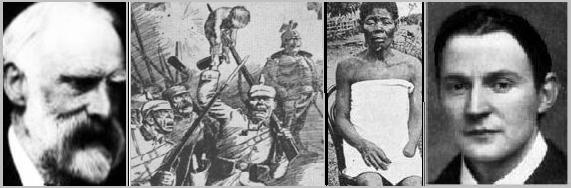
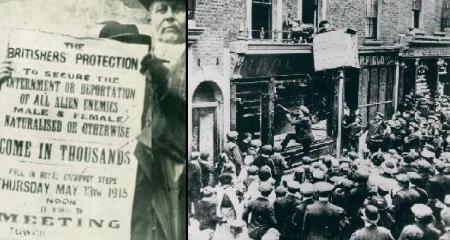
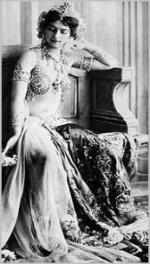
| .Below: Riots. Bryce, Masterman, Mara Hari |