| The Genocide Against Germans in East Prussia |
| "Kill!Kill! In the German race there is nothing but evil. Stamp out the fascist beast once and for all in its lair! Use force and break the racial pride of these German women. Take them as your lawful booty. Kill! As you storm forward. Kill! You gallant soldiers of the Red army." Ilya Ehrenburg |
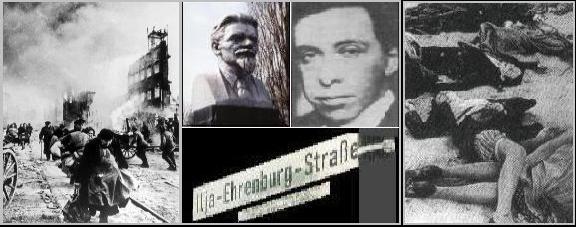
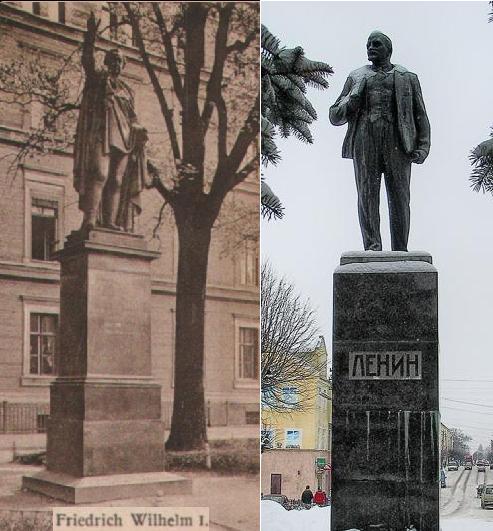
| By February of 1945, thousands upon thousands of panic stricken refugees who managed to survive the grueling exodus from the eastern regions flooded into Dresden and other towns and cities seeking shelter and help. On the 14th and 15th of February, Dresden was incinerated. Virtually every city that refugees were known to have flocked to, from Kiel to Swinemünde, suffered from major catastrophic Allied bombing attacks as part of "Operation Thunderclap" and "Operation Clarion" at the hight of their exodus. Two Allied air raids were carried out on the old city of Königsberg on August 26/27 and August 29/30, 1944 based on "misinformation" from Churchill that it was a "a modernised heavily defended fortress." 90% of the city of Kant was absolutely destroyed and it burned for several days. The entire historic city center, including the cathedral, the castle, the old churches, the old and the new universities and the old shipping quarter were entirely destroyed. After the Red Army's capture of Königsberg under General Chernyakhovsky, the wreckage of the city was cordoned off and turned into a giant internment camp, then a mass grave. The Red Army immediately and methodically set about erasing any trace of former German presence, starting with the human beings who did not or could not get out in time. Out of Königsberg's prewar population of 316,000, an estimated 50,000 to 75,000 people were still present in the ruins of the devastated city on the day of capitulation and thousands did not survive the communist orgy of bloodshed and revenge. Many that did survived murder soon met their end by starvation, disease and freezing to death. Probably no other German city paid so cruel a price for defeat. 90,000 German military prisoners were also taken, almost none of whom were never heard from again. During January and February of 1945, the "evacuation" of surviving German began, including those who had returned to reunite with or save their families. Almost two years later, in October of 1947, there were still 30,000 Germans in the city and they were shipped by trains to the future GDR or sent to Soviet gulags. In February of 1948, the Ministerial Council of the USSR decided to "resettle" all remaining Germans they discovered in East Prussia to the GDR, officially declaring them illegal residents. According to Soviet sources, 102,125 persons were "resettled" to the GDR in 1947 and 1948, but only 99,481 arrived (GDR authorities attributed this to "perhaps a Soviet calculation error.") In May 1951, another 3,000 East Prussian were shipped to the GDR. These last remaining German residents were expelled in more ethnic cleansing of 1949-50. Thousands totally vanished and are presumed murdered. Below: Victims of Allied bombing; Kalinin, Ehrenburg; Street sign in today's Rostock, Germany; Victims of the Red Army; Right: The monument in Gumbinnen, East Prussia honoring Prussian King Friedrich Wilhelm 1, who offered a homeland to thousands of refugees from all over Europe was replaced by a monument to a Red Army general (click) |
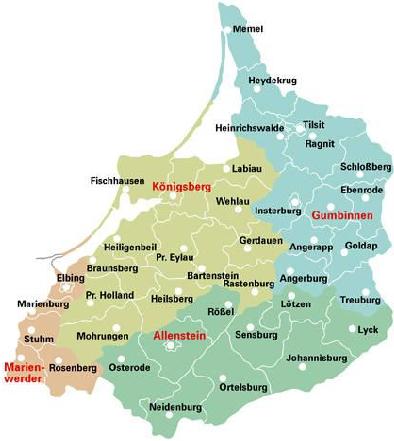
| German cities and towns were neglected or demolished and the place names all changed. Königsberg, founded in 1255, was renamed Kalingrad in honor of a murderous Soviet thug who never stepped foot in the city. In July of 1945, northern East Prussia became part of the USSR and in the autumn the first Soviet settlers arrived from Russian, Belarus and the Ukraine. The city of Kant was doomed, and the beauty that had come with wisdom, age and grace was to be poorly remodelled. The 800 year old Königsberg castle was dynamited to make way for the hideous 22-story "House of Soviets," however the castle had contained many underground tunnels and the building above began to slowly collapse. Because of Kalingrad's use as a navy base, there is nuclear pollution and the city bore grave contamination from the Chernobyl disaster. Its streets are crime and drug infested, filthy and stinking, and it has one of the world's highest rate of AIDS. The German inhabitants who settled these deserted plague and famine devastated lands and made the area their home for centuries, working the land, raising their families and building canals, villages, homes, schools, churches and businesses, were brutally driven into exile with their farms and properties all stolen by force. They are referred to in contemporary Russian and Polish travel guides as "the German invaders". Any evidence of the region's long Germanic heritage was carefully obliterated. Russia even claims the great German philosopher Kant as "one of their own". In the late 1980's some ethnic Germans arrived, most driven out of other parts of the USSR, and by 1991, 5,000 ethnic Germans inhabited the city and 13,000 the region. Closed off to foreigners since WWII, the Kaliningrad region, about one half the size of Belgium and some 200 miles away from the border of Russia proper, was reopened on January 1, 1991 when the first direct train since 1945 ran from Kaliningrad to Berlin. After the fall of the USSR when neighboring Lithuania and former Soviet republics gained their independence, Kaliningrad had been cut off from Russia. Although railroads connect Kaliningrad to Russia though Lithuania and Belarus, high tariffs in Lithuania make importing food and supplies from Russia prohibitively expensive. Kalingrad was declared a 'free economic zone' in 1992 in a futile attempt to revive the economy. It never developed into a "Hong Kong of the Baltic" as some desired, and corruption keeps most investment away. Approximately 400,000 people live in metropolitan Kaliningrad and a total of one million are in the "oblast" but not those people who bravely settled the land hundreds of years ago. The name "Prussia" was formally expunged from international language by order Number 46 of the Allied Control Commission on February 23, 1945 because, as it incorrectly stated: "Since time immemorial it has been the pillar of militarism and reaction in Germany." Lost in this heroic rhetoric was the fact that Prussia was also the "pillar" of historical religious tolerance lacking in its European neighbors, and a pillar of hospitality in its offering of a new, free, undiscriminating homeland for persecuted refugees from Scotland, France, Austria and elsewhere throughout its history. Prussia was also a "pillar" of musical genius, the arts, science, philosophy and medicine. Prussia as a state was far less aggressive and warlike than Britain, France or Russia, and certainly less adept at gobbling large areas of the earth and subjugating native populations by enforcing blood thirsty colonial rule on anywhere near the scale of her neighbors. Prussia's history did not include murderous suppression of minorities, profiteering from slave trading or using hunger blockades and enforced famine to inhumanly starve out its enemies. Nor did Prussia ever encourage the exile, rape or burning alive of millions of women and children non-combatants in wartime. |
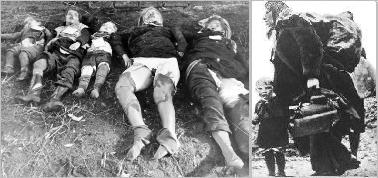
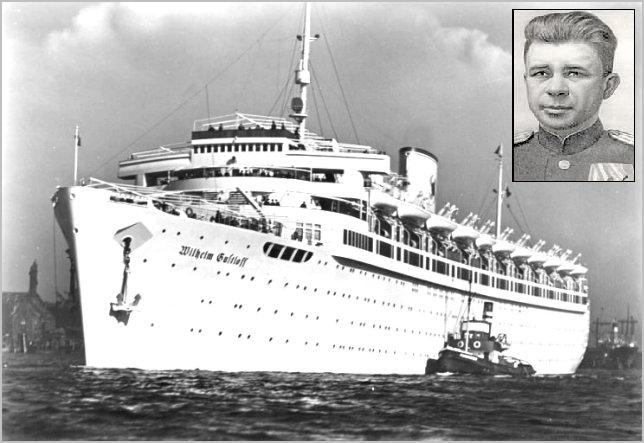
| In August, 1944, news got out that in the East Prussian villages of Nemmersdorf and Goldap, the Red Army had raped, tortured and murdered all of the inhabitants down to the last baby. In Nemmersdorf, reporters from Switzerland and Sweden were present when the grisly atrocities were uncovered. In barns, houses and sheds where the Red Army had discovered civilians hiding, they had not only machine gunned them but had thrown hand grenades into the groups. 95 German civilians were murdered in this bestial fashion in the Nemmersdorf area of Schulzenwalde, above. Below: Swiss journalists photographed bodies of two raped and murdered German women and three children also murdered by the Red Army in Metgethen, East Prussia, another plaec of slaughter. This scene soon played out in West Prussia, Pomerania, Silesia, the Sudetenland and other areas of eastern Europe. The Red Army was cajoled to behave in Germany "as Mongolian hordes of old" by Stalin's propagandists, among whom was the grand master of hate, Ilya Ehrenburg, who encouraged troops to injure, torture, rape and kill all German civilians. As the violence spread, the only option for the endangered East Prussians was to flee, and they would face uncounted scenes of terror. In an article of March, 3,1945 Ehrenburg emphasized that the "historical mission of the Soviet army consists in a modest and honorable task of reduction of the population of Germany." Ehrenburg whipped the Red Army into such a pathological fury of hatred that by the time they arrived in East Prussia it was easy to rape and kill the mostly female population. There were reports of young women in East Prussia having been crucified on barn doors, tied up by their legs and torn in two by cars, or groups of naked girls being tied to a rope like fish on a line and dragged behind wagons, or of small groups of children being found with their tongues nailed to tables and lifeless babies discovered with their skulls broken and bodies punctured by bayonets. It is said that every captured woman between eight and eighty was violently raped, most multiple times and many were killed after. "The Germans are not human beings. From now on the word German is for us the worst imaginable curse and strikes us to the quick. We shall not get excited. We shall kill. If you have not killed at least one German a day,you have wasted that day....for us there is nothing more joyful than a heap of German corpses." IIya Ehrenburg. In the winter of 1945, East Prussia was cut off from the west, the only escape route for many being from the small port of Pillau and over the Baltic Sea toward the west. Throngs of desperate Königsberg civilians had only one way out, a frigid walk over half frozen lagoons to Frische Nehrung, a narrow slice of land, from where they hoped to reach Danzig. Almost a million people are said to have tried this perilous crossing. Survivors later recounted the hopelessness and horror of making this deadly trek in the dark as whole families pulling carts and sleds filled with children and the elderly slid into holes in the ice and plunged into the unforgiving sea. In daylight, Soviet planes circled overhead and intentionally cut off large ice floes with artillery fire, sending them hopelessly adrift. Those who escaped on land joined an endless parade of stunned, bereaved people on overflowing roadways. They witnessed whole cartloads of people crushed and mowed over by advancing Russian tanks, with wailing children and frantic mothers stretched for mile after mile of human misery. Unprepared for the 60 degree below zero wind chill and deep snow, some turned back home in despair. Blazing farms lit up the horizon, burned by the Red Army or set on fire by hopeless owners who then committed suicide. This was the "orderly and humane expulsion" of Germans that Churchill, Roosevelt and Stalin shook hands to. More than 1.9 million of nearly 2.4 million East Prussians joined by Germans from central Poland fled westward under horrible conditions. 173,000 people could not or would not leave. Later, researchers of the Federal Archives counted 3,300 locations just in areas they had access to where at least 120,000 German civilians were either shot or beaten to death by the Red Army. "The German 'good fellows', those who at home give way to sentimentalities, piggy-backs to their kiddies and feed the German cats with morsels of their rationed hamburgers, murder Russian children with the same pedantry as do the bad Germans. They murder because they have come to believe that only people with German blood are worthy of living on this earth of ours." Ehrenburg The Germans initiated "Operation Hannibal" to withdraw German civilians and troops from East Prussia. Beginning on January 21, 1945, it ended up being one of the largest emergency evacuations by sea in history and one of the German Navy's most significant achievements. In a period of about 15 weeks, between 500 and 1,080 merchant vessels of all types and numerous naval craft, including Germany's largest remaining naval units, transported about 900,000 refugees and 350,000 soldiers across the Baltic Sea to Germany and occupied Denmark. But not all rescues were successful. The Wilhelm Gustloff was a 25,000-ton passenger liner. On January 30, 1945, when it steamed out of Gotenhafen, it carried a crew of 1,100 officers and men, 73 critically wounded soldiers, 373 young women of the Women's Naval Auxiliary and more than 6,000 desperate refugees, most of them women and children who had reached the safety of the ship after grueling personal ordeals. The Gustloff was 13 miles off the coast of Pomerania when 3 torpedoes from a Soviet sub under the command of Captain A.I. Marinesko, struck the ship. 90 minutes later it sank under the icy waves of the Baltic. Barely 1,100 survived. At least 7,000 Germans died. A few days later, on February 10, Marinesko struck again and sank the German hospital ship the General von Steuben carrying 3,500 wounded soldiers and another 1,000 refugees. Only 650 people survived. Hailed as a hero despite a record of drunkenness and desertion, Marinesko was later awarded the Combat Order of the Red Banner for his record in sinking the most tonnage in a single cruise. He would later be demoted for other offenses and he died in prison. On May 6,1945 the German freighter Goya, also part of the rescue fleet, was torpedoed by another Soviet submarine, and more than 6,000 non-combatant refugees fleeing from East Prussia also died. Below: Wm.Gustloff; Marinesko (click). There is a monument glorifying him in 'Kalingrad'. |

| click |