| A Brief Overview of the Frankonian Colonies |
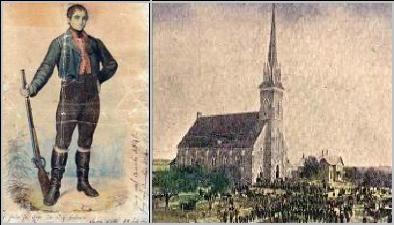
| They soon built a combination church and parsonage and a log cabin school named St. Lorenz after their church at home. In 1846, a second group of about 90 more emigrants journeyed to Frankenmuth. Pastor Löhe then organized the three other colonies in Michigan. Immigration continued through the end of the 19th century as friends and relatives of settlers joined them. Above: settler Lorenz Lösel and the permanent church. Frankenmuth stayed somewhat loyal to its founders’ intentions for over a half century, and remained a culturally isolated German Lutheran enclave. In 1847, there was a religious divide, and many of the Franconians joined with Saxon German immigrants from Perry County, Missouri to form what eventually became the Lutheran Church-Missouri Synod. When the first Frankenmuth settlers boarded the train from Albany to Buffalo, New York on their journey to Michigan, they sang an old German hymn of thanksgiving called 'Nun danket alle Gott' |
| Frankentrost |
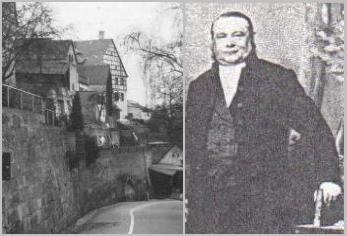
| Meanwhile, hearing of the success of Frankenmuth and answering Löhe's call, about 60 more Frankonian men, women and children decided to go to America, including a couple of Joseph Schaitberger's descendents. In anticipation, they sent a total of about 6,000 guilders to Pastor Crämer in Frankenmuth for the purchase of land. The first of this group left Nürnberg on Palm Sunday, March 27, 1847 and contained the following members: J.P. Schlenk and wife, Adam Wißmüller and wife (Margaretha Schaitberger) and two children, Michael Huber, wife and two children, George Wißmüller, Christian Frisch and wife, Conrad Munker, wife and daughter, Ludwig Reinbold, wife and three children, and the widow Jäckel. The group spent the first night in Kulmbach and met with Pastor Johann H.P. Gräbner. On Thursday they reached Hannover and on Friday, Bremen. In Bremen, they spent eight days at the “Black Horse Inn.” On the Sunday after Easter they came to Bremerhaven, hoping to set sail on the “Hermine” April 18, but when that ship did not appear on time, they took another ship, the “Creole,” instead. After a rough voyage and tedious journey to Michigan, they reached Frankenmuth where they were offered housing and assistance until they purchased their own land and built cabins in Frankentrost. According to instructions from Pastor Löhe, Frankentrost was to be no less than six miles from Frankenmuth. A surveyor was hired who recommended that they settle the land about seven miles to the northwest of Frankenmuth and about the same distance from Saginaw. Here they purchased land from the government land office on July 22, 1847 at 77¢ per acre. The colonists of Frankentrost did not scatter their houses on farms as in Frankenmuth, but built them in a straight row like a German “Weiler” as Löhe had perceived. A main street ran from east to west and the cabins were built about two rods from this road on the north and south side of the Frankentrost portion of Blumfield Township. Georg Schaitberger bought acreage immediately to the west and operated a stagecoach. The close arrangement of the houses in Frankentrost made it necessary for the individual farms to be a mile long. Church, School and parsonage were in the center of the colony and 56 acres were set aside for church property with 40 acres for the parsonage. To pay for these 96 acres, each settler was to contribute the price of every twentieth acre that they owned. The wives and children of the Frankentrosters remained in Frankenmuth for the first summer and autumn, and by the end of October, after the clearing of the forests and building of crude, clay floored cabins, the whole colony could move to its new location. Soon, after their savings were extinguished, many Frankentrost men found it necessary to work in saw mills to earn a living, alternately spending a month on their farms and a month in a mill. In the first year, a road was laid through the village and 100 acres of timber cleared, so that by the spring of 1848, the first crop of corn, potatoes, wheat, and vegetables was grown, only to be killed by drought. Many babies died in the first years and one settler lost his life when a tree fell on him. Swamp fever was prevalent in the beginning, and the nearest other homes were six miles away on a rough, overgrown road to Frankenmuth through the thick forest. A new road was built the following year, but necessities still had to be purchased in Saginaw or Flint, and frequently it was all but impossible to get through to those towns. The colonies soon had their own flour and wood mills and were industriously making a living. New houses, churches and schools were built and the forests turned into fertile farms. Eventually, the railroad would come to the area, changing the face of business and travel.The Flint & Pere Marquette Railway was organized January 22, 1857 with construction beginning in 1861. The road was completed from East Saginaw to Mount Morris in January 1862, Flint in 1863 and Midland in 1867. The entire area of old Mittelfranken was tight-knit and included many people of Salzburger descent. George Veit Schaitberger, below, a descendant of Joseph Schaitberger, was the Minister in Rosstal from 1850-1863. Many of the folks in the Frankenmuth area heard bad news from home in 1866. The largest disaster since the Thirty Years War had hit in Rosstal: the collapse of the old castle wall which was then 30 meters high, double its current height. In the course of time, water pressure collecting behind the wall had loosened the rock and on the night of March 15/16, 1866 the largest part of the wall collapsed and destroyed two houses, a barn and 2 other buildings. |
| The bravery and sacrifice of these early settlers cannot be understated. They left their homes in Germany knowing they would probably never see their loved ones there again. They faced long and dangerous sea voyages and often land journeys just as brutal. When they arrived after dangerous ordeals, they found wilderness. The forests were thick and abundant with wild animals, the comforts they enjoyed in their homeland were absent, and medical care, food, clothing and other basic needs were not to be found. Injury, sickness, and death were commonplace for settlers. They suffered physical injury, gunshot wounds, burns and were killed by falling trees. Animal, insect, and snake bites, overturned wagons, drownings, scurvy, cholera, typhoid, consumption (tuberculosis), diarrhea, pox, infections, including puerperal fever following childbirth, were all commonplace. Many women got their long skirts got caught in moving wheels on emigrant wagons or farm equipment, and were dragged or crushed, as were children. They were tormented by insects, vermin and some perished due to extreme heat, cold, rain, blizzards or lightning. People, especially children, got lost, some never to be seen again. They spoke a language others did not understand, and they came from hamlets called Dinkelsbühl and Gunzenhausen, Wachendorf and Schweinfurt. Often their children died in infancy or at birth, and at times whole families perished together. Yet, they had a strong, abiding faith in their God and formed intense friendships and strong communities that clung together in hard times. Some arrived almost childlike in their optimism, while others came in a frenzy, eager to leave the frightening and uncertain times of revolution behind them. However, they all brought skills with them and in a short time adapted because of their industry, virtue and patience. Out of about 10,000 Frankonians, in the first 35 years of their history, they did not produce one pauper, and only once or twice did one of their community members end up in jail. Even today, the crime rate is almost non-existent and the divorce rate is extremely low among these hearty descendants of Charlemagne. Once in America, very few returned to Germany. Although their common ethnic community bond would last only a little more than a half a century in Löhe's other settlements, and the pledge to remain loyal to their fatherland and to the German language was mostly forgotten, Frankenmuth is still home to many descendants of the original settlers and has an active Lutheran church community. One of two Lutheran churches in town, St. Lorenz has today 4,700 baptized members, five pastors and three organists, and although only 30 to 50 worshipers still show up for the bi-monthly German- language service, unlike most victims of anti-German hysteria in World War One, it somehow managed to survive. There are 500 students in its parochial school, and 98 percent of Frankenmuth’s high school graduates go on to college. The town retained some old charm and created new charm, becoming a popular tourist spot as a "Bavarian" village. The old Frankish dialect is in danger of dying out in the younger generation, however, and most folks here today communicate in High German. Frankenlust is now a subdivision of Saginaw. Frankentrost is a just a church on a broad highway. Frankenhilf, founded to help poor Germans lead better lives, changed its name to Richville to avoid sounding "too German" during World War I. The churches founded by Löhe are still standing and all have either a stained glass window featuring Löhe or his portrait hanging in the church. Frankenmuth has a small exhibit of the original church bells cast for Löhe’s settlers in Nürnberg, Germany, and brought across the ocean for their new church. It is interesting to note that during Prohibition, German "strongholds" were especially vulnerable to the long, dry arm of the law and under constant suspicion due to their apparent genetic attraction for beer, and Germans descended from early settlers in the Frankenmuth area were no exception. Not quite able part with the amber nectar, they simply made it themselves. Zehnder's Frankenmuth hotel was owned and operated by descendants of the first settlers, and they had poured their hearts and souls into maintaining a clean, well-run establishment. Now and then, they would secretly serve some of their home brew to a few local families and even some special out-of-town friends. It all came to a fiendishly brutal end when, on July 30, 1930, near the last chapter of Prohibition, both the Zehnder's and Fischer's Hotel across the street were surprised by a raid of ten armed federal agents. The proprietors were both well-respected town fathers and community leaders with no other offenses of any kind, but when these small town boys went to trial on August 4, 1930, the Judge fined Zehnder an extraordinarily harsh $5,000 and Fischer with the absolute maximum fine of $10,000, although in a spurt of "kindness", he offered to deduct $1,200 from the fines if the offenders were willing to have their beautifully hand-crafted oak bars smashed into schmidtereens, which they were. Fischer's fine was the highest paid in the history of Prohibition in the United States. |
| Seven people, some relatives of settlers in Frankenmuth, were killed on impact. In a document drawn up on the morning after the accident, the events were described in detail. Donations poured in from neighboring villages. The Protestant ministers of middle Franconia also took up a collection. Some settlers sent money from Michigan. The official investigations gave way to some controversy and accusations of negligence since a bulge of the high wall had been observed for 30 to 40 years. When a farmer excavated a portion of the mountain for a new barn, he also noted the weakness, but the municipality responded that the wall simply required a bit of repair and was in no danger of collapse. Then, in 1864, the mountain vibrated violently and people reported it. Also, when the local chimney sweep Johann Schaitberger and a carpenter had done their winter fire-inspection, they noticed the that the castle wall was bowing and complained of it. Again, the municipality expressed its confidence in the wall's strength, the high costs for repair of the wall accounting for some of their hesitation. When after the tragedy it was rebuilt, it was constructed at half the height of the old wall. |
| Twelve young Frankonian men and women were among those who left their German homeland and boarded the ship Caroline in April of 1845 bound for the wilds of America with the vision of forming a mission-hamlet called Frankenmuth, Michigan. Eight of the group were from the village of Roßtal. After saying goodbye to their loved ones and cherished homes, the first tedious leg of the journey took them from hilly, green Frankonia by small boat, canal, train, by foot and by boat again to the Port Of Bremen. Their courage was as great as their enthusiasm. The emigrant ship had hardly left Bremen when four couples of the group were married by Minister August Crämer who accompanied the party. Most of them had tried in vain to get permission to marry at home, but many young couples did not qualify because of the strict governmental marriage requirements which demanded proof of a "safe and independent guaranteed income." Anna Margaretha Walther and Lorenz Lösel, were among the newly wedded. Lösel came from Göckendorf near Schwabach and was until his emigration a coachman at Wilhelm Löhe's parsonage building in Neuendettelsau. It wasn't the greatest honeymoon. The drunk captain's mate grounded on a sand bar in the Weser River and then they had to sail around Scotland instead of through the English Channel because of storms. They had a tumultuous voyage across the Atlantic where they encountered several violent storms, seasickness, the "pox", which killed one child, and they even managed to collide with a fishing trawler. Wind blew them north and they had to dodge icebergs for three days through dense fog. They didn't reach New York Harbor for fifty days. Then, to get to Michigan, they had to take a steamboat and then a train which ended up colliding with a coal train, and then another steamboat. They next took a steamer to Detroit and a sailing ship from there up Lake Huron for a 7 day trip to Bay City where they had to pull the ship 15 miles up the Saginaw River to Saginaw. Four months after they left Germany, the 15 colonists then walked 12 miles through swamps and forest with their belongings in an oxcart to Frankenmuth where they selected an area with slightly rolling hills for their settlement because it reminded them of home. Once in Frankenmuth, on the 680 acres of Indian land purchased from the federal government for $1,700.00, they cleared the land, built up farms and raised families while faithfully tending to their mission of educating the Indians. |
| Frankenlust |
| Reverand Georg Ernst Christian Ferdinand Sievers was a native of Lueneburg in the province of Hannover. In 1833, he entered the University of Goettingen where he studied theology and also attended the University of Berlin and the University of Halle to continue his education. He was ordained in 1847, and in that year he lead a group of Frankonian emigrants to the U.S., settling initially in Frankenmuth. The following year, with financial support from the Franken Society for American Missions in Erlangen, Germany, Sievers turned his attention to a new settlement in Frankenlust; he purchased of 645.7 acres of Indian reservation land from the government in the area which was then a part of northern Saginaw County. This facilitated the arrival of a second group of emigrants to the Frankenlust colony. They held their first service at their newly organized St. Paul Evangelical Lutheran Church on Sunday, June 25, 1848. Sievers spent the rest of his life attending to the needs of the church community he founded. |
| Frankenmuth |
| Frankenhilf |
| As previously mentioned, marriage requirements of the day were very strict in Bavaria, and sometimes a considerable sum of money was required before a couple could marry, money most small farmers could not afford. Consequently, many couples "shacked up" together. Löhe raised money for these common-law families to immigrate, provided they would promise to marry in the eyes of God once they arrived. The families that agreed to Löhe’s offer settled in Frankenhilf. But Frankenhilf had a shaky beginning. Most of the original group of settlers immediately left for Detroit and other areas after arriving in Michigan in 1850, and only two families and their pastor, Herman Kuehn, actually made it to the primitive settlement of Frankenhilf. The settlement consisted of only 6 families before 1852. It was the poorest of the settlements but was helped by the other villages until the farmers could make their own living. The first log cabin church was built and dedicated on September 29, 1853 and the took the name St. Michael Lutheran Church. After that, more families arrived from Germany and the colony grew a bit. Since that time, the church congregation has grown to almost 1,600 members, and continues to run its own school. |