| German Days at the Fair and the Turners |
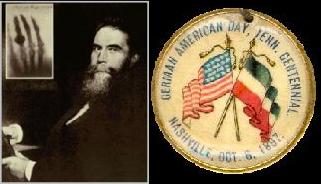
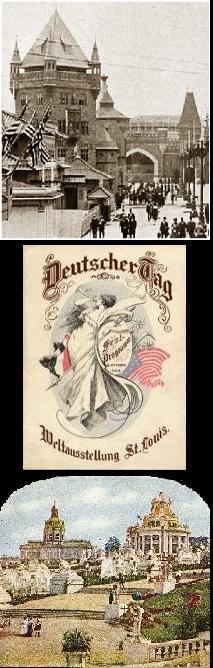
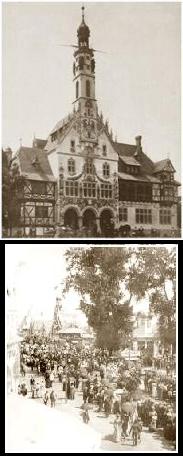
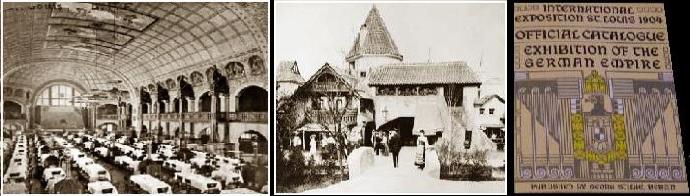
| The late 19th Century was a golden age of the exposition or "World's Fair" and German Americans and the German Empire played a large part in the most popular exhibits and activities. The 1876 Philadelphia Centennial Exposition was the first of its kind in the US. It marked the 100th anniversary of the Declaration of Independence, took ten years to plan and cost more than eleven million dollars. It covered more than 450 acres of Philadelphia's Fairmount Park and drew ten million visitors to see 30,000 exhibitors, the most important of which was Machinery Hall filled with new inventions such as electric lights and elevators. It was here where typewriters, a calculator, Edison's telegraph and Bell's telephone were first seen by the public. The stately "German Building" pictured below drew giant crowds. The World's Columbian Exposition in Chicago in 1893 was more international in scope than any previous fair, and reflected the awesome changes brought on by industry. Chicago built an entire new city for the Exposition called "TheWhite City". Foremost among the foreign structures at the Exposition was the German Building on the shore of the lake. June 15th was German day at the fair. There was also a German village where a replica of Heidelberg castle, furniture and all, loomed above quaint cottages at its base, with old-fashioned German shops and the "Inn of The Golden Bear" with good beer. The verdant prater or park which covered two acres near the Manufactures building was a miniature reproduction of the site on which the Vienna Exposition of 1873 was held.Performances in its concert hall were conducted by the Austrian imperial court's musical director. "The German House" contained a hundred "delicacies of color and ornament that gladdened the hours in Jackson Park". It cost $250,000 and had a cupola which rose to one hundred and fifty feet, a Swiss veranda and Gothic bays. The main portion simulated a chapel by the inner timber-framing and furnishings. The raftered and galleried house was filled with displays of rare books. Representatives from larger cities in the Trans-Mississippi states founded the Trans-Mississippi Commercial Congress in 1894 and these delegates met in Omaha in 1895 where William Jennings Bryant, convinced the group that Omaha was the ideal site for the "Trans- Mississippi and International Exposition" of 1898. On January 25, 1896, the Exposition Corporation was founded with the incentive to help the area rebound after depression and drought. More than $600,000 was raised to finance the building of the exposition on 184 acres of land north of the city donated by real estate developer Herman Kountze. On the opening day of June 1, 1898, nearly 28,000 visitors flocked to the Exposition with its Grand Court of impressive white buildings. Modern technology played a big role in the fair and there were exhibits from 25 states andThere was also a 2,000 foot long lagoon where people could ride on a swan boat or gondola. A special power plant operated thousands of incandescent lights which ceremoniously lit up the fair grounds to the cheers of the crowd. territories. Attractions on the Midway included a "German Village and Scenic Railway". The Tennessee Centennial and International Exposition in 1897 was held in Nashville and also featured German exhibits and a German day. German physicist Wilhelm Konrad Roentgen's new invention of an X-ray machine, discovered only a year earlier, was part the Exposition in Nashville. Roentgen was awarded the first Nobel Prize in Physics in 1901. The 1901 Pan-American Exposition in Buffalo intended to show the connection between the US and the other nations of the Western Hemisphere and to show the benefits of electric light made possible from Niagara Falls hydroelectric power. A greatly successful and popular exhibit was "Alt Nürnberg", left, which replicated several historic buildings in Nürnberg and contained an open-air restaurant and concert area. Within the buildings were reproductions of artwork and other cultural treasures of Germany. President William McKinley was shot here on September 6th by anarchist Leon Czolgosz, who hid in the receiving line with a revolver concealed in a handkerchief. Eight days later, McKinley died of his wounds and Theodore Roosevelt became President. The Louisiana Purchase Exposition in St. Louis, 1904, celebrated the 1803 Louisiana Purchase and intended to demonstrate progress and technological advancement. More than two hundred buildings covered the exposition area of two square miles and its cost of $19.6 million was double that of the Columbian Exposition ten years before. It had the first successful demonstration of wireless telegraphy between the ground and the air in the United States as well as meteorological balloon experiments which sent small balloons up to great heights to record temperatures. The Department of Physical Culture taught the superiority of the Anglo-Saxon "civilized" man over the "primitives" in the rest of the world. As one aspect of the fair, the third modern Olympiad, the 1904 Olympic Games, were brought to St. Louis. More than 3280 Turners took part in exercises and competitions. There was also a 1,000 man German choir. The German House was an accurate reproduction of magnificent Charlottenburg Schloss near Berlin, complete with the grand stairway of the Cascade Gardens. It housed a fashionable restaurant and exhibited rare art treasures and samples of interior decorations sent over by the German Emperor. The Royal Palace contained its own theater which showed scenes from the Oberammergau Passion Play. Another treat was a spectacular Alpine village financed by Adolphus Busch. It had nine acres of mountain scenery and villages, complete with a stream train and twenty one buildings with a statue of Andreas Hofer in the center! Its snow-capped mountains ran a tram ride through the mountain valleys while peasants in native dress performed concerts. It even contained the birthplace of Mozart. The Luchow-Faust Cafe, below left, seated over 4,800 people. The St. Louis Inn, a replica of a German Inn, seated another 2,500 in its first class restaurant, the largest restaurant at the fair. Will Rogers entertained the crowds. |
| The Turner Movement |
| The German American institution known as the Turnverein was an important component of their communities. The Turner movement originated in the early 1800's as part of the effort to liberate the German states from Napoleon's rule. They combined patriotic and liberal principles with an emphasis on physical training. Napoleon might therefore be credited for creating German nationalism. As Napoleon had worn thin on the average German, it is said that even Beethoven, who had written the Eroica with Napoleon Bonaparte in mind, erased the dedication after Napoleon's pompous self-coronation. This mutual German sentiment gave birth to the first wave of German nationalism and to the student associations at German universities known as 'Burschenschaften' with their motto of: "Ehre, Freiheit, Vaterland" (honor, freedom, fatherland).The Wartburgfest, or student festival, at Wartburg castle in October of 1817 was the Burschenschaften's first major appearance, commemorating both the Protestant Reformation of 1517 and the Battle of Leipzig four years earlier which had effectively ended French supremacy in Europe. The word "fatherland" was their motto, Germans began to feel increasingly uneasy with the disparity between sharing one cultural heritage and belonging to one nation but living in 38 separate states. The cry for national unity became louder and created a threat to the established order. The students chose black, red, and gold as the colors for their flags, ribbons and caps,the colors of the uniforms of the Lützower Jäger, a volunteer infantry unit which had distinguished itself in the wars against Napoleon, and also the colors used for the flag of the Deutsches Reich in medieval times (a black eagle on a golden rectangular cloth attached to a red shaft.) Friedrich Jahn, founder of the Turner Society, was associated with this movement. The real impetus for widespread organization of Turner groups in America came from the 1848 revolution that drove so many Germans to America and resulted directly in the U.S.Turnverein founded in Cincinnati in 1848 on Friedrich Hecker's initiative. Others followed in rapid succession and active societies existed from Boston to Richmond in 1850. Although largely a gymnastic society, the immigrants wished to combine their physical education endeavors with efforts to preserve German culture and traditions.In its early days, the U.S. Turnverein was a movement whose principles were comparable with those of German freethinkers' societies. Antislavery, anti-prohibition, and anti-nativism were basic tenets of the Turner movement in America. The Turners were also popular among many progressive non-Germans. The Turnverein offered German-style physical fitness regimes along with ethnic solidarity and support in blending the old and new cultures. The St. Louis Turner Society was a social athletic club that also offered defensive military training because of the violent "Nativist" demonstrations and riots in the mid-1850's against German immigrants in some areas. In one of several large meeting halls, young men were trained in shooting, bayoneting and hand-to-hand combat in addition to gymnastics. Upon advice from Franz Sigel, German-American militias were formed with Sigel himself instructing volunteers. The membership was dedicated to "cultivation of rational training, both intellectual and physical in order that the members may become energetic, patriotic citizens of the Republic." The intellectualism was displayed by lectures and by the establishment of Turner libraries. Immigrants could enjoy colorful militia formations and the Germanic gun clubs, the Schützenverein, or don fanciful uniforms and join companies of German huzzars, fusileers and riflemen. There were many German American cultural organizations in most states aside from Turnvereins, including abundant musical societies. Germans formed choral groups and glee clubs wherever they settled. |
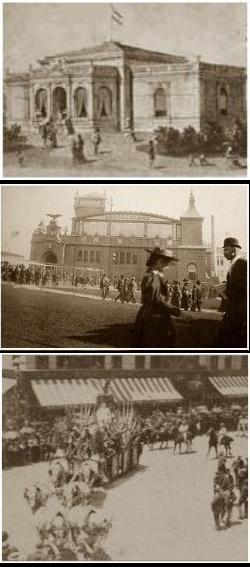
1876 Philadelphia
1893 Chicago
1893 Chicago
Trans- Mississippi
1898
1898
1901
Buffalo
Buffalo
St Louis
1904
1904
St Louis 1904
Tennessee 1897
CLICK