| The Sweet Singer of Lutheranism |
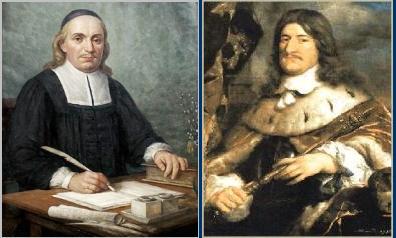
| Paul Gerhardt is considered to be the greatest European hymn writer. Born in 1607 near Wittenberg to a village mayor, he trained as a Lutheran pastor and also tutored the children of Andreas Barthold, later marrying daughter Anna Maria. In 1651, he was ordained as the minister for Mittenwalde where he spent six peaceful years, during which time he began to publish his hymns. They were popular and put into the hymn-books of Brandenburg and Saxony. His reputation established, he was invited to the church of St. Nicholas in Berlin in 1657 where he became a favorite preacher of the city and crowds flocked to hear him. Equally well liked in his private life, he displayed great generosity toward the under-privileged. However, when "The Great Elector" Friedrich Wilhelm of Brandenburg became concerned by the internal warring between factions of the Lutheran church and demanded that the clergy accede to his requests for compromise, a new edict requiring ministers to pledge to refrain from attacking each other's doctrines in the pulpit troubled Gerhardt. Gerhardt met Johann Crüger, the kantor and organist of Saint Nicholas Church in Berlin and together they produced some of the greatest Lutheran chorales. He wrote more than 120 hymns, many of them appearing for the first time in the "Praxis Pietatis Melica" a collection of hymns and tunes by Johann Crüger. The opening page of Johann Crüger's 1656 hymnal 'Praxis Pietatis Melica' began with Paul Gerhardt's hymn, "Wach auf, mein Herz, und singe". After Gerhardt's death, his hymns were republished separately, revised from his own manuscripts by his son. Many of his hymns are well known to English readers, thanks to translations by John Wesley and others. Many of the clergy refused to sign the pledge and were deposed; Gerhardt, although popular with all factions, also refused, feeling that his conscience would not allow him to compromise his beliefs and he was soon removed from office and barred from holding services even in his own home. He urged his fellow clergymen to be steadfast in asserting their right to freedom of speech. His life was hard. Three of his five children had already died in infancy, and when he had lost another son, he wrote the touching hymn, "Thou art mine, yes, still Thou art mine own." Gerhardt's wife, exhausted by sorrow, soon died, leaving him alone with his only surviving child, a boy of six. Meanwhile, the city of Berlin mourned the loss of its favorite preacher, and meetings were held and petitions addressed to the Elector who soon relented, declaring the preacher Paul Gerhardt exempt because he had never been guilty of "bitterness and uncharitableness" in the pulpit in the first place. This satisfied Gerhardt's admirers. However, when the Elector sent word to Paul Gerhardt of his re- appointment, he said made it clear that he relied on Gerhardt's moderation and loyalty, and that he expected him to act in conformity with the spirit of the edict. Gerhardt was just as disturbed by the implied undertaking, which he said was to a Christian man as binding as any subscription could be, and he therefore felt himself still unable to accept office on these terms. Persistent in his objections, he refused the offer, saying, "It was only the most urgent necessity which induced me to retire from my pastoral office, and should I now accept it again on these terms, I should do myself a great wrong; and, so to speak, with my own hands inflict on my soul that wound which I had formerly, with such deep anguish of heart, striven to avert. I fear that God, in whose presence I walk on earth, and before whose judgment-seat I must one day appear; and as my conscience hath spoken from my youth up, and yet speaks, I can see it no otherwise than that if I should accept my office I should draw on myself God's wrath and punishment." Gerhardt departed, accepting a small post at Lübben an der Spree in Saxony in 1668. Here he spent the last seven sad, lonely years of his life, for his wife was gone, his only child sickly, and he was living in a kind of exile. He died on May 27, 1676 at 70 years old. His last words were a line from one of his own hymns: "Us no death has power to kill". The Lübben congregation commissioned a life-sized painting of him for the church and in 1930, following renovation, the church was renamed Paul Gerhardt Kirche in his honor. The painting still hangs there. Beneath it is inscribed a fitting epitaph: "Theologus in cribro Satanae versatus", "A theologian sifted in Satan's sieve." He was buried at the Paul Gerhardt- Kirche. His remains are in a crypt below the altar. During the Salzburger's march through Schwaben, one of the hymns of comfort they sang was an unusually beautiful creation of Paul Gerhardt from 1653, 'Warum sollt' ich mich denn grämen'. It was written based upon Psalm 73:23: “Nevertheless I am continually with Thee: Thou hast holden me by my right hand.” The Soldier King of Prussia, Friedrich Wilhelm, grandson of the Great Elector and the king who offered a new home in East Prussia to the vast majority of displaced Salzburgers, requested that this hymn be played on his dying day, and Paul Gerhardt himself recited the words of the fourth stanza of this hymn upon his own deathbed. The hymns of the Salzburgers came with them to America, this being one of them. |
| Gerhardt and The Great Elector of Prussia |
| THE SALZBURGERS: GEORGIA |