| 'Shall We Hang the Kaiser?' by Lovat Fraser |
| Can you wonder that our commanders have sternly forbidden fraternisation with the officers and men of the German Army and Navy? Can you wonder that our own clean- minded officers will not shake hands with their German foes? Can you wonder that Admiral Beatty designated the Germans as "beasts," or that the mild Mr. Balfour said that "brutes they were, and brutes they remain"? I have seen similar foul acts in disturbances between Hindus and Mohammedans in India, but only on a small scale in the temples, as the outcome of perverted religious fanaticism, and never in private houses. I have ridden in the track of the troops in China, and heard of no such conduct, except on the German trail. I have seen something of the Australian aborigines in the heart of Australia, tribes usually supposed to be the lowest in the grade of humanity. I left Douai feeling that collectively, and in spite of shining individual exceptions, the Germans to-day are mentally the most degraded and contemptible race on earth. Their cowardice and shamelessness in defeat, the flight of the Kaiser and their leaders, with the exception of stout old Hindenburg, the effrontery of the populace in the Rhineland, are all factors which confirm this strong and ineffaceable impression. |
| Kaiser Bill, we are coming, With our army over sea. And you forgot our motto. Which is,"Do not tread on me." It’s a job we never started, But we’ll finish Germany; And we’ll hang you, Kaiser William. On the highest linden tree. |
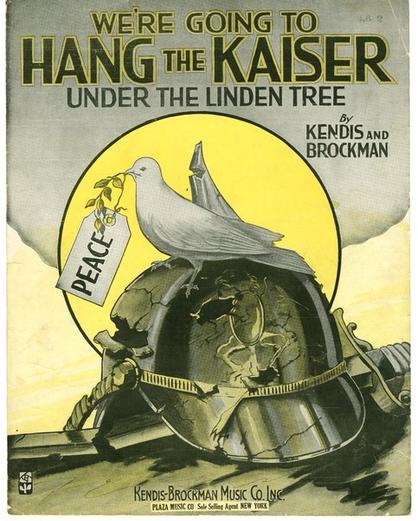
| Dispensing with the old adage, "it takes two to fight", the victors promptly pounced on the defeated powers and exacted as much revenge...and money.. as humanly possible by pronouncing "war guilt" solely on the central powers. The following is typical of that expression. |
| Sir Herbert Stephen points out that, because the Kaiser cannot be "tried," it does not in the least follow that it is impossible to punish him. Napoleon had no trial, yet we interned him until his death upon the island of St. Helena. The fact that he was declared an outlaw by the Congress of Vienna, presumably had no legal sanction. I take it that we based our action upon his surrender as a prisoner of war. Some similar course could probably be adopted with the Kaiser, though as to its legality I can express no opinion. What I am chiefly against is the illegal taking of life; and I cannot recall any case in history where the killing of a monarch under pseudo-legal forms has not in the end done far more harm than good. Where public opinion in this country has gone astray is in concentrating all its wrath upon the contemptible and fugitive Kaiser. He has more blood-guiltiness than any man on earth since Genghiz Khan, but he does not stand alone. Whatever punishment is meted out to him should be shared by the men who stood around him. |
| Shall we Hang the Kaiser? To Hang or not to Hang |
| A Guilty Nation |
| Punish these men by all means, with such severity as is not incompatible with observance of the law. My feeling is, however, that the guilt for countless crimes is shared in almost equal measure by the whole German nation. My anxiety is lest the guilt of all Germans should be obscured by concentration upon the guilt of a handful of leaders. When we have administered what punishment we may to the Kaiser and a few of his satellites, the German nation will instantly declare that their collective criminality has been expiated, They will tell us that it was all the Kaiser's fault, and the more we denounce the Kaiser exclusively the more we play into their hands. |
| Having committed themselves to the trial of the Kaiser by a clause in the Peace Treaty, the Allies went through the formality of addressing a note to the Netherlands Government on January 16, 1920 referring to the Kaiser's "immense responsibility" and asking for him to be handed over "in order that he may be sent for trial." The refusal of the Netherlands Government on January 23rd and was immediately accepted. However, before the decision was publicly known, and even after it became clear that the Government of Holland would not give him up, the "Hang the Kaiser" campaign was begun, and candidates in the British General Election of 1918 who would not commit themselves to this policy lost votes. |
| In 1915, Teddy Roosevelt said: "attempts to paint the Kaiser as a bloodthirsty devil are an absurdity. He and his family have given honorable proof that they possess the qualities that are characteristic of the German people. The Germans, from the highest to the lowest, have shown a splendid patriotism. They themselves are fighting, each man for his own hearthstone, for his own wife and children, and all for the future existence of the generations yet to come. The Germans are not merely brothers; they are largely ourselves." But Roosevelt changed his tune when it bacame politically expedient. |
| Kaiser Wilhelm was probably the second most reviled man in modern history. All of the frustrations, antagonisms and heartache of the war were laid squarely at the feet of this single human being that the propagandists had masterfully turned into the very figurehead of War. Wilhelm was portrayed as a ruthless demon intent on "taking over the world", something he never gave utterance to. He had become the very symbol of all that was evil. It had not always been that way. He was once regarded as a fine family man and a devout, serious, responsible leader who wanted the best for his country. |
| Even when the hostilities came to and end, throngs of people demanded his death. He, who had lost everything, was in their minds responsible for all of the immense suffering engendered by the war. The mass of anger was not directed at the handful of bankers and investors who had grown fat from their profiteering, nor the industrialists who had become tremendously wealthy at the price of millions of lives, nor at the media which had manipulated them into such an unnecessary, deadly venture. |
| Likewise, Creel's cartoonists continued to draw scathing caricatures of Wilhelm, the embodiment of the bad German, in the Sunday papers, and scores of now unemployed writers continued to rake him over the coals, hoping to keep the momentum of the lucrative hate business alive just a tad longer. |
| Songwriters, used to the government business the war had provided, continued to pump out music such as 'Hang the Kaiser to the Sour Apple Tree', 'We've Turned His Moustache Down', 'We Sure Got the Kaiser, We Did' and 'The Kaiser Now is Wiser' well after the Armistice. |
| It is understood that the Law Officers of the Crown, and high judicial authorities, have expressed the opinion that such a trial can be held under existing laws. Sir Herbert Stephen, in whose calm and impartial mind I have the strongest possible belief, has just declared emphatically—first, that there is no existing tribunal before which the Kaiser could be brought; second, that it is impossible now to create an impartial tribunal; and third, that any trial we imposed upon him would be a mock trial, and therefore "a prostitution of justice." I am no jurist, but to these views I venture to subscribe. |
| There are impetuous men who say that, if there are no laws to meet the case, we should make them. Supposing we made such laws, it would be an outrage to make their effect retrospective. At once we should be brought back to the position of the mock trial. To me it is astonishing that so temperate a man as Lord George Hamilton has proposed that the Kaiser should be "tried" in Brussels, and if found guilty, shot against the wall where Nurse Cavell met her unhappy fate. |
| There can be no doubt that the recent Victory election disclosed a widespread and even passionate desire on the part of the people of this country to bring the Kaiser and the Crown Prince to trial before some form of international tribunal. Before we proceed upon such an undertaking, we must be certain that laws exist under which such a trial is possible. We have been temperate in war, let us not be intemperate at the peace. |
| Justice Before All |
| I can appreciate his indignation, but not his balance of mind. Just as Nurse Cavell said that "patriotism is not all," so I would say that "vengeance is not all." The Kaiser richly deserves such an end, but it would not be just in the eyes of the law. We in Great Britain have to remember that there is a bigger issue at stake than the shooting or hanging of the Kaiser. These islands have long been the home of calm, inexorable, impartial justice to an extent which exists nowhere else in the world. I would let a thousand Kaisers go free rather than sully the British reputation for strict justice and observance of the law. Wherever I have been throughout the world I have always found the Englishman respected because he is just. We are a law-abiding race, and our judicial system, as well as our judiciary, is the admiration of every nation. If we start killing one man illegally, however, deep his guilt, we do not know in these times where the process is going to stop. An evil precedent would be created, and we should assuredly have cause to rue it. |
| The Germans are not as we are. They belong to a lower grade of civilisation. It is true that they are methodical and industrious, but so are ants; yet no one would think of comparing ants with mankind made in God's image. All Germany wanted this terrible war, and thought and dreamed of it for years. Some people tell us that the character of the German tribes changed and deteriorated during the last forty or fifty years. Nothing is farther from the truth. The character of the "square-heads" has remained unchanged since primeval times. They are the same to-day as they were when they burst out of the barren North and glissaded on their shields down the southern slopes of the Alps to the sack of Rome. They are an agglomeration of tribes which have deliberately, and from time immemorial, adopted the doctrine of expansion by conquest and loot. There is no incident of the present war which could not be matched by an examination of their foul exploits more than a thousand years ago, save only their use of weapons pr6duced by a perversion of science to base uses. |
| Things Seen in Douai |
| They are not in the least repentant to-day. They are only angry because they were soundly beaten. If they had entered English towns as we have entered Cologne and Bonn, there would be a very different story to tell. No doubt there are exceptions. I have had- German friends to whose companionship I look back with pleasure. I once made a longish voyage with Herr von Heineken, now the head of the North German Lloyd. I thought him a "white man" then, and am still inclined to fancy that I was not mistaken. He was quite a different, stamp of man from the Jew Ballin. But, collectively, the Germans are brutal and treacherous, and their qualities are not of recent growth. The thing this country must never lose sight of is the collective guilt of the German nation. |
| A day or two before the war ended I went into the empty city of Douai. The inhabitants had vanished, and very few of our troops were there. It was . like a city of the dead. There were not many external signs of destruction, and one had to go inside the houses to realise the devastation the Germans had wrought before they fled. Some of the houses were marked " Dangerous," and evidently contained booby-traps. For the rest, you could open any door in Douai and witness the same scene. Every scrap of furniture, every picture, every little ornament, had been smashed as if by men in a frenzy. Nothing was left undestroyed. Upstairs the very mattresses had been ripped up, and the floors were inches. deep in flock or feathers. There was no bed-room that did not contain indescribable proofs of the inherent German foulness of mind. |
| The Americans discovered similar disgusting conditions when they entered the ruined town of Chateau-Thierry. The same story can be told of town after town in the occupied territories in France and Belgium. These acts were not spontaneous on the part of the soldiery. It is inconceivable that the men billeted in every house in Douai should have simultaneously resolved upon committing the same deeds of malicious destruction and filth. The foul work was done by order of the officers, and the men obeyed with eager alacrity. It was done not in the first fever-heat of war, like the crimes in Belgium in 1914, but within a very short time of the armistice. |
| Culpability Beyond Dispute |
| Burke said that "You cannot indict a whole nation." It may be so; but the point of this article is that whatever may be decided about the Kaiser and his immediate confederates, a heavy toll must be taken of the German nation as a whole. Its culpability is beyond dispute. (end) from ‘the War Illustrated’ January 11, 1919 |

| "Hang the Kaiser" British cartoonist takes up the election cry of British Premiere George Lloyd |
| click |