| Ludwig the Pious had founded a chapel on the hill where ancient trade routes passed in the year 815, and the first large cathedral was formed out of native rock in 872 by Bishop Altfried. Under the direction of Bishops Bernward and Godehard in the beginning of the 11th century, the town began to flourish with craftsmen and artists, sculptors, goldsmiths and traders. By 1217, a Rathaus was built, and by 1300, the citizens had drawn up a lasting town charter, followed by their own constitution in 1345. By 1367, prosperous little Hildesheim was a member of the Hanseatic League. |
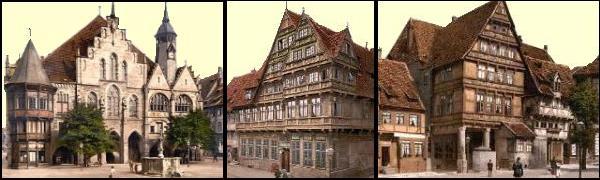
| Hildesheim was a perfect old Saxon town nestled between the Weser and the Elbe Rivers. It had not changed very much in 600 years and was probably one of the most intact medieval towns with her narrow, winding lanes framed by fairy tale timber framed buildings both tall and intricate, charming and even at times comical. The rosebush near the cathedral was rumored to be 1,000 years old. |
| By the time of the last meeting of the Hildesheim Council on February 2, 1945, people were war weary. Long before Allied "round the clock bombing" was initiated against civilian targets at the tail end of the war, few civilians had difficulty with the idea of surrendering peacefully. |
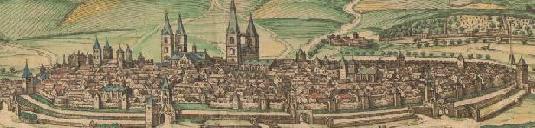
| From 1573 (pictured above) to 1767, the bishops of Hildesheim were almost exclusively chosen from the ducal House of Bavaria whose job it was to help combat Protestantism, and they brought Jesuits to Hildesheim to do this. The Thirty Years War, aside from creating a bit of religious turmoil, did not physically scar Hildesheim as it had so many other medieval towns, but she did struggle to remain Catholic while surrounded by a sea of Protestantism. By the Treaty of Westphalia, what had been Protestant to 1624 was mandated to remain so in the future. Hildesheim was secularized in 1803 under Napoleon, and given to Prussia as a secular principality. In 1807, it became part of the Kingdom of Westphalia under Jerome Bonaparte, and in 1813 it was incorporated with the Kingdom of Hanover. Hildesheim was more than 1100 years when the Second World War arrived. |
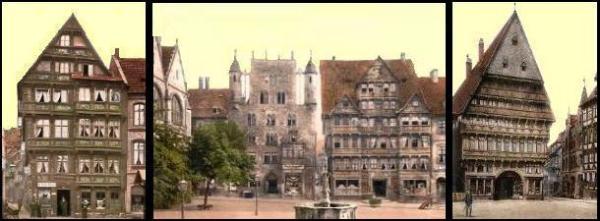
| Anatomy of an Ancient City |