| Germany's Greyhounds: All Eyes on the Booty |
| More than a military threat, Germany was deadly competition for the British because Germany had a significant share of the trans-Atlantic trade between 1897 and 1914 with some of the fastest and most fashionable ships on the Atlantic. The Germans had the two largest ships in the world in 1913- 1914, Hamburg-Amerika's Imperator and Vaterland. Norddeutscher Lloyd and Hamburg-Amerika Line were Germany's two major transatlantic shipping companies |
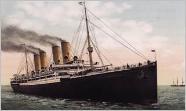
| Norddeutscher Lloyd's Kaiser Wilhelm Der Grosse entered service in 1897 as the world's biggest, fastest and the first of the four-funneled ocean greyhounds and she became the first liner to have a Marconi commercial wireless telegraphy system in February, 1900. She was 648 ft. long and 14,349 tons of awesome beauty, and was named for Kaiser Wilhelm I, first emperor and founder of the German empire in 1871. After she won the legendary and coveted 'Blue Ribbon' trans-Atlantic speed record from the British in 1897, she and her look-alike, Hamburg-America's Deutschland, kept the speed record until the British launched the Lusitania and the Mauretania which recaptured the record in 1907 (the Mauretania kept the record until 1929, when the Germans recaptured it with a pair of super-liners using the innovative 'bulbous bow' hull design). |
| Norddeutscher Lloyd repeated its excellence with other large liners, including the Kronprinz Wilhelm, Kaiser Wilhelm II and the Kronprinzessin Cecile, all of them four stackers. Hamburg-Amerika invented the "Ala Carte" ship-board restaurant and its interiors were of top-notch design, and both were planned in cooperation with the Ritz Hotel. One can almost hear the strains of the Blue Danube playing in the opulent ballrooms of these elegant luxury ships. |
| Kronprinzessin Cecilie, twin of the Kaiser Wilhelm II, was the last of the set of four ocean liners built for North German Lloyd and the last German four stacker. She had grand amenities: first class suites fitted with private dining rooms, a fish tank was in the kitchen with fresh fish, lush detail and professional decorating. She was made with the best of German craftsmanship with her lofty salons elegantly ornamented with carved wood and gilded mirrors. American millionaires loved her as did countless emigrants. |
| Like other liners of the time, accommodations were divided into three classes, first class being the most luxurious. But the third class passengers during the massive European emigration made the company its most profit. The Kronprinz Wilhelm, completed on August 25th 1901, was a ship similar to the Kaiser Wilhelm der Grosse but even larger. She also had the four funnels characteristically grouped in two pairs. The Kronprinz Wilhelm was designed for 1,761 passengers, of which 1,054 would travel in third class below decks. While a deluxe suite could cost as much as $2,500, it could cost as little as $10 on a ship like the Kronprinz Wilhelm to reach the Americas. She could carry some 2500 people. |
| When launched on August 12, 1902, also at the Vulcan Company near Stettin, the "Kaiser Wilhelm II" represented a great advance over all former steamers. The Kaiser Wilhelm II was even larger and faster than its beautiful predecessors and was so impressive that 40,000 people toured her grand interior while she was at Hoboken pier in New Jersey. She was a comfortable and popular ship. |
| Aside from ordinary berths, there were two Imperial suites, eight special staterooms, eight "cabines de luxe" and four suites with private baths. First class passengers enjoyed a dining saloon, a library, a smoking room, a children's salon, a drawing room and two cafés. Second class passengers had their own dining salon, drawing room and smoking room. There were 28 bath rooms for first and second class passengers, a large number for its day. The passengers were provided with electric light, steam heat and an extensive telephone system. |
| See more about the sad fate of these ships later |
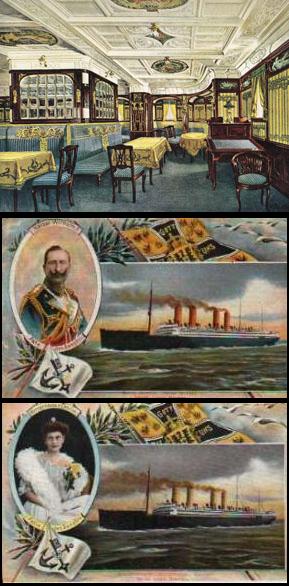
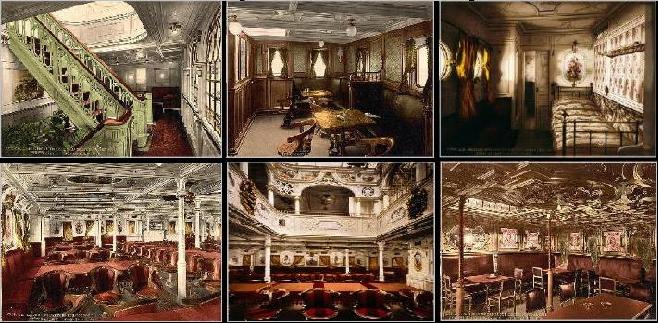
| Above top row: König Albert stairway, smoking room, ladies bedroom. Bottom: mailroom, dining room. Maria Therese dining room (click on image) |
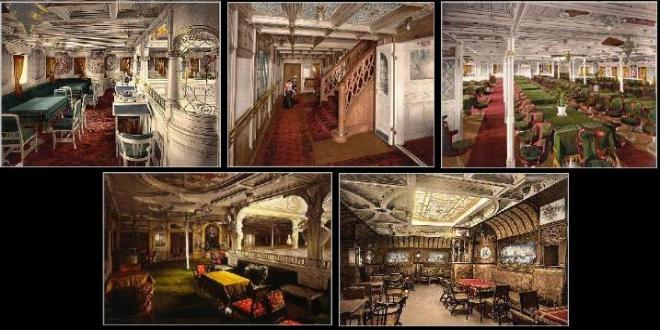
| A Norddeutscher Lloyd Ladies sitting room. Grosser Kürfürst passageway and dining room. Kaiser Wilhelm Der Grosse. Parlor, left; smoking room, right (click on image) |
| In 1889, Kaiser Wilhelm was a guest at the British naval review, an impressive display of British naval power, and he spent two hours touring the luxurious interior of the new White Star Liner Teutonic. He remarked that he thought Germany should have this type of ship. Eight years later, the very first German super liner, Kaiser Wilhelm der Grosse built by Norddeutscher Lloyd, won the coveted the 'Blue Ribbon' trans- Atlantic speed record from the British. |
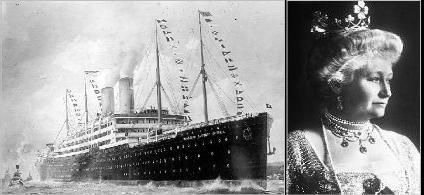
| Another jewel of German craftsmanship was Hamburg American's SS Kaiserin Auguste Victoria. On June 12, 1910, Theodore Roosevelt was a passenger on this amazing ship, and he enthusiastically toured it, expressing amazement at its luxury and modernity and came home eagerly boasting about the grand vessel. She was able to cross the Atlantic in about one week and offered luxury and comforts such as had never been previously imagined or attempted. |
| Originally laid down as SS Europa, she was launched on August 29, 1905 as the SS Kaiserin Auguste Victoria and was the largest ship in the world at the time. Her namesake, the Kaiser's wife, was present at the ceremonies. The twin-screw steamer had a tonnage of 24.581 gross tons, 20.401 under deck and 14.847 tons net. |
| Her dimensions were: length 677.5 feet, 77.3 feet beam, and holds 50.2 feet deep. The bridge deck was 354 feet long and the forecastle 84 feet. She had two funnels snd four masts (schooner). Her only peer in size was the very slightly smaller Amerika which had been launched a few days earlier. The ship a maximum speed of 18 knots and her service speed was 17,5 knots. She had 5 decks and 4 shade decks, electric lights, submarine signalling device, wireless and refrigerating machinery. With a crew of 593 persons, she could accommodate for 472 first class passengers, 174 second class passengers, 212 third class passengers and 1608 forth class (steerage) passengers. |
| On her maiden voyage commanded by Captain Hans Ruser, the SS Kaiserin Auguste Victoria left Hamburg on May 10, 1906 and went onto Dover, Cherbourg and New York. She sailed the route between Hamburg and New York regularly. In 1910, the ship was slated to be used in flying experiments for the world's first ship-to-shore airplane flights by pilot John McCurdy and a special platform was constructed to provide a runway. The pilot abandoned the attempt after being beaten to the punch by rival pilot Eugene Ely who flew off a naval warship in Virginia in November, 1910. In June 1914, the Kaiserin August Victoria made her last voyage under a German flag, sailing from Hamburg to Southampton, Cherbourg and New York and returning to Hamburg. |
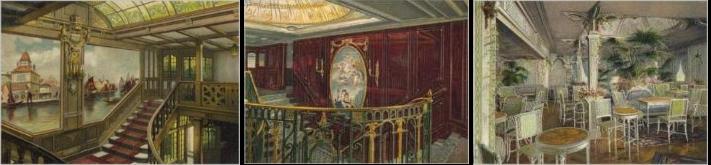
| Kaiserin Auguste Victoria and her staircase and luncheon room |
| Kaiser Wilhelm der Grosse |
Kronprinz Wilhelm library; Kaiser
Wilhelm II; Kronprinzessin Cecilie
Wilhelm II; Kronprinzessin Cecilie