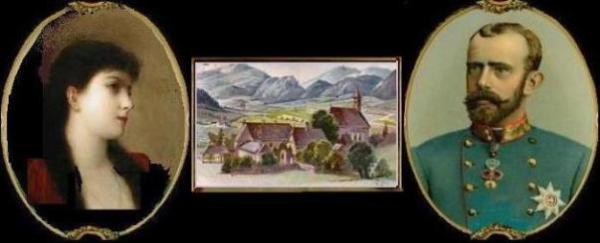
| The love affair between beautiful baroness Marie Vetsera and the Austrian Crown Prince, Archduke Rudolph, ended tragically on a cold, white January day in 1889 in the Vienna Woods under strange circumstances which are to this time shrouded in mystery and may never be otherwise. Rudolph and Marie were found dead at the royal hunting lodge at Mayerling. Their deaths caused immediate scandal and made world headlines. On the surface, it appeared to be a classic suicide pact, but there were so many bizarre factors, unanswered questions, lost and destroyed pieces of evidence and disparate theories that the event will be debated for generations to come. Rudolph, 1858-1889, was the only son of Kaiser Franz Josef I and Kaiserin Elisabeth of Austria. He was born in Schloss Laxenburg near Vienna, and from a very early age he was very interested in natural sciences. His relationship with his mother apparently held little warmth and his political views contrasted with those of his father. In 1881, the 22 year old Prince obediently married Princess Stéphanie, a daughter of King Léopold II of Belgium, and their daughter Elisabeth was born in 1883. The marriage was not fulfilling to Rudolph, and he soon found comfort in drinking and women. Mayerling is a small village in Lower Austria on the Schwechat River in the Vienna woods fifteen miles southwest of Vienna. Here, Rudolph bought a building which was owned by the abbey of Heiligenkreuz since 1550, and he turned it into a royal hunting lodge in 1887. He always found solace in nature and spent much of his time collecting mineral specimens. He also loved hunting and walks in the woods, and relished his private time here. Baroness Marie Vetsera, Marie Alexandrine Freiin von Vetsera, 1871–1889, was one of four children of Baron Albin Vetsera, a wealthy diplomat in foreign service for the Austrian court, and his wife Helene Baltizzi who was from a prominent Greek banking family. A month after her 17th birthday, Marie met the 30-year old crown prince at the horse races in 1888. After a brief flirtation, she fell in love and he found her very attractive. With the help of Countess Marie Larisch, illegitimate daughter of the Empress's oldest brother, Marie was given access to Rudolf's chambers. Soon, the affair was common knowledge and at the end of January, 1888, Rudolph and his father had reportedly argued about his liaison. After a typically lovely carriage ride to his beloved Mayerling on a winter day in 1889, Rudolph was, as usual, joined by a hunting party. Marie, who had accompanied him, stayed out of sight of Rudolph's guests, but they indicated that they sensed a woman present. On the day before his death, Rudolph did not go hunting with the others, and he excused himself early to have a private dinner with Marie. On that last night, his valet served them a meal of pheasant with fresh mushrooms, leeks and baked potatoes with two bottles of Tokay on the side. The next morning, January 29, 1889, Rudolph's servant awakened him, but was told to come back in a half an hour. When he returned, there was only an eerie silence and no answer. He called for help. Rudolph and Marie were found dead together in the room. Their deaths, reported as an apparent suicide-murder, caused an immediate scandal which made international headlines. Fueled by conspiracy rumors (that in retrospect do not seem far-fetched) it is thought by some to have played a part in the ultimate doom of the Habsburg monarchy, for had he lived, he would have been the Emperor. The exact facts remain to this day unclear. After their bodies were found, the local police cabled the minister of police who ordered Mayerling sealed off. He left for the lodge immediately, and after examining the bodies and the room where they were found, he told the details of the case as far as he could understood them to the family. The first official version was that the crown prince died from heart failure. It was not for 24 hours after the tragedy that the Emperor learned that Rudolph had supposedly shot himself. Elisabeth was the first member of the Imperial family to be told of her son's death, and at first she bore up well, breaking the news herself to the Emperor and to Marie's mother and others. After the first few days, however, her grief exploded in rage at her daughter-in-law whom she accused of being indirectly responsible for Rudolph's death, because she had been cold, unloving, and was supposedly having an affair herself. Only one bullet was actually found at the scene, but there were many discrepancies. At one point it was claimed that six shots were fired from the firearm, a gun which did not belong to Rudolph. On the surface, it looked like Rudolph shot his mistress in the head and then, after a few hours, himself. If this were the case, and it was a suicide, Rudolph would have to be officially declared in a state of "mental unbalance" in order to enable a Catholic burial in the Imperial Crypt in Vienna. Mary Vetsera's uncles were later summoned to Mayerling to clean and remove Marie's body. They dressed her, and propping up her body with a broomstick so that she could be placed upright in the carriage, smuggled her out of the estate in the middle of the night, probably in the futile hope of avoiding a bigger scandal. Marie was also allowed Catholic burial and was secretly buried in an unmarked grave, at Holy Cross Abbey in Heiligenkreuz. In May, 1889, Mary's temporary grave was opened and she was moved a few yards away to a permanent grave that was commissioned by her mother. The wooden coffin was replaced by a copper one and a simple monument was erected. There have been numerous theories, one even claiming that Marie went there to have an abortion but died in the process, and Rudolph consequently became so distraught that he killed himself. However, Rudolf's aunt, Princess Zita, who had been a confidante of both the family and the Austro-Hungarian court, firmly believed that he was murdered because he had refused to participate in a plot hatched by France's Clémenceau to overthrow Franz Josef and place Rudolph on the Austrian throne, thinking him to be more flexible than the Emperor and more likely to break Austria's alliance with Germany in favor of an alliance with France. In retrospect, after viewing the horrendous world events which followed, it now seems more than reasonable that, for political reasons, a third party or parties committed the murders, killing Vetsera simply to silence her and to cover up the political nature of a criminal assassination. It appeared that Marie had been killed several hours before Rudolf, and perhaps he was forced to watch her brutal, quietly inflicted death, which forensic analysis generally concludes was probably from beating, not gunshots. Furthermore, Rudolf's alleged "suicide letter" to his wife could have been written under duress. In it, he bids farewell to her and his friends, saying that "only death can save his good name", but it does not give a reason why he killed himself, and in fact makes no mention of suicide or of Marie. In any case, how would a double-suicide or murder-suicide "save his good name"? Evidence in reports made at the time of the deaths stated that his body showed evidence of a major violent struggle. The body of the Crown Prince wore gloves at his funeral and his mother was not allowed to see his hands, since they were supposedly injured and possibly covered with defensive wounds. This also resembles what Empress Zita said about the events. All the same, the exact cause and circumstances of Rudolf's death remain a mystery to this day. Plundering Russians who fought in the area in World War Two blew open Marie's tomb in 1945 looking for loot. The copper coffin was broken and when the monastery repaired the grave they saw a small skeleton in the damaged coffin with a small, intact skull. A young physician stationed nearby was called to examine Vetsera's remains and to witness their re-interment. He carefully studied her skull and bones for traces of a bullet hole, but there was no apparent bullet damage. Since the Catholic Habsburgs were rumored to have asked the Pope for dispensation in order to secure a Catholic funeral for their son, this doctor requested to see the detailed reports filed by the Pope's nuncio to Mayerling as it was filed in the Vatican archives. Since the main finding, kept secret for almost a century, said that only one shot was fired, it was thought that maybe the Russians had lost the real skull, so the grave was re-opened. Bones were all over the coffin and Marie's shoes and long black hair were still there. Witnesses again stated that the skull had no bullet hole but showed signs of trauma. Further research requested in 1979 was refused by the church, but in July of 1991, a salesman apparently obsessed by the Mayerling mystery dug up the coffin and took it to Linz with two accomplices where a medical specialist examined the remains which were taken to Vienna for further study. The bones were said to be about one hundred years old and those of a woman around twenty, but part of the skull was missing. The examination was ordered stopped and the body reburied. Some people felt that the photographs showed possible bullet entrance and exit holes, but others insisted that it showed evidence of severe blows instead. Marie's remains were again put to rest in 1993. In the Carmelite convent established by Emperor Franz Josef on the site of the rustic lodge where his son and heir died, the altar of the convent church stands over the spot where the bodies were found, in what was once the Prince's bedroom. Today prayers are still said daily by the nuns for the repose of Rudolph's soul. |
| Tales from the Vienna Woods: The Man who would have been Emperor |
| Rudolph's daughter, Princess Elizabeth (1883-1963) and her mother continued to live at the court of the Emperor and Elizabeth felt in love with Prince Windisch-Graetz. After the Emperor ordered Windisch-Graetz, who was in love with another woman, to marry Elizabeth, she and the Prince were married in 1902, had four children, divorced, and then Elizabeth remarried a socialist politician, which resulted in her nickname, the Red Princess. She died in 1963 at age 80. |
| Countess Marie Larisch, who as a girl had received several marriage proposals including one from Bismark's son, facilitated the affair between Rudolph and Marie. She was married to a count and bore him five children, among them oceanographer Franz-Joseph Ludwig Georg Maria Larisch. Publicly disgraced after the Mayerling tragedy, she and the Count divorced in 1896, and in 1897 she married musician Otto Brucks in Munich, and they had a son, Otto. She was rumored to have been given "hush money" not to publish her memoirs, and to have accepted relocation to the United States in exchange for an annual pension of $25,000. She did write of it, however. Once in the states, she married again, and again divorced. She died in 1940. |
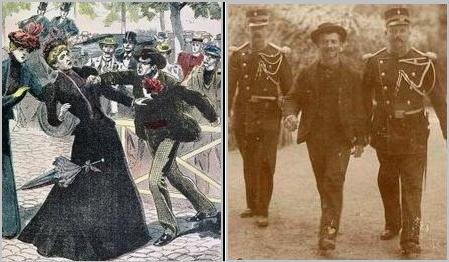
| When Rudolf, was found dead, the Empress displayed great strength at first and then completely broke down. She wore black from that day on. In September, 1898, the Empress Elizabeth travelled to Lake Geneva under her pseudonym "the Countess of Hohenembs." An Italian anarchist named Luigi Luccheni was also in Geneva, at first intent on murdering the Duke of Orléans, but since the duke had already left, 25-year old Luccheni decided to kill the Elizabeth instead. On September 10, the 60-year old Empress and her lady-in-waiting were rushing to catch a steamer when Luccheni surprised them, stabbing Elizabeth in the chest with a home-made dagger in the name of "freedom and anarchy". At first, she continued walking, but after boarding the ship and noticing blood on her blouse, the Empress realized what had taken place and collapsed. She opened her eyes and asked, "What has happened to me?" Those were her last words. Vienna was telegraphed. When Franz Joseph was informed, he sank back into his chair. "I am to be spared absolutely nothing in this world," he moaned, then quietly whispered, "No-one will ever know how much I loved her." Orders were issued to bring her body back home. She was buried on September 17, 1898 in the imperial crypt of the Capuchin Church. Sisi's husband, the Emperor, would live on for several years and experience even more personal family tragedy. Lucheni received a life sentence in prison. On October 19, 1910, he was found dead and hanging in his cell. Above: a gloating Lucheni after his arrest |
| "April is the cruellest month, breeding Lilacs out of the dead land, mixing Memory and desire, stirring Dull roots with spring rain. Winter kept us warm, covering Earth in forgetful snow, feeding A little life with dried tubers. Summer surprised us, coming over the Starnbergersee With a shower of rain; we stopped in the colonnade, And went on in sunlight, into the Hofgarten, And drank coffee, and talked for an hour. Bin gar keine Russin, stamm' aus Litauen, echt deutsch. And when we were children, staying at the archduke's, My cousin, he took me out on a sled, And I was frightened. He said, Marie, Marie, hold on tight. And down we went. In the mountains, there you feel free. I read, much of the night, and go south in the winter. |
| And Another Family Murder... |
| (end of Habsburgs) |
| Marie Larisch met and conversed with T. S. Eliot, and part of their conversation found its way into "The Waste Land". |