| A Grand Old Duchy |
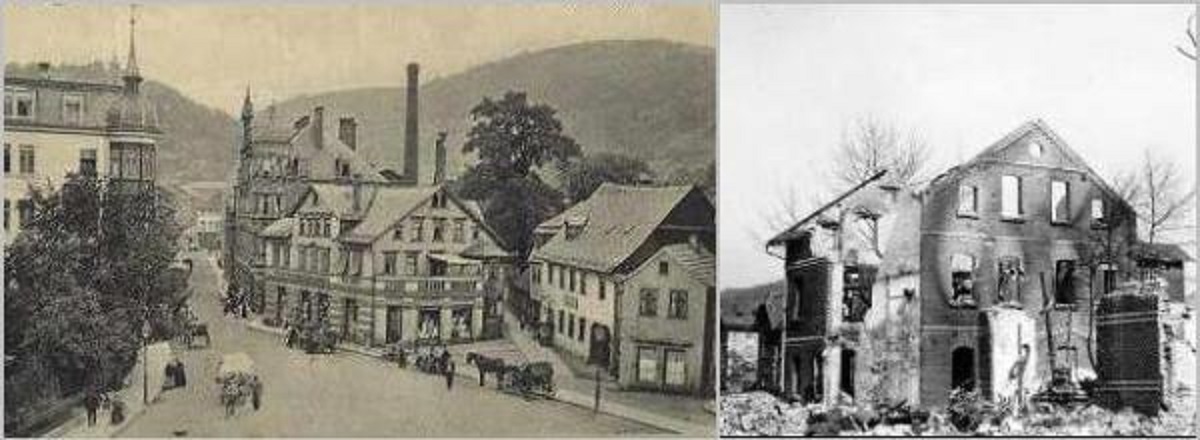
| The old duchy of Saxe-Meiningen was a fairy tale unto itself. Meiningen on the Werra River was the capital of the old, almost exclusively Protestant duchy of Saxe-Meiningen in hilly Thuringia, tucked between the south-west slope of the Thuringian Forest and the Rhön Mountains, at a time when old Germany was made up of 350 mini-kingdoms and tiny duchies. It bordered on the old duchy of Coburg, Bavaria and portions of four other former Thuringian states and former Prussia. It had a territory of only 530 square miles and was less than half the size of Rhode Island. First mentioned in the 10th century, it passed to the dukes of Saxony in 1583, and the ducal palace in Meiningen dates from the 16th and 17th century. The duchy of Saxe-Meiningen was founded in 1681 by Bernard, the third son of Ernest the Pious, duke of Saxe-Gotha. The Dukes were Wettins of the Saxonian royal dynasty. By 1763, the duchy was in financial trouble until the emergence of Charlotte Amalie, who ruled as regent for her sons, Carl and Georg. She led it into prosperity until the war with France brought poverty and destruction. The Meiningen Court Orchestra is one of the oldest orchestras in Europe, being first mentioned in 1690. Georg Caspar Schürmann, director from 1702-1707, and Johann Ludwig Bach, director from 1711-1731 (and founder of the Meiningen Bach line), were responsible for the high musical standard as conductors of the court orchestra. While J.S. Bach was never there, Saxe-Meiningen was one of the duchies where numerous members of the Bach family lived and worked. Coupled with cattle disease and bad harvests, the land again plunged into distress and recovered very slowly. In 1825, the extinction of the male line of Saxe-Gotha necessitated a rearrangement of the Saxon duchies, and Saxe-Meiningen benefited greatly by receiving 530 new square miles of territory. Duke Bernard granted a new constitution in 1829. In 1866, unlike the other Saxon duchies, Saxe-Meiningen sided with Austria in the war with Prussia and the land was immediately occupied by Prussian troops. Duke Bernard abdicated in 1866 and was succeeded by his son Georg, who immediately made peace with Prussia and joined the North German Confederation, becoming a member of the new German empire. Their rulers were expelled in 1918, and in 1920 the state of Thuringia was founded under the Weimar Republic by the union of Saxe-Coburg-Gotha (without the city of Coburg which went to Bavaria), Saxe-Weimar-Eisenach, Saxe-Altenburg, Saxe- Meiningen, the two principalities of Reuss, and two principalities of Schwarzburg. In 1885, Brahms wrote to Duke Georg II of beautiful, peaceful Saxe-Meiningen: "A journey to Meiningen always offers the most beautiful prospects." Meiningen's court orchestra, during the reign of Duke Georg II between 1866 and 1914, was among the best in Germany, especially when musical director Hans von Bulow brought it to the status of a top European orchestra. Bülow invited Brahms to Meiningen in 1881, marking the start of a Brahms tradition along with Richard Strauss, Bülow's most famous pupil and his successor. Duke Georg II founded a resident theater troupe in 1866, a fore-runner to the Royal Shakespeare company, who toured Europe and Russia from 1874 to 1890, giving lavish productions as far as Moscow and London. From a small theater, the Meiningen Court Theater became the theatrical sensation of its age and was a major influence in the movement toward modern theater. Duke George II developed ensemble acting and realized the importance of using historically accurate costumes and settings. He was the first to recognize the importance of central artistic control, which anticipated the function of the director in the production of plays. The last duke abdicated in 1918, and in 1920 Saxe-Meiningen was incorporated into Thuringia. On February 23, 1945, the 8th US-Air Force dumped 582 Spring loaded bombs on the old center of Meiningenin Saxony, killing 208 people and destroying 160 historic buildings. |
| The ancient Thuringians, conquered by the Franks during the 6th century AD, were a Germanic tribe that occupied central Germany between the Elbe and the Danube and converted to Christianity in the 8th century. Charlemagne made Thuringia a defensive frontier country in the 9th century, and it passed to the Saxon dukes in the 10th century. In the 11th century, the landgraves of Thuringia with their seat at Wartburg became princes of the Holy Roman Empire, and in 1247 Thuringia fell in part to the house of Wettin, the Meissen Margraves who became electors of Saxony in 1423. In 1485, when the Ernestine branch of the family acquired most of the Thuringian territories, Thuringia was split into several duchies prefaced by "Saxe." Thuringia towns also include Eisenach, Gera, Jena, Gotha, Suhl, Nordhausen, and the capital Erfurt (most of these towns are covered elsewhere). Johann Philipp Kirnberger was among the many musical souls born in Thuringia. Today's Saalfeld-Rudolstadt, his birthplace, is in the south of Thuringia, a medley of little dukedoms and home to Luther, Bach and others. Saalfeld, the capital of the duchy Saxony-Saalfeld from 1690 to 1735, was about 24 miles from Weimar and founded around 1200AD. In the 16th century it was a silver mining center. The duke of Saxe-Coburg traded Saalfeld for Gotha with the duke of Saxe-Meiningen in 1826. The city included a 14th-century church, a 16th-century city hall, a 13th-century Franciscan monastery and castle, and an 18th-century palace. It is one of the most ancient towns in Thuringia, and was lorded over by the palace Kitzerstein, standing on an eminence above the river, built by King Heinrich I. and further constructed the 16th century. There is also the ruin of the HoherSchwarm, later called the Sorbenburg, a relic of the past said to have been erected in the 7th century. Saalfeld is a small industrial town. Thuringia towns also include Eisenach, Gera, Jena, Gotha, Suhl, Nordhausen, and the capital Erfurt. It includes part of the Harz mountains and a forest, the beautiful Thüringer Wald. |
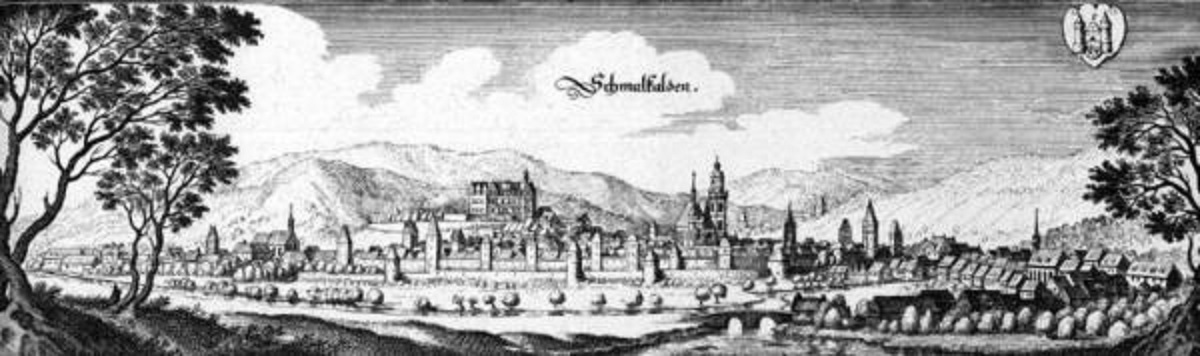
| Schmalkalden, above in the 1600s, is situated on the southern slope of the Thuringian Forest at the Schmalkalde river. First mentioned in a 874 deed, as a Frankish duchy of Thuringia, it received town privileges about 1180. In 1531, the town hall of Schmalkalden was the site of the establishment of the Schmalkaldic League by Protestant princes under the lead of Landgrave Philip I of Hesse, in order to protect religious and political interests within their domains. In 1537, the "Smalcald Articles" were drawn up by Martin Luther, Philipp Melanchthon and other reformers. Under the league's protection, the Reformation spread over Germany. It was defeated by Catholic forces under Karl V in the 1547 Schmalkaldic War at the Battle of Mühlberg. On July 7, 1944, February 6, 1945 and Feb 16, 1945, Allied air attacks damaged a post office, an historic church together with 55 houses, 40 of which were totally destroyed in the Haindorfgasse, mostly two-and three-storey plastered timber-frame houses of the 16th century, among them Lutherplatz 5, where Martin Luther once stayed. The attacks cost the lives of 87 civilians. |
| Musical Saxon Thuringia |
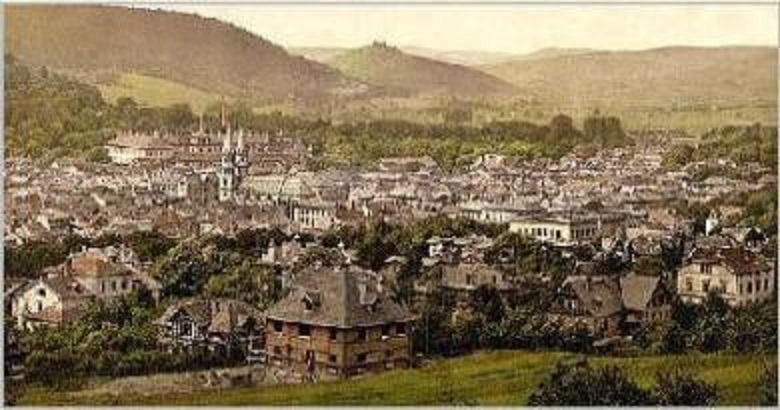
| Sonneberg, above, was founded in 1200 during the period of Frankish settlement in Thuringia and had a long and vibrant history spanning the rule of the illustrious House of Wettin, the Margraves of Meissen and the Elector of Saxony. It was until the19th century famous for its toy industry. On February 14, 1945, Sonneberg experienced its heaviest Allied air raid. No less than 800 bombs fell on Sonneberg, about half of which were fire bombs. The Allied reports stated that the railtracks were the target, yet most of the bombs "missed their mark" and ended up falling on the residential districts. It resulted in 28 civilian deaths, including six children. Two other people died later of their injuries and scores were badly injured. One family lost four family members and another five. Yet, Sonneberg experienced even more air raids after that deadly bombing. |