| The Teacup in a Tempest |
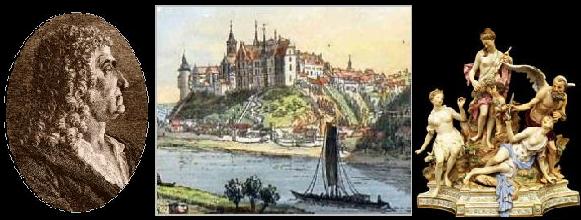
| Albrechtsburg Castle sets on the hill high above Meissen on the banks of the Elbe. It is regarded as the first castle to be used a royal residence in the German speaking world. Built between 1472 and 1525, its origin goes back to the year 929 when Heinrich I created a fortified military camp. In the Middle Ages, the Wettin dynasties of Albrecht and Ernst, the wealthiest princes in the empire thanks to the silver mined in the Saxon mountains, became the Margraves of Meissen. At the height of their powers and while jointly ruling, the brothers built a new stately residence with room for two court households. It was not given the name Albrechtsburg until 1676. |
| Augustus was already building a porcelain factory in Meissen and the industry was transferred there in June of that year. Since the old Albrechtsburg castle was impractical for living in due to political circumstances and living conditions, August had the first porcelain factory set up there. The factory occupied all of the castle’s rooms. By 1713, Meissen was producing the desired white porcelain, and colored wares were soon developed, run by Böttger from his guarded confinement in Dresden. The King finally released Böttger, who was still young, in 1714, but he died young only 5 years later, perhaps a result of years of breathing deadly fumes in the laboratory. |
| Two other figures are equally as important in the early history of Meissen: color chemist and painter Johann Gregorius Höroldt, 1696-1775, and sculptor Johann Joachim Kaendler, 1706-1775. Höroldt developed the rich colors and adapted the motifs of Asian porcelain to European tastes, and Kaendler created many of Meissen's best-known shapes and figurines. |
| In 1700, a talented 18 year old chemist named Johann Friedrich Böttger was arrested in Wittenberg and brought to Dresden by order of the King, who hoped to manufacture gold from basic materials. Imprisoned in Dresden, Böttger was forced to make the King's dream come true. At one point, in 1703, the unlucky Böttger tried to escape to Prague, but was captured and brought back to Dresden to continue his fruitless experiments. Dresden scientist, Ehrenfried Walter von Tschirnhaus, had meanwhile been trying to discover the secret of porcelain for at least twenty years with little progress. Recognizing Böttger's genius, he suggested that he join him in his research, and in 1705, Böttger, still under guard, began his work with Tschirnhaus. In 1707, a laboratory was established for Böttger, and a year later he achieved a formula for porcelain. |
| Augustus II the Strong, 1670-1733, reigned from 1697 to 1733, an ambitious absolutist who loved beauty and culture. Although he had German roots as the son of Johann George of Saxony, he was elected King of Poland in 1697, having converted to Catholicism to better his chances. |
| He had the dual role of Elector of Saxony from 1694. He allied himself with Czar Peter and this pulled Poland into the Northern War. As a result, Sweden once again attacked Poland, deposing Augustus who abdicated after Swedish armies entered Saxony. Ultimately, Czar Peter defeated the Swedes and Augustus regained the crown. He was called "the Strong" for his brute physical strength (which he demonstrated by breaking iron horseshoes with his hands) and for his numerous offspring. He is alleged by some to have sired 365 or 382 children, with only one of them a legitimate heir. |
| Soon, production began in the Dresden laboratories, and the first pieces went on sale at the Leipzig Fair in 1710. The first wares were red and are known as Böttger stoneware. |
| The Quest for Gold |
| Who would have known that it would one day become known as the world's most famous china shop? For about three centuries, porcelain has been manufactured in Meissen. First produced in China in the eighth or ninth century A.D. and introduced to Europe in 1474, it wasn't until the beginning of the 18th century that two alchemists in Dresden under the patronage of August der Starke (Augustus the Strong) uncovered the secret of porcelain by mixing a very white clay called kaolin with alabaster powder. |
| In 1707/08, white, delicate, European hard paste porcelain was born. The earliest Meissen used Oriental styling, but soon produced European court scenes, satirical pieces and other elaborate designs. The fame of its most recognizable crossed swords mark, used as early as 1728, spread with its reputation for fine workmanship and artistic beauty. The Meissen Royal Manufactory in Saxony has weathered Europe's most calamitous wars, economic depressions and various governments. Since the 18th century, the factory has had its own education and training facility to assure succession in the craft, including very special techniques. |
| The Albrechtsburg where Augustus the Strong set up the porcelain factory, eventually suffered serious damage from its hard use. In 1863, the factory was closed. The castle buildings were repaired, and between 1875-1885 several murals depicting Saxon history were added. Since 1881, Albrechtsburg Castle has been open to the public as a museum. Meissen survived the war, but the occupying Russians afterwards looted the factory thoroughly and took all of the stock which they didn't manage to break to Moscow. Some of it has been bought back ( or maybe a better term is ransomed ) at a dear price. Even August the Strong´s table silver and other royal objects were taken by the Red Army. |