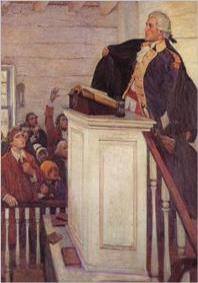
| Son Peter Gabriel Muhlenberg had an even more exciting history. 16-year-old Peter was sent to Halle and became unhappy in his studies. He was apprenticed to a cruel druggist in Lübeck, and after three miserable years he ran away and signed up with a British “Hessian” regiment going to America. He made his way home as such after 4 months with some military training under his belt. He was licensed as a Lutheran minister in 1769 and assisted his father with congregations in New Jersey before marrying Hannah Meyer. Next he preached at Woodstock in Virginia's Shenandoah Valley, a settlement of Pennsylvania Lutherans. Since Anglicanism was the established state church in Virginia, he had to travel to London to receive ordination as an Anglican clergyman. He was an admirer of Patrick Henry and became a friend of George Washington. His relatives once related the following story: One January Sunday in 1776, while giving a sermon taken from Ecclesiastes 3:1, he suddenly ended it with these words: "There is a time for all things..a time to preach and a time to pray; but there is also a time to fight, and that time has now come." He took off his clerical robes, revealing his full Colonel's uniform underneath and proceeded to the door. Ordering a drumbeat for recruits, he stood proudly while 300 men of his congregation responded at once. This group became the 8th Virginia Regiment or the "German Regiment." A faithful, efficient officer trusted by both General Washington and General Steuben, Peter Muhlenburg successfully engaged in a number of battles and rose to the rank of Major General in the Continental Army. He played key roles at Brandywine, Germantown, Monmouth and in the Southern Campaign that culminated at Yorktown. After the War, Muhlenberg did not feel he could return to being a parson after having been a soldier, and in 1784 he surveyed military bounty lands assigned to Virginia veterans. He returned to his native Montgomery County, Pennsylvania, and in 1784 his German neighbors elected him as Montgomery County's representative to Pennsylvania's Supreme Executive Council, the state's governing body under its first constitution. After a three-year term, he served as Vice-President of the Commonwealth, and then served three terms in the U.S. Congress. He was elected Senator in 1801 but never served, having resigned to accept an appointment from President Jefferson as Supervisor of the Revenue for Pennsylvania and collector of customs in Philadelphia. |
| The Patriot |
| Promising young Heinrich Melchior Muhlenberg was raised near Hanover and educated at Göttingen University where he studied Greek, Hebrew, and mathematics. He was also proficient organist. He left Göttingen for Halle in 1738 where he taught at the Orphan-House, and in 1741, Muhlenberg was presented with a call from Halle's August Hermann Francke to go to Pennsylvania. He came to America in 1742, going through Georgia where he met with the Halle-trained pastors to the Salzburger refugees before he moved near Philadelphia, from where he helped frontier churches. He had to continually travel under harsh conditions and for a long time ministered to German Lutheran and Reformed congregations in Pennsylvania, Maryland, the Shenandoah Valley of Virginia and in New York. He is thought of as the founder of the Lutheran Church in America. In his travels, he met Conrad Weiser’s daughter and married her in 1745. Expert frontiersman Conrad Weiser was William Penn's chief negotiator with the Indians from the 1730’s through the 1750’s. He had come to America at age 14 with the Palatinate Germans in New York. His father sent him to live with the Mohawks at age 16 to learn their language, and he was adopted into their family. For 15 years, Weiser learned the Indian language, habits and customs. After the New York troubles, the Weisers and other Palatines relocated to eastern Pennsylvania where Weiser would spend the rest of his life. Weiser regularly corresponded with Halle's August Hermann Francke. In 1731, Weiser, armed with his knowledge of frontier skills, was the Provincial Indian Interpreter and Agent at a meeting between the provincial council and Shekilammy, the Chief of the Six Nations Federation. Weiser devoted his remaining years to interpreting the thoughts and words of the Indians to white men. Weiser strove more than any other man of his time to see friendship maintained between the two. Later, after marrying a German-born woman, the couple joined the celibate order at Ephrata after being moved by their preaching in 1735, and although they left within two years, he remained interested in religion all his life. It must have been a strong combination of genes. The three Muhlenberg sons were all successful. The Muhlenbergs sent their three sons to Halle for their education in 1763. Henry August Muhlenberg became a noted botanist and was often described as “the American Linnaeus.” He was founder and president of Franklin College in Lancaster, Pennylvania (established as a German college), and a member of the Göttingen and Berlin philosophical and scientific societies. He was visited by Alexander von Humboldt in 1807. Frederick Muhlenberg was also a minister, and became a member of the Continental Congress in 1779. A collaborator of Alexander Hamilton, he served four terms in the U.S. Congress and was the first Speaker of the U.S. House of Representatives. |
| The New Americans: A Family of Patriots |
| THE INDIAN WARS OF PENNSYLVANIA . From an old manuscript: "The Rev. Henry Melchior Muhlenberg relates in the 'Hallische Nachrichten,' a touching incident:.It was of the widow of John Hartman who called at his house in February, 1765, who had been a member of one of Rev. Kurtz's congregations. She and her husband had emigrated to this country from Reutlingen, Wurtemberg, and settled on the frontiers of Lebanon County. The Indians fell upon them in October, 1755, killed her husband, one of the sons, and carried off two small daughters into captivity, whilst she and the other son were absent. On her return she found the home in ashes, and her family either dead or lost to her, whereupon she fled to the interior settlements at Tuipehocken and remained there. The sequel to this occurrence is exceedingly interesting The two girls were taken away. It was never known what became of Barbara, the elder, but Regina, with another little girl two years old, were given to an old Indian women, who treated them very harshly. In the absence of her son, who supplied them with food, she drove the children into the woods to gather herbs and roots to eat, and, when they failed to get enough, beat them cruelly. So they lived until Regina was about nineteen years old and the other girl eleven. Her mother was a good Christian woman, and had taught her daughters their prayers, together with many texts from the Scriptures, and their beautiful German hymns, much of which clung to her memory during all these years of captivity. At last, in the providence of God, Colonel Bouquet brought the Indians under subjection in 1764 and obliged them to give up their captives. More than two hundred of these unfortunate beings were gathered together at Carlisle, amongst them the two girls, and notices were sent all over the country for those who had lost friends and relatives, of that fact. Parents and husbands came, in some instances, hundreds of miles, in the hope of recovering those they had lost, the widow being one of the number. There were many joyful scenes, but more sad ones. So many changes had taken place, that in many instances, recognition seemed impossible. This was the case with the widow. She went up and down the long line, but, in the young women who stood before her, dressed in Indian costume, she failed to recognize the little girls she had lost. As she stood, gazing and weeping, Colonel Bouquet compassionately suggested that she do something which might recall the past to her children. She could think of nothing but a hymn which was formerly a favorite with the little ones: 'Allein, und doch nicht ganz allein, Bin ich in meiner Einsamkeit.' She commenced singing, in German, but had barely completed two lines, when poor Regina rushed from the crowd, began to sing also and threw her arms around her mother. They both wept for joy and the Colonel gave the daughter up to her mother. But the other girl had no parents, they having probably been murdered. She clung to Regina and begged to be taken home with her. Poor as was the widow she could not resist the appeal. The three departed together." |