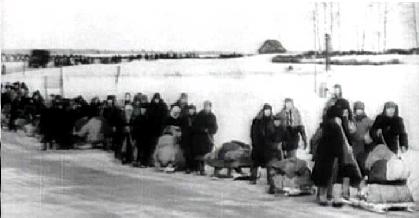
| Later in time, East Prussia witnessed plunder under Napoleon, and the destructive French occupiers drained the local economy and food supply. This period included a harvest failure in 1811 which had a lasting effect on the province and left a debt unpaid until 1901! Despite it all, the people bravely persevered. Their farms flourished and their villages grew into small cities. Ancient Königsberg had further evolved into a lovely, historic city and a lively center of trade and culture, with its libraries, hospitals and world famous university. Hundreds of years of glorious history were embodied in the beautiful kingdom built with hard work and rooted in religious and ethnic tolerance. From 1824-1878, East Prussia was combined with West Prussia to form the Province of Prussia, after which they were reestablished as separate provinces. Along with the rest of the Kingdom of Prussia, East Prussia became part of the German Empire in 1871. In 1875, the ethnic make-up of East Prussia was overwhelmingly German. After 1890, the population started to drop in East Prussia because of emigration and economics, but the majority population of the province in 1900 was still German and predominantly Protestant, with one third of the population having Salzburger roots. East Prussia, the first threshold of foreign armies, suffered greatly from World War One in material damages amounting to 1,5 billion Marks and also from catastrophic loss of life. She suffered even more indignities when she was vindictively ripped away from her ethnic and cultural roots with Germany by the harsh terms set by the victorious Allies at Versailles. Separated from the Fatherland by the new "Polish passage", she was an island in a sea of hostility, her population isolated and unprotected. Scores of East Prussians fled in wagons and on foot, many never to return to their devastated homes and farms, and those who remained were increasingly harassed and attacked. East Prussia was cut her off from substantial and traditional channels of distribution with neighbouring markets, greatly harming the already weak economy. The majority of road connections and railway lines through former German lands which had been given away to the newly reinvented Poland at Versailles were now closed or redesigned with punitive taxes and tariffs for Germans, and the price of transport injured East Prussian commercial interests. East Prussia was being "starved out" of the markets. Her population was in grave danger. German war widows, farmers, children and old folks were suddenly victimized by marauding gangs of communists, hoodlums and others with avaricious and duplicitous motives, and violent acts against Germans were rampant. By 1933, East Prussia had 2.49 million people, 85% of them German and all of them soon to be in dire peril. They had lived there for centuries and built up the land with their blood, sweat and tears, and by the time World War Two arrived, their culture was on the verge of extinction. The punitive terms of the Treaty of Versailles paved the way for the tumultuous events of World War Two and Prussia's brief but ill-fated reunion with the German Reich. In 1945, at the close of World War Two, most of the remaining population of East Prussia fled in terror from the advancing Red Army, who ended up committing horrendous atrocities on the civilian population and carried out the biggest spree of mass rape in history with the Eat Prussian women and little girls claimed as the first victims of their unchecked violence. By winter of that year, East Prussia was cut off from the west and the only possibility to escape for many was from the small port of Pillau and over the Baltic Sea toward the west. Others fled in what is known as the Great Trek over frozen ice or in long wagon trains toward the wast and what they hoped was safety. Many refugees fled in exactly the reverse direction from which some of their Salzburger ancestors had arrived after banishment from their original homeland so long before. In January and February of 1945, the "evacuation" of surviving Germans began, including those who had returned to reunite with their families. Any lingering German population of East Prussia was expelled at that time, with many people deported to the Gulag as slaves and others held as virtual prisoners until 1949, during which time many died of disease and starvation. These last remaining German residents were expelled in a more detailed ethnic cleansing of 1949-50. The frantic situation produced approximately 25,000 East Prussian orphaned children. Some were sent to Soviet work camps, others were shipped to the GDR by train under adverse conditions, some were kept as slaves or workers and thousands just roamed the countryside homeless in bands known as Wolfskinder. Thousands of children perished. A few were adopted, notably in Lithuania, but lost their heritage. As planned with the Allies, East Prussia was divied up between Russia and Poland. The communist Red Army immediately began methodically erasing any trace of former German history and presence. There is barely a trace of the Salzburgers once important presence in East Prussia today, or even of East Prussia's long German history itself. The German cities and towns were neglected or demolished and the place names were all changed. Königsberg, founded in 1255, was renamed Kalingrad. In July of 1945, northern East Prussia became part of the USSR and in that autumn, the first Soviet settlers arrived from Russia, Belarus and the Ukraine. More Poles were settled in southern East Prussia, renamed the "Warminsko- Mazurskie Voivodship." The policy of communist Poland after the war dictated that German names be systematically removed, church yards and grave stones ploughed under, monuments demolished, and houses stripped of elements reflecting German history, language and culture. Use of the German language was a punishable offense, in some cases by death. The ancient churches and castles crumbled. The parts of East Prussia annexed by Poland are still policed, and until 1990, the central Polish government and Polish activists took consequent measures demolishing churches, graveyards and other clues indicating a German history. Some older German expellees have tried to erect expulsion commemoration monuments, but most Polish authorities stubbornly refused to recognize southern East Prussia's German history and heritage. The name "Prussia" was formally expunged from international language by order Number 46 of the Allied Control Commission on February 23, 1945 because, as it incorrectly stated: "Since time immemorial it has been the pillar of militarism and reaction in Germany." Lost in this heroic rhetoric was the fact that Prussia was also the "pillar" of historical religious tolerance lacking in its European neighbors, and a pillar of hospitality in its offering of a free, undiscriminating homeland for persecuted refugees from Scotland, France, Austria and elsewhere throughout its history. Prussia was also a "pillar" of musical genius, the arts, science, philosophy and medicine. Prussia as a state was far less aggressive and warlike than Britain, France or Russia, and certainly less adept at gobbling large areas of the earth and subjugating native populations by enforcing blood thirsty colonial rule on anywhere near the scale of her neighbors. Prussia's history did not include murderous suppression of minorities, profiteering from slave trading or using hunger blockades and enforced famine to inhumanly starve out its enemies. Nor did Prussia ever encourage the exile, rape or burning alive of millions of women and children non-combatants in wartime. |
| Addendum: The Sad Fate of East Prussia |
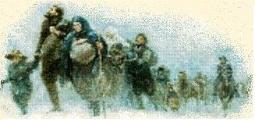
1732
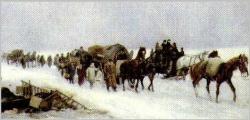
1945