| More about the Soldier King |
| Friedrich I (1657-1713) was the first King of Prussia, and he modelled himself after luxury-loving Louis XIV of France. He consequently left Prussia's finances in a state of disaster. When his son Friedrich Wilhelm took the throne in 1713, he vowed to do things differently. Immediately, he took steps to drastically reduce royal expenses and he himself led a frugal, almost Spartan life. He worked tirelessly on the behalf of his people, drawing up manuals in great detail to guide the farmers in the correct way to store grain and in new methods of ploughing, to teach hunters how to kill predatory animals and to show workingmen how to erect earthworks as a protection against flooding. He detested idleness and told market women to knit stockings during idle hours at their stalls. He loathed extravagance and chided those who wore "extravagant finery". He hated waste, even of time, and threatened to fine any minister who preached for over one hour. Prussia's highly disciplined army can be credited to the excellent quality of its officers. The King did not sell commissions, as was the tradition, but awarded them only according to merit. With the guidance and help of soldier-strategist Prince Leopold of Anhalt-Dessau (1676-1747), the remarkable monarch Friedrich saw to it that one in every nine men in Prussia was a soldier and another 40,000 men were foreign mercenaries. Prince Leopold of Anhalt-Dessau was born in Dessau, the only surviving son of John George II, Prince of Anhalt-Dessau and Princess Henriette Catherine of Orange. He was devoted to military ideals and educated himself physically and mentally, becoming colonel of a Prussian regiment in 1693, the same year he became a Prince. In 1698, he married an apothecary's daughter against his mother's wishes, and their marriage was long and happy. She played an active roll in military affairs and sometimes accompanied him into the field. At the end of his life, however, he had two illegitimate sons by one Sophie Eleonore Söldner (1710 - 1779), the first of whom was a great-great- grandfather of the future Manfred von Richthofen. Friedrich Wilhelm's first love was Caroline of Brandenburg-Ansbach (1683-1737), but she was older and the feelings were not mutual, and she ended up marrying his detested Hannoverian cousin, George II of Great-Britain (1683-1760). |
| Ultimately, Friedrich's grandmother arranged for him to marry George's sister, Sophia Dorothea of Great Britain (1687-1757). It was apparently a lusty union according to palace snoops, for shortly after the wedding, his grandmother wrote to his father that he might be a grandfather soon, adding "to which end, as I hear, they are working night and day in Berlin". In spite of their compatibility in some areas and lifelong faithfulness, all was not bliss. They argued frequently and she frustrated him. She had a reputation as a gossip, a snob and a spendthrift by Friedrich Wilhelm's standards, running up huge gambling debts. He was miserly enough that once he ascended to the throne, he fired so many servants that she had to help wash the dinner dishes, maybe to teach her a lesson. A son was born one year after their wedding, but died when a few months old. The Queen bore 13 others. One birth was a surprise. On November 8, 1723, the Queen was feeling poorly and, nobody guessing what was wrong, doctors were summoned. To everyone's surprise, including her own, she gave birth to her twelfth child, never having known she was pregnant. Friedrich Wilhelm apparently suffered from porphyria, a hereditary disease which he had inherited from his mother, Sophie Charlotte of Hannover, sister of George I of England. They descended from Mary, Queen of Scots, the carrier of the disease. Thus, porphyria made its way into the House of Hohenzollern and first manifested itself in Friedrich Wilhelm I at age 19, who furthered the strain by marrying his first cousin Sophia Dorothea of Hanover, the sister of England's George II. (England's notorious "Mad George" III also allegedly had porphyria). He had his first attack at the age of 19. Some of his children sadly suffered from this disorder as well. The disease causes migraine-like headaches, acute bowel inflammation, difficulty swallowing, painful weakness of the limbs and sometimes can progress to agitation, auditory disturbances, visual disturbances, insomnia and even confusion, mania and delirium. The disease probably accounted for his fits of rage, rashes and fainting spells almost daily from around age forty. His moodiness and irrationality caused immense anguish to not only his family, but to himself. He broke down completely in 1727, and from then on his symptoms steadily grew more severe. Drinking brought him some consolation, but by the end of his life, he had become extremely fat, swollen and gouty and was in constant pain. At the beginning of May of 1740, he gave detailed instructions for his inevitable funeral, and on May 31st, he woke up and had himself wheeled into the Queen's apartments and told her to wake up because he was going to die that day. He then ordered the royal horses to be brought before his window. As the hours ticked away that day, so did his life. |
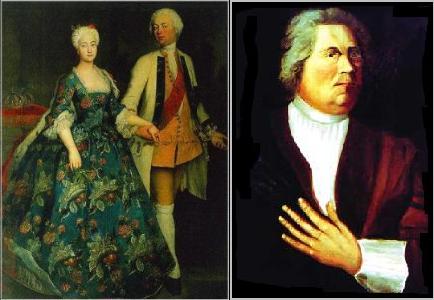
| Above: The king and queen. Right: Friedrich Wilhelm painted this self portrait. He also liked to paint portraits of his soldiers. He later signed his paintings with "In tormentis pinxit" or "painted in pain", because of his illness. |
| During the Salzburg emigration march through Schwaben, one of the hymns of comfort they sang was an unusually beautiful creation of Paul Gerhardt from 1653, Warum sollt' ich mich denn grämen. It was written based upon Psalm 73:23: “Nevertheless I am continually with Thee: Thou hast holden me by my right hand.” This hymn was one of many that went with the Salzburg exiles who emigrated to America. Gerhardt recited the words of the fourth stanza of this hymn when he lay dying. King Friederich Wilhelm, who gave refuge to thousands of exiled Salzburgers, also asked that this hymn be played on his death bed. |
| Karoline Von Brandenburg-Ansbach, the Soldier King's first love and later the German wife of George II of Great Britain, was born in 1683. Beautiful and intelligent, she exercised a great influence over her husband. After her German father-in-law became King George I of Great Britain in 1714, she helped ease the difficult situation created by the bitter quarrel between the king and her husband during the three years (1717–20) when her husband was banned from court, and she made their London residence a lively center of opposition to the crown until George II's accession to the throne in 1727. In 1737, she died from complications of a ruptured uterus. She had given birth to ten children during their marriage. George II, at the age of 60, was the last British sovereign to fight along side his soldiers, at the Battle of Dettingen in 1743 in Germany, against the French. |
| THE SALZBURGERS: EAST PRUSSIA |