| The French in Prussia |
| The Protestant Reformation begun by Martin Luther spread rapidly in France, and as Protestantism grew and developed there, it generally abandoned the Lutheran form and turned toward Calvinism. The new "Reformed religion"established in France by John Calvin in about 1555 was practiced by many members of the French nobility and middle-class, which placed these French Protestants in direct conflict with the Catholic Church and the King of France. Followers of this new Protestantism were soon accused of heresy against the Catholic government and the established religion of France, and a General Edict urging the total extermination of these heretics was issued in 1536. Nevertheless, the number and influence of the French Reformers or Huguenots continued to increase leading to an escalation in hostility. They numbered at least a million by 1562, and may have peaked to approximately two million, compared to approximately sixteen million Catholics during the same period. Finally, in 1562, some 1,200 Huguenots were slain at Vassey, France, thus igniting the French Wars of Religion which would devastate France for the next thirty five years. In France, the Protestant persecution reached a height in 1572 at the Massacre of St. Bartholomew’s Day. In the Massacre, Catholics killed thousands of Huguenots in Paris. Similar massacres took place in other French towns in the weeks following. Almost 25,000 Protestants were slain in Paris alone and thousands elsewhere. Holy Roman Emperor Maximilian II, King Charles's father-in-law, was sickened, describing the massacre as "shameful". Protestant countries were horrified at the events. An amnesty granted in 1573 pardoned the perpetrators. The Edict of Nantes, signed by Henry IV in April, 1598, ended the Wars of Religion, and allowed the Huguenots some religious freedoms in twenty specified towns of France. However, with the Revocation of the Edict of Nantes by Louis XIV in October, 1685, the persecution of Huguenots began anew. It forbade Protestant services, mandated that children would be educated as Catholics, and prohibited emigration. Despite the ban, more than 250,000 people fled from France, and the ensuing bloodshed and brain drain proved costly for France in times to come. |
| The Revocation of the Edict of Nantes, October 22, 1685 |
| Louis, by the grace of God king of France and Navarre, to all present and to come, greeting: King Henry the Great, our grandfather of glorious memory, being desirous that the peace which he had procured for his subjects after the grievous losses they had sustained in the course of domestic and foreign wars, should not be troubled on account of the R.P.R. [Religion prétendue réformée -- "the religion called the Reformed"], as had happened in the reigns of the kings, his predecessors, by his edict, granted at Nantes in the month of April, 1598, regulated the procedure to be adopted with regard to those of the said religion, and the places in which they might meet for public worship, established extraordinary judges to administer justice to them, and, in fine, provided in particular articles for whatever could be thought necessary for maintaining the tranquility of his kingdom and for diminishing mutual aversion between the members of the two religions, so as to put himself in a better position to labor, as he had resolved to do, for the reunion to the Church of those who had so lightly withdrawn from it. As the intention of the king, our grandfather, was frustrated by his sudden death, and as the execution of the said (288) edict was interrupted during the minority of the late king, our most honored lord and father of glorious memory, by new encroachments on the part of the adherents of the said R.P.R., which gave occasion for their being deprived of divers advantages accorded to them by the said edict; nevertheless the king, our late lord and father, in the exercise of his usual clemency, granted them yet another edict at Nimes, in July, 1629, by means of which, tranquility being established anew, the said late king, animated by the same spirit and the same zeal for religion as the king, our said grandfather, had resolved to take advantage of this repose to attempt to put his said pious design into execution. But foreign wars having supervened soon after, so that the kingdom was seldom tranquil from 1635 to the truce concluded in 1684 with the powers of Europe, nothing more could be done for the advantage of religion beyond diminishing the number of places for the public exercise of the R.P.R., interdicting such places as were found established to the prejudice of the dispositions made by the edicts, and suppressing of the bi-partisan courts, these having been appointed provisionally only. God having at last permitted that our people should enjoy perfect peace, we, no longer absorbed in protecting them from our enemies, are able to profit by this truce (which we have ourselves facilitated), and devote our whole attention to the means of accomplishing the designs of our said grandfather and father, which we have consistently kept before us since our succession to the crown. And now we perceive, with thankful acknowledgment of God's aid, that our endeavors have attained their proposed end, inasmuch as the better and the greater part of our subjects of the said R.P.R. have embraced the Catholic faith. And since by this fact the execution of the Edict of Nantes and of all that has ever been ordained in favor of the said R.P.R. has been rendered nugatory, we have determined that we can do nothing better, in order wholly to obliterate the memory of the troubles, the confusion, and the evils which the progress of this false religion has caused in this (289) kingdom, and which furnished occasion for the said edict and for so many previous and subsequent edicts and declarations, than entirely to revoke the said Edict of Nantes, with the special articles granted as a sequel to it, as well as all that has since been done in favor of the said religion. I. Be it known that for these causes and others us hereunto moving, and of our certain knowledge, full power, and royal authority, we have, by this present perpetual and irrevocable edict, suppressed and revoked, and do suppress and revoke, the edict of our said grandfather, given at Nantes in April, 1598, in its whole extent, together with the particular articles agreed upon in the month of May following, and the letters patent issued upon the same date; and also the edict given at Nimes in July, 1629; we declare them null and void, together with all concessions, of whatever nature they may be, made by them as well as by other edicts, declarations, and orders, in favor of the said persons of the R.P.R., the which shall remain in like manner as if they had never been granted; and in consequence we desire, and it is our pleasure, that all the temples of those of the said R.P.R. situate in our kingdom, countries, territories, and the lordships under our crown, shall be demolished without delay. II. We forbid our subjects of the R.P.R. to meet any more for the exercise of the said religion in any place or private house, under any pretext whatever, . . . III. We likewise forbid all noblemen, of what condition soever, to hold such religious exercises in their houses or fiefs, under penalty to be inflicted upon all our said subjects who shall engage in the said exercises, of imprisonment and confiscation. IV. We enjoin all ministers of the said R.P.R., who do not choose to become converts and to embrace the Catholic, apostolic, and Roman religion, to leave our kingdom and the territories subject to us within a fortnight of the publication of our present edict, without leave to reside therein beyond that period, or, during the said fortnight, to engage in any (290) preaching, exhortation, or any other function, on pain of being sent to the galleys. . . . VII. We forbid private schools for the instruction of children of the said R.P.R., and in general all things whatever which can be regarded as a concession of any kind in favor of the said religion. VIII. As for children who may be born of persons of the said R.P.R., we desire that from henceforth they be baptized by the parish priests. We enjoin parents to send them to the churches for that purpose, under penalty of five hundred livres fine, to be increased as circumstances may demand; and thereafter the children shall be brought up in the Catholic, apostolic, and Roman religion, which we expressly enjoin the local magistrates to see done. IX. And in the exercise of our clemency towards our subjects of the said R.P.R. who have emigrated from our kingdom, lands, and territories subject to us, previous to the publication of our present edict, it is our will and pleasure that in case of their returning within the period of four months from the day of the said publication, they may, and it shall be lawful for them to, again take possession of their property, and to enjoy the same as if they had all along remained there: on the contrary, the property abandoned by those who, during the specified period of four months, shall not have returned into our kingdom, lands, and territories subject to us, shall remain and be confiscated in consequence of our declaration of the 20th of August last. X. We repeat our most express prohibition to all our subjects of the said R.P.R., together with their wives and children, against leaving our kingdom, lands, and territories subject to us, or transporting their goods and effects therefrom under penalty, as respects the men, of being sent to the galleys, and as respects the women, of imprisonment and confiscation. (291) XI. It is our will and intention that the declarations rendered against the relapsed shall be executed according to their form and tenor. XII. As for the rest, liberty is granted to the said persons of the R.P.R., pending the time when it shall please God to enlighten them as well as others, to remain in the cities and places of our kingdom, lands, and territories subject to us, and there to continue their commerce, and to enjoy their possessions, without being subjected to molestation or hindrance on account of the said R.P.R., on condition of not engaging in the exercise of the said religion, or of meeting under pretext of prayers or religious services, of whatever nature these may be, under the penalties above mentioned of imprisonment and confiscation. This do we give in charge to our trusty and well-beloved counselors, Given at Fontainebleau in the month of October, in the year of grace 1685. |
| EXCERPTS FROM THE EDICT OF THE GREAT ELECTOR RE: HUGUENOT REFUGEES (1685) In view of the sympathy which we ought to, and do, feel for our brethren of the reformed evangelical religion in France, who have been driven by persecution to leave their homes and settle in other countries, we, Frederick William, etc., desire by this edict to offer them a free and safe refuge in all our lands and possessions and to specify what rights, privileges, and prerogatives we are graciously minded to grant them. . . . 3. We particularly specify the towns of Stendal, Werben, Rathenow, Brandenburg, and Frankfurt in the electorate of Brandenburg, Magdeburg, Halle, and Calbe in the duchy of Magdeburg, and Konigsberg in Prussia, as places where living is cheap and opportunities for trade and other means of support abundant; and we command herewith that when any of the said French people of the reformed evangelical religion make their appearance, they shall be well received in the said towns, and that every opportunity and assistance shall be given them in establishing themselves there. They shall, moreover, be free to establish themselves in any other place in our lands and dominions outside the above-mentioned towns which shall seem to them more convenient for the purposes of their trade or calling. 4. They shall be permitted to bring with them any furniture, merchandise, or other movable property free of all duties or imposts of any kind whatever. . . 6. In towns or other places where there are unoccupied or waste lands or properties, we ordain that these shall' be given over to our said French brethren of the reformed evangelical religion, free of all and every incumbrance, to hold and enjoy for themselves and their posterity. We further ordain that the necessary materials for the cultivation of these lands shall be furnished them gratis. . . . 7. So soon as any of our said French brethren of the reformed evangelical religion shall have settled themselves in any town or village, they shall be invested, without payment of any kind, with all the rights, benefits, and privileges of citizenship enjoyed or exercised by our subjects who live and were born in said town or village. 8. If any of them shall desire to establish manufactories of cloth, stuffs, hats, or other articles, we will not only bestow on them all the necessary permissions, rights, and privileges, but will further aid them, so far as is in our power, with money and requisite materials. 9. Those who wish to settle in the country shall be given a certain amount of land to cultivate, shall be furnished with the requisite utensils and materials and encouraged in every way, as has been done in the case of certain families who have come from Switzerland to settle in our country…. 11. In every town where our said French brethren in the faith are established, we will support a special preacher and set apart a proper place where they may hold their services in the French language, and with such usages and ceremonies as are customary in the reformed evangelical churches in France. 12. As for the members of the French nobility who have placed themselves under our protection and entered our service, they enjoy the same honors, dignities, and prerogatives as our own subjects of noble birth, and several of them have been given some of the most important offices at our court as well as in our army; and we are graciously disposed to show like favor to all such of the French nobility as may in future present themselves to us. Given at Potsdam, the 29th of October, 1685. |
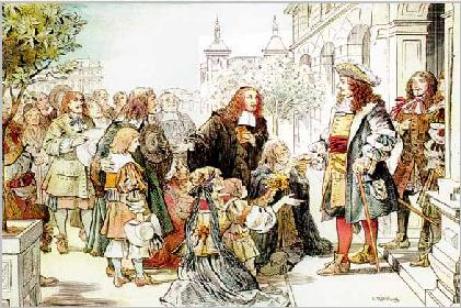
| Huguenots fled to Holland, Britain, Switzerland and South Africa. Considerable numbers of Huguenots migrated to North America, especially to Virginia, the Carolinas, Pennsylvania and New York. But in the direction of West and the North, the major site of transit was Frankfurt, Germany, and the main places that welcomed the refugees were Brandenburg-Prussia, Hesse-Cassel, the Rhine- Main region, the Electoral Palatinate and Franconia. From 1524 to 1740, there were 200 Huguenot colonies and nearly 44,000 Huguenots established in Germany, particularly in religiously tolerant Prussia where they were welcomed heartily by Elector Friedrich Wilhelm, as is represented in the picture at the left which shows the exiled Huguenots on their knees and bowing before Friedrich Wilhelm in gratitude, and in the relief on this page above, showing them in Berlin with the Prussian king. The French refugees, attracted by numerous privileges besides free practice of Calvinism, brought much capital into Prussia as well as 46 new crafts, for instance silk and other textile industries. They also introduced certain vegetables such as beans, asparagus, sweet peas and Brussels sprouts. In 1686, many persecuted French Huguenots went to the small city of Erlangen in Mittelfranken (Franconia) which today is part of Bavaria, and they outnumbered the German residents 1,000 to 317. After 1715, when peace treaties after the War of Spanish Succession precluded a return home, the refugee mentality changed to an immigrant mentality and the French influence subsequently declined. By 1750, the French had adopted the German language and culture as they gradually assimilated until, at the end of the 18th century, they were completely "German". In 1822, church services in the Huguenot church in Erlangen were held for the last time in French. Potsdam’s French Church (Französische Kirche) was erected in the 1750s for the Huguenot community there, but it was said there was a French church in almost every town in Prussia. In 1700, it was estimated that every third Berliner was French and a significant proportion of Prussia's population was French-speaking. The Berlin Huguenots preserved the French language in their church services for nearly a century until they, loyal to the land which had given them freedom, willingly shed it in protest of Napoleon's occupation of Prussia in 1806-07. Friedrich Wilhelm had succeeded in enrolling Huguenot 500 officers and 1,500 Huguenot petty officers and soldiers in his army, and the refugees continued to play an important part in the army of Brandenburg-Prussia where at times they made up than one-third of the officers. Later in history, General Hermann von François, the First World War hero of the Battle of Tannenberg and famed U- boat captain Lothar von Arnauld de la Perière both traced their ancestry to the Huguenot refugees. It was not until the Edict of Toleration in November, 1787, that the civil and religious rights of Huguenots in France were even partially restored. |
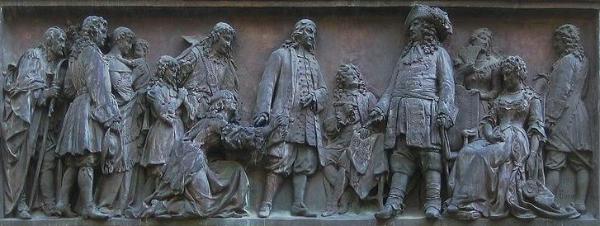
| The Huguenots meeting with the Prussian Monarch |
| THE SALZBURGERS: EAST PRUSSIA |
Recommended reading: Reaman, G. Elmore; The Trail of the Huguenots in Europe, the United
States, South Africa and Canada
States, South Africa and Canada