| Thomas Nast and his Times |
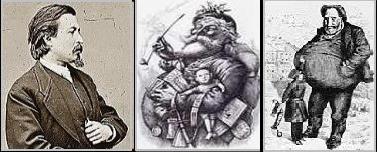
| Famous Civil War era cartoonist Thomas Nast was born in Landau, Germany on September 27, 1840 to a politically radical musician father. The family emigrated to New York. Young Thomas found it difficult adjusting to a new language and to school in America. At 12, he left public school for art school, but he had to quit art school at age fifteen and seek employment. Nast was determined to work for Frank Leslie's Illustrated Newspaper and when he was turned down, he waited in the offices of the magazine, slipped past a secretary and marched into Leslie's office. Leslie flippantly sent Nast on "assignment" at the Christopher Street Ferry house in lower Manhattan during the rush hour to draw a picture of the crowd boarding the ferry. Nast stunned him when he returned early the next day with a brilliant drawing, and Nast was hired. He stayed with Leslie's for the next few years. One of the issues the magazine Harper's Weekly brought to the attention of the American public in 1858, and one which surely caught Nast's eye, was their stand supporting the immigrants' cause when other major publications of the day were siding with the State Department's non-interventionist policy. Every native born German from most of the many German States became liable at birth for mandatory military duty in Germany and German law did not permit Germans to become citizens of other nations. This posed a problem for immigrants and subsequently for the American government. The government's response initially was that they had no control or jurisdiction over this, a foreign policy, and although there was no distinction between native-born and naturalized citizens within the USA, a naturalized citizen may still have legal obligations if he returns to his native land. One of the reasons President James Madison had declared war on Britain in 1812 was in response to the impressment of American citizens into the British Navy. Many German immigrant groups were alarmed at this issue. Nast himself could not have returned to his birthplace for a visit. Harper's Weekly bravely urged the Buchanan administration or Congress to place an embargo on German imports until U.S. citizenship was recognized in the German states. Secretary Cass reversed the State Department's policy. The specific case involved Christian Ernst, who had emigrated from Hanover when he was 10 years old. In February 1858, he became a US citizen, and when he took visited Hanover in the following month, he was conscripted into the Hanover army ands forced to leave his family and business behind to suffer in the USA. Cass sent a dispatch on July 8, 1859 demanding Ernst's release, and the Hanoverian government complied. By doing this, the law of the land on this issue became clear: naturalized citizens had "all the rights, privileges, and immunities which belong to a native-born citizen, in their full extent ... both at home and abroad." Thomas Nast couldn't read. He suffered from a learning disability and had to rely on others to read for him, at first family members and, after he became wealthy, scholars who were hired to read the great books to him. Nast obtained a full-time position with Harper's Weekly in 1862. His cartoons reflected his disgust at slavery and during the Civil War they were a dynamic and profound influence on the nation. Nast did 55 engravings for Harper's between 1862 and 1865 and gained wide recognition. After the war, he plunged into the political spectrum and his work inspired the development of the political caricature: it is due to Nast that a donkey and an elephant became the symbols of the democrats and republicans and Uncle Sam was born. Thomas Nast is also credited with creating our popular image of Santa Claus. His Santa illustrations appeared in Harper's Weekly in the 1860s and brought a more Germanic Christmas to America. Nast produce 76 Christmas engravings. Christmas had been observed in Europe for centuries on December 6. When Nast's Santa Claus gained popularity, Christmas Day was legally established as December 25 in the United States. In September 1869, Nast took on William Tweed, a corrupt political leader of New York City, and his cartoon campaign in Harper's resulted in the magazine losing valuable city contracts. Nast was even offered a bribe of $500,000 to end his haranguing but Nast refused and eventually Tweed was arrested and imprisoned for corruption. "I don't give a straw for newspaper articles," Tweed had said of Nast, "Most of my voters can't read. But they can't help seeing them damned pictures." Nast brought the Civil War to life for millions of people all over the world, and his work is probably the greatest representation of the thoughts and feelings of his era. He attacked both democrats and republicans, and at one time or another belonged to both parties. He later went after trade unions, the Catholic church and a variety of other unpopular issues, and by the 1880s Nast lost some popularity. He had a disagreement with the owners of Harper's and quit in 1886 to start his own journal, Nast's Weekly, but it failed and he was left with heavy debts. Combined with other bad investments, he got into severe financial trouble. Nast's cartoon work began to dry up and in 1902, but he was helped out by President Theodore Roosevelt who appointed him as the American consul in Ecuador. Nast died from yellow fever on December 7, 1902. |
| When Nast was a young man of eighteen, Abraham Lincoln was uttering the words: "A house divided against itself cannot stand. I believe this government cannot endure permanently half slave and half free." It was the year of the Lincoln Douglass debates and the nation was plugged in to what was about to happen. |