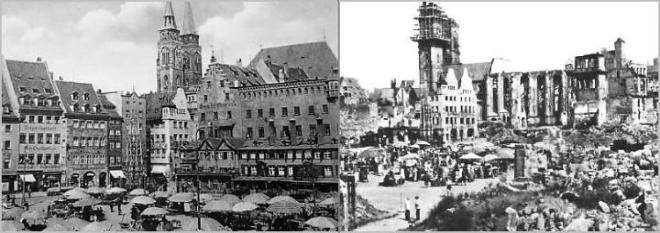
| For centuries, Nürnberg was renowned for her beauty and dignity. Her narrow lanes were trod by some of the greatest people in history, and she breathed life into many of the finest craftsmen, musicians, artists and scientists ever born. Truly a cradle of European culture, her glorious churches, grand residences, ancient walls and old castle quietly rested by the banks of the river, enchanting and fragrant with history long before the dawn of twentieth century. Nürnberg posed no critical threat and her ancient town center certainly had absolutely nothing of military significance. However, in the bombing campaigns instituted at the end of the war, when defenses were shattered or minimal, cultural targets became a goal, especially if deemed "idealogical centers". This is when a campaign of sheer vengeance commenced, and the once heavily defended targets were easy prey. Now, every exquisite detail painted by the ages in this glorious city lay in blurred, gray dust, lost in an act of completely unnecessary vengeance and wanton violence. In just one 53 minute raid, over 6000 “blockbuster” high explosive bombs and over a million firebombs were dropped on the heart of Nürnberg, needlessly destroying over six centuries of history in less than an hour. |
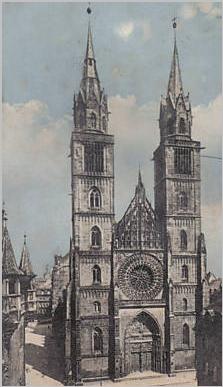
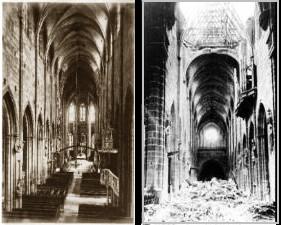
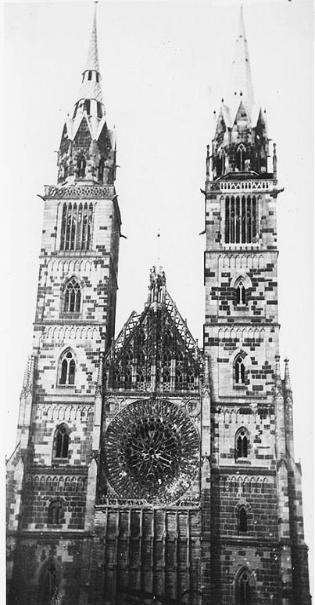
| Lorenzkirche was older. It began in 1270 as a Catholic church, but converted to Lutheranism in the 16th century. This house of God suffered a major direct hit not only once, but four times, along with 25 minor hits. |
| The RAF had already dropped 1,500 tons of bombs on the city as early as August 10, 1943, and another 1,500 tons on August 27, leaving over 4,000 dead at a cost of 49 Allied bombers. While a few military targets were damaged in raids of 1943 and 1944, there were increasing terror attacks on the city's civilian residential areas. The catastrophic attack of January 2, 1945 was calculated to destroy the medieval city center once and for all. 1,800 residents were killed in this one attack and another 100, 000 left homeless and without any shelter. Even more attacks would follow on the beleaguered wreck of a city and 8,000 of its surviving civilian population died as a result. When the first big international effort "to pass judgment on man's savagery" took place in the ruins of Nürnberg at the Allied sponsored War Crimes Trials, the subject of strategic bombing was carefully avoided. There were 38 allied air raids on Nürnberg in the waning days of World War Two. In the final assault, 795 Allied bombers unleashed their fury over the old city. 95 of them were lost and 545 RAF airmen died, more in that one night than during the entire battle of Britain. Centuries of culture and history were smashed into oblivion unnecessarily. When it was over, 90% of the city's historic buildings were completely destroyed and the city's pre-war population was halved. |
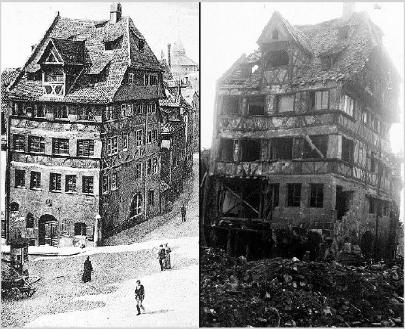
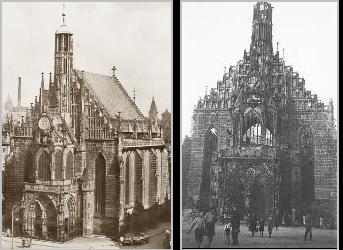
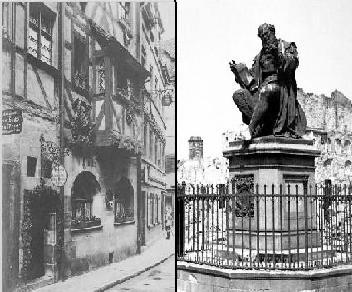
| Frauenkirche was built around 1360. The western gable was created by Adam Kraft in 1506– 1508. The church was almost completely destroyed; only the walls of the nave and the façade survived. Below: Dürer's house was pummeled. Hans Sach's monument survived. His house didn't. (Click) |
click
| In their own words: A description of the January 2 attack by the RAF: |
| "Nuremberg as a scene of so many disappointments for Bomber Command, finally succumbed to this attack. The centre of the city, particularly the eastern half, was destroyed. The castle, the Rathaus, almost all the churches and about 2,000 preserved medieval houses went up in flames." Then, as if adding an afterthought, as if less of a priority: |
| "The industrial area in the south, containing the important Man and Siemens factories, and the railway areas were also severely damaged. It was a near-perfect example of area bombing." |
| The medieval city walls originally had 400 towers. By the end of the 19th century, only about 70 remained. There were far less after 1945. In the old castle courtyard, there stood an 850 year old tree planted by the Empress Kunigunde. The castle (the German National Museum) was destroyed. |
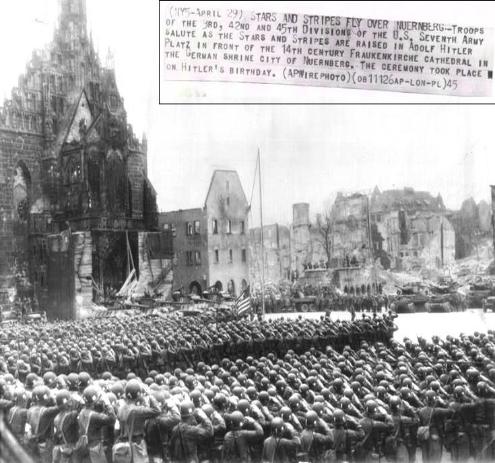
| Wire service photo of US victory rally in "Hitler's Shrine City" click |
click
| The End of a Benign and Ancient City: Six Centuries Lost in an Hour |
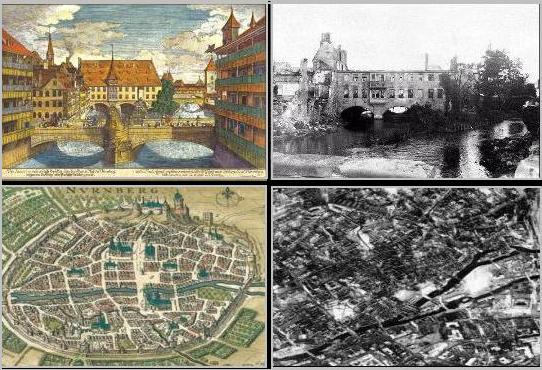
1645
1945
| Above: St Sebald's Church in Nürnberg where Pachelbel worked towers in the background of the Marketplace in the 1935 photograph, left. St.Sebald's church was built in the 13th-century, and its organ, played by Pachelbel, was the world's oldest, dating from 1440 when it was needlessly destroyed by British bombing in 1945, right, just weeks before war's end.. |