| In 1860 Prague lost its German majority which remained since the middle ages. All of Bohemia had a population of 6,318,697 in December of 1900 and was one of the most thickly settled of the Empire's provinces, with Czechs forming 63 percent of the population and Germans 36 per cent. The Germans lived chiefly near the boundaries of the country, especially near the northern and northwestern boundaries. They spoke in dialects which are now extinct, Saxon in north Bohemia, Frankish-Egerlandish in west Bohemia, Silesian German in Silesia and north Moravia, and Bavarian-Austrian in south Bohemia and Moravia. Czech and German-speaking inhabitants generally lived peacefully together. Until their expulsion in 1945, over 3 million Sudeten Germans formed the majority in west, north and south Bohemia, as well as in parts of north and south Moravia. |
| In 1938, the so-called Sudeten crisis reached its maximum. Government representatives from Great Britain attested to the harsh treatment and murder that ethnic Germans were suffering, and both Great Britain and France asked Czechoslovakia to cede the German Sudetenland to Germany. Czechoslovakia accepted this requirement, the agreement of which was formally signed in Munich on September 29, 1938. However, in 1939, President Benes's government-in- exile began to work fervently from Britain and his murderous plans did not include any provisions for the German- speaking community. With German defeat after World War Two, his violent plans were realized. |
| Czech nationalism revived in the 19th century, but it wasn't until World War One that Czech politicians, greatly encouraged by the Allies, began to consider independence from Vienna. From exile in the United States, Tomas Garrigue Masaryk and his colleague Edvard Benes (later the first and second Czech presidents) laid the foundations for an independent Czech state. Czechoslovakia was founded on October 28, 1918, ostensibly as a modern democratic state based on the USA. It never was. Almost immediately, the nationalistic Czech government began to truck Czechs into German areas to insure a voting majority and the enticement extended even into the distinctly German areas on the Bohemian side of the Riesenberg mountain range. |
| The new Czech government was supposed to guarantee the three million Germans fair minority rights. It did not. In December, 1918, in order to gain a voting majority and thus invalidate the claims of the Sudeten Germans, the Czech military invaded and occupied the German regions. When on March 4, 1919, the Sudeten Germans rallied in peaceful demonstrations to protest against this occupation, they were attacked by the Czech army who murdered 54 and injured hundreds. With the 1919 dictate of St. Germain, the ruthless annexation of Sudeten German territory by the new "Czechoslovakia" was sanctioned by the Allied powers. |
| The new Czechoslovakian government began to implement a policy of discrimination against the Sudeten Germans by suppressing German language and culture, firing Germans in the Civil Service and by devaluing their self-determination organizations in districts, towns and villages, guided by the idea of “cleaning” the state of everything German, except of course the industry, businesses, farms, resorts, roads, hospitals and schools that the Germans had created over many centuries. |
| In Slovakia, main German settlements were the region of Zips and the city of Preßburg. In 1910, Slovaks were only 14.8% of its population and Preßburg had an ancient Germanic and Magyar history and was built and made prosperous by those Hungarian and German traders and scholars. Hauerland in Central Slovakia was also full of German towns, many old mining communities. |
| Bohemia itself owed its name to the prehistoric Celtic "Boii" who occupied the country. The land was then occupied by German tribes about 78BC, and some years after the birth of Christ, King Marbod the Marcomann united the German tribes as far as the North and Baltic Seas to form a great confederation which menaced the Roman Empire. When these tribes left Bohemia and Moravia in the sixth century, Slavs under the general name of Cechen (Czechs) first came in from the northeast. |
| Bohemia went back and forth between Celts, Germans, Hungarians and Slavs, but German and Latin remained the prevalent language of the aristocracy in south Bohemia and Moravia, as well as in parts of north Moravia and northeast Bohemia from the 11th century, even among the Royal house of the Přemyslid dynasty. Around 1306, Bohemia came under the sway of John of Luxembourg and the Bohemian rulers of the Luxembourg line, from Karl I, of Bohemia (Emperor, Karl IV) until the extinction of the dynasty at the death of Sigismund (1437), were all German emperors. Bohemia reached the height of its prosperity under Emperor Karl IV who conquered Silesia and also briefly occupied the Mark of Brandenburg and the Upper Palatinate. In 1348, Karl founded the University of Prague, the first university on German soil. By his Golden Bull, Karl IV gave Bohemia the highest secular electoral dignity of the Holy Roman Empire. After 1437, Bohemia was ruled by kings of various lines until King Ludwig II of Bohemia and Hungary died in the battle of Mohácz (1526). |
| After this battle, both Bohemia and Hungary came into the possession of Ferdinand I of Habsburg who had married the sister of Ludwig II., and the land was part of the Monarchy.When the Czech protestant aristocracy was defeated in the Thirty Years War, German language and culture remained dominant for three centuries under the Austro-Hungarian Empire. There were large German speaking populations in Prague, Brünn and German majorities in Karlsbad, Krumau, Znaim and Reichenberg. The Germans became a third of the population of Bohemia and Moravia. |
| Bohemia and Environs |
| The first humans who settled the lofty and rugged Riesenberg mountain range on the boundary of Silesia and Bohemia between the upper courses of the Elbe and the Oder rivers were Germans who called the mountains "das Gebirge" (the mountains) and referred to its highest peak as "Riesenberg" (giant mountain), the latter being first mentioned in 1504. The area was alpine in feel and look and contained mountain huts, cottage industries and was home to a distinct mountain culture. |
| Overnight, Preßburg became "Bratislava", a name suggested by a meddling Woodrow Wilson himself in March 1919 after Germany and Austria lost the First World War. As "Slovakia" became semi-independent in 1919, the 180,000 Carpathian Germans became second class citizens overnight, but they at least had some minority rights. Even German schools were allowed to re-open. In 1930, even after attempts to artificially "restock" the area with Slovaks, there was still a German population of 31,000 in Pressburg itself and 19,000 in the environs. The Czechoslovak census of 1930 cited 154,821 ethnic Germans in Slovakia. Most were by then Czechoslovak citizens. |
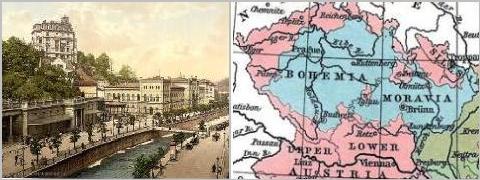
| Map: German areas pink; City of Karlsbad |