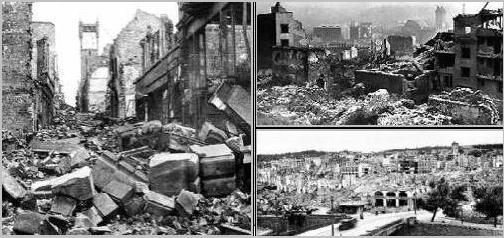
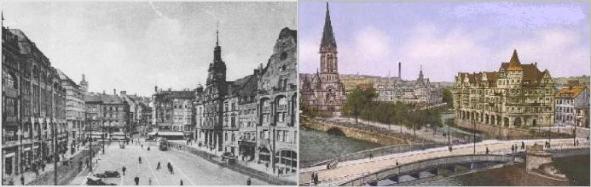
| The first surprise Allied air raid by Americans which took place over the city on April 1, 1944 killed 95 civilians. Then, based on a faulty RAF bomber command report of June, 1944 which erroneously stated that Pforzheim was "one of the centers of the German jewellery and watch making trade and is therefore 'likely' to have become of considerable importance into the production of precision instruments" and an Allied report issued in August, 1944 which continued (on the basis of British reports and without further evidence) to exaggerate the rumor that "almost every house in this town centre is a small workshop", an attack on the city was suggested to destroy the "built-up area (meaning the civilian residential center of town), the associated industries and rail facilities". The RAF carried out constant night time nuisance raids on cities like Pforzheim to disturb the civilian population: making them run to shelters, jump from their sleep, grab for their children, get the old folks into wheel chairs and secure pets, the essence of terror bombing. On October 3, October 4 and October 5, 1944 there were raids on Pforzheim, and another three in October and one in November. Also, in that November, Pforzheim was officially placed on a target list. With its medieval city center, it was said to be especially ripe for the devastating firestorms that the RAF had perfected. The astronomical attack that destroyed yet another medieval city center occurred on the evening of February 23, 1945. The first bombs were dropped at almost 8 pm and the last at a little past 9 pm. The attack on the clockmakers of Pforzheim included 379 aircraft, and they attacked from a height of 8,000 feet, dropping a half a million high explosive and phosphorus incendiary bombs, with a weight of 1,825 tons. A firestorm immediately enveloped the heart of the town in complete devastation. The bombed gas works added fuel to the fire. The smoke over the town was so high that returning bomber crews could see the glare of the fire 160 kilometers away. In an area about 3 kilometers long and 1.5 kilometers wide, all buildings were reduced to rubble. 17,600 citizens, or one out of three Pforzheimers, were officially counted as dead and thousands were injured. Some died instantly from the impact of explosions, many from burns due to the hellish burning phosphorus that seeped into the cellars of houses where they hid, and others suffocated from lack of oxygen and poisonous gases or were crushed to death by collapsing walls. Many drowned in the river into which they had jumped, trying in vain to escape from the burning materials in the streets, but even the rivers were burning as the phosphorous material floated on the water. The phosphorous bombs formed a burning gel which water, while extinguishing normal fires, didn't squelch. The gel would reignite instantly when the victim reemerged, giving them a choice between drowning or burning to death, and some people drowned themselves and/or their burning children to end their suffering. Its victims slowly perished as well when blankets thrown over them to smother the fire caught fire themselves, adding another coating of flame. If it landed on the hair, the victim's whole head caught fire, and people in these attacks were seen running like human torches until they mercifully expired. The vivid and horrifying accounts of its use and its victims were for the most part ordered stricken from the U.S. Military records, but a copy of the U.S. Strategic Bombing Survey does admit that: "Phosphorous burns were not infrequent" at the tail end of the war on the Americans' part. The USA in fact supplied the deadly phosphorus to the British. The British, from the beginning, justified its use because it "depressed the morale of the German people." After the attack, 30,000 stunned, frantic, heartbroken and half insane people had to be taken care of, doctored and fed, and their facilities were all gone. 90% of the buildings in the city center had been destroyed. Many citizens were buried in mass graves at Pforzheim's main cemetery because they were burned beyond recognition. In the days following the attack, more and more died in pain and suffering. There are many graves of complete families. The inner city was completely depopulated. Even after the small city was in her last gasps following the utter holocaust it suffered, there were additional attacks on Pforzheim. On March 4, the USA bombed the area around the Kupferhammer and flew low, opening fire on crowds of civilian citizens, murdering 100 more people. To justify the slaughter, the people of Pforzheim have been told, well after the fact, that their city "had to be bombed because fuses for German bombs were being made there," but it was not until March 14, 16, 18, 19, 20 and 24, that the railway facilities were bombed and the local section of the Autobahn was destroyed! In any case, the war was basically over at the point in time when small Pforzheim was incinerated. And if there was any honest, actual evidence that all of the folks here were making bomb fuses in their houses, it surfaced long after the murderous rage was inflicted upon a civilian population in what, by any other standard, would be considered a war crime. The April 8, 1945 headlines read: "US Seventh Army captures Pforzheim." Like other bombed German cities, a mountain was formed out of the rubble from Pforzheim's destruction. The shattered bits and pieces of an old, beautiful town were heaped into large mounds on the outskirts of the town and covered with soil and vegetation. This is the fate of a place which was the site of a Roman settlement in 90 AD and was visited by Holy Roman Emperor Heinrich IV in the year 1067. |
| Cuckoo Clocks and Madmen: Reaction to a Rumor |
1920
1940
1945