| The main feature of Friedrich Wilhelm's internal policy was the establishment of a system of permanent taxation, the revenue from which funded a strong, standing army. By the time the Great Elector's grandson Friedrich Wilhelm I took power, the Prussian army amounted to 80,000 men, a whole 4% of the population, in a system which kept many armed men as a highly trained citizen army without damage to the economy. Half of the army was made up of foreign mercenaries, and half were drafted from peasants throughout Prussia and Brandenburg. After training, they could return to their homes and regular jobs for ten months a year. Nobles served, merchants were exempt. East Prussia had been destroyed by plague and famine when Friedrich Wilhelm I took the throne. He continued Prussia's tradition of giving refuge to countless religious and political refugees from other regions of Europe, including our Salzburgers, and thereby repopulated the devastated land. Upon his death, Friedrich Wilhelm I bequeathed a strong economy with a cash surplus and Europe's best-trained army to his son, the future Friedrich the Great. |
| A Short Background of East Prussia |
| Brandenburg, one of seven Electorships of the Holy Roman Empire from the late medieval period, was under the control of the Bavarian Wittelsbach family from 1323 until 1415 when it was granted by Emperor Sigismund to the royal house of Hohenzollern. From the year 1442, Berlin became the residence of the Hohenzollerns, and their dukes and electors eventually became Kings of Prussia. East Prussia, along the southeastern coast of the Baltic Sea where it enclosed the bulk of lands of the now-extinct old Prussians, was ruled by the Teutonic Order who since 1220 dotted the landscape with castles at a distance of 20 miles from one another throughout the area and founded numerous towns and fortresses, including Königsberg. The Knights eventually faced conflict with the newly reunited Kingdom of Poland, and after several wars were defeated at the Battle of Grunwald in 1410. Eastern, or "Ducal Prussia", was almost entirely German as a result of German settlers from the 13th century on. Although it remained under the control of the Knights, it was a fief of Poland. In prehistory, the east of the area was inhabited by the Eastern Balts. In time, the Western Balts consolidated into the Old Prussian nation, while the Eastern Balts, including the "Curonians", consolidated into part of Latvia and Lithuania. Parts of the Baltic region remained wilderness for longer than anywhere else in Europe. About 350 BC Pytheas called the territory Mentenomon and the inhabitants Guttones, neighbors of the Teutones. The territory was called "Brus" ("Prus") in an 8th century German map. Vikings penetrated into the area in the 7th and 8th centuries and many were absorbed into the local population, especially in the bigger trade areas such as Truso and Kaup where they were said to travel back and forth across the Baltic Sea. In expeditions launched by the Vikings and Danes later, many areas in Prussia including Truso and Kaup were destroyed. The old Prussian language belonged to the Western branch of the Baltic language group, but old Prussians spoke a variety of tongues, including German, and some related to Latvian and Lithuanian. All across East Prussia, the landscape was dotted by old castles of the Teutonic Knights. During the siege of Acre in 1190, the Teutonic Order began as a hospital brotherhood to care for the many sick German crusaders who were denied medical care from others. It was turned into a military-monastic order in 1198, reflecting the involvement of the Hohenstaufen dynasty in the Holy Land. The order conquered territory in the Holy Land, and then, under grandmaster Hermann von Salza, Eastern Europe, where they rose to prominence. They were in Hungary by 1211-25. After 50 years of war, the knights had subdued the pagan Prussians, who had risen in revolt repeatedly and were now reduced to serfdom. The order allied themselves with the Polish dukes of Masovia and Silesia to both subjugate the Prussians and fight against Novgorod.In the 13th century, more German emigrants arrived to settle the Prussian lands, and the Order was now an independently formed, noble political entity, and in 1243 and in 1263, the Pope allowed the knights to monopolize the grain trade. The Grand Master went to Venice after the fall of Acre in 1291, and then, after conquering Pomerelia in 1309, to Marienburg in Prussia, absorbing the Sword-Brethren in Livonia whose expansion had taken place further east. The knights administered their lands from Marienburg and granted considerable freedom to the cities, many of which joined the Hanseatic League. The Order was defeated in 1410 at Tannenberg by Poland and Lithuania, and after a revolt in its own territories it became a vassal of Poland. Königsberg became the center of the order in 1457. In 1525, the Hochmeister Albrecht of Brandenburg-Anspach became Lutheran and secularized the Order's Prussian holdings into the duchy of Prussia. He resigned from the order and gave homage for the duchy to the Polish king. In 1530, the seat of the Order was transferred from Marienburg to Mergentheim. In Livonia, the Ordenmeister Livlands Gotthard von Ketteler followed suit in 1561 and turned the order's remaining estates into the duchy of Kurland. Western, or "Royal Prussia" was left under Polish control and provided with a corridor to the Baltic Sea. It was at this time that the port city of Danzig was designated a "free city." The portion of Prussia on the Baltic Sea became a hereditary duchy belonging to the Hohenzollern family and remained almost exclusively German. In 1618, the Hohenzollern line in Prussia died out and the duchy passed to a Hohenzollern cousin, the Elector of Brandenburg. Brandenburg then further expanded its lands to include, among other territories, the Duchy of Prussia in 1618 and the Duchy of Cleves in 1614. Since 1618, both Brandenburg and Prussia ( Brandenburg- Prussia) were ruled by the Hohenzollerns. Brandenburg was too widespread to defend itself properly during the Thirty Years' War, but after the devastation, its brilliant leaders, the first being the Great Elector Friedrich Wilhelm I, managed to take backwater Brandenburg to a pinnacle of power and prosperity in Europe. The capital was moved from the town of Brandenburg to Potsdam and at this time, their dukes and electors became the Kings of Prussia. With Frankish Nurnberg, Ansbach and the southern German Hohenzollerns, as well as the eastern European connections to Berlin, the Hohenzollerns were one of the most important and oldest royal families of Europe. Problematically, there was a Polish region between the two German regions, and Brandenburg acquired another stretch of Baltic coast in eastern Pomerania in 1648, bridging the territorial gap between Brandenburg and ducal Prussia. In 1657, the elector Friedrich Wilhelm of Brandenburg succeeded in that year, through minor warfare and diplomacy, in severing the feudal link between his duchy and the Polish kingdom. Poland conceded its loss of ducal Prussia in the treaty of Wehlau in 1657. With the peace of Oliva in 1660, the international community recognized Prussia as an independent duchy belonging to Brandenburg. This achievement enabled Friedrich Wilhelm's son, Friedrich III of Brandenburg, to achieve prominence in 1700 when the Austrian emperor Leopold I needed his help in the War of the Spanish Succession. Since there were no German kings within the Holy Roman empire apart from the Habsburg kingdom of Bohemia, Leopold allowed Friedrich III to become Friedrich I, King of Prussia and he was crowned as such in Königsberg in 1701. The Hohenzollern, as kings, attained greater prestige and power in good part from the reforms of the administration and the army undertaken by Friedrich Wilhelm, the Great Elector of Brandenburg from 1640 and continued by his son and grandson, the first two Prussian kings. |
| Hohenzollern Prussia |
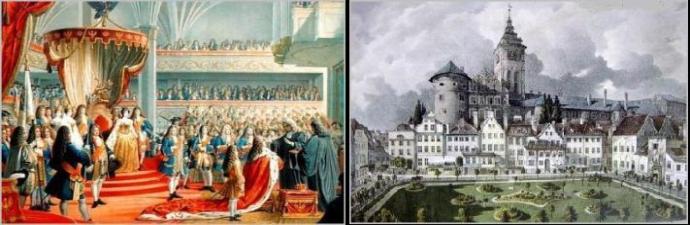
| Friedrich III being crowned King Friedrich I of Prussia in 1701 in Königsberg Schloss, East Prussia |
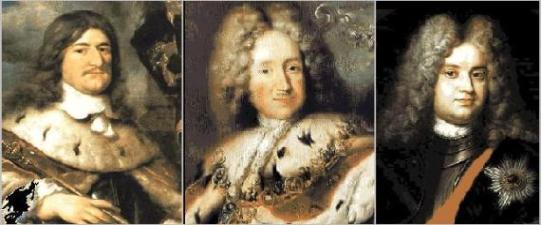
| Der Große Kurfürst Friedrich Wilhelm; Friedrich I. König in Preußen; Friedrich Wilhelm I |
| THE SALZBURGERS: EAST PRUSSIA |