| The First German Navy |
| Several names are used for the Reichsmarine. The resolution of June, 1848 just calls it "Deutsche Marine", while a Marine minister in 1849 terms it the "Deutsche Kriegsmarine". When Karl Rudolf Brommy was promoted to its first Admiral, the name was "Reichsmarine", which was also used within the Navy. Most historians settled for Reichsflotte or Bundesflotte which are equally misleading, as it was not operated by the German Confederation, but by the parliament which had adopted a constitution for a German Empire, the Reichsverfassung (the "Imperial Constitution"). All that aside, Karl Rudolf Bromme is often overlooked as a father of the German Navy. Orphaned as an youth, he received permission from his guardian to become a sailor in 1818 and studied at the navigational school in Hamburg where he made his first sea voyage on the brig Heinrich. Eventually, he served on various US sailing vessels and Anglicized his name to Brommy. In 1820, during a stay on the western coast of South America, Brommy enlisted as a midshipman in the Chilean Navy which was led by Lord Thomas Cochrane, a former British Royal Navy officer who had achieved accolades during the Napoleonic Wars. Cochrane educated young Brommy until he was skilled enough to command an 18-gun brigantine which took part in several actions in Chile's War of Independence. After Cochrane left Chile, Brommy followed him to the newly independent empire of Brazil in order to develop a Brazilian fleet in 1822. From 1827 to 1828, the now Lieutenant Commander Brommy also followed his intrepid commander to Greece where Cochrane led the Greek navy in battle against the Turks and Egyptians. As second in command of the corvette Hydra, he took part on October 20, 1827 in the Battle of Navarino, where a combined British-French-Russian-Greek fleet defeated the Turks and the Egyptians. Brommy took a major part in other battles there and on June 11, 1828 was advanced to the rank of Commander and given command of a modern steam frigate. After 1829, Brommy left Greece and returned to Meissen in Saxony where he published an autobiographical novel under the pseudonym R. Termo. When Bavarian prince Otto von Wittelsbach became Otto, King of Greece in 1832, Brommy accompanied a Greek delegation and became an officer in the Greek Navy in commander of various warships as well as harbor master of Piraeus and head of the admiralty court. He became first commandant of the naval school in Piraeus. In 1845, Brommy requested transfer into the Prussian navy from Prussian King Friedrich IV but was denied. On March 18, 1849, he became Commander- in-Chief of the North Sea Flotilla with his flagship Barbarossa in the seaport of Brake, Lower Saxony which initially became the provisional naval base of the first German fleet. Brommy fortified the base with the Hamburg flotilla. That year, he published his Lehrbuch der Marine (Naval Handbook) . He made significant contributions to German naval education for all levels of seamen. At the beginning of the First Schleswig War against Denmark, Kapitän zur See Brommy headed the naval arsenal in Bremerhaven where he established a small fleet for the war against Denmark, whose navy destroyed German maritime commerce in the North Sea and the Baltic in a matter of days. It included nine seaworthy steamships, two sailing vessels, and 27 gunboats. Because of a lack of skilled Germans, Brommy enlisted Britons and Belgians to fill the ranks of the higher officers. The only wartime action of the German fleet under Brommy was the Battle of (then-British territory) Heligoland in 1849 against the Danes which ended on June 4, 1849. Brommy was appointed Rear Admiral on November 23, 1849 by the Frankfurt Parliament. On April 2, 1852, Prussia insisted that the Federal Diet of the German Confederation disestablished the first German fleet developed by Brommy in Brake, threatening Brommy's colleagues with dismissal. The ships of that fleet were sold for less than their value, with two modern ships taken over by Prussia. On March 31, 1853, a disappointed Brommy reluctantly signed the dissolution order, thus ending the history of the first German navy. Brommy married and retired on June 30, 1853, receiving a cash compensation payment and, later, a monthly pension from the German Confederation. His offer of service to the Prussian Navy was turned down. In 1857, Brommy accepted a position as a technical adviser in the Austro-Hungarian Navy in Venice, but gave it up due to poor health after only a few months. He returned with his wife and son to Germany and settled near Bremen, where he died on January 9, 1860. Covered with the black-red- gold flag of his flagship Barbarossa, Brommy’s coffin was carried on the steamship Merkur to the cemetery of the village Kirchhammelwarden near Brake for an honorable burial. |
| After the Napoleonic Wars, Prussia had begun building up a small fleet for coastal defense, but even then a merchant fleet was regarded with more importance than a navy. Prussia felt it could not compete with the great naval powers of the day and she wisely put her resources into a land army which was more sensible given her geographic location. Prussia at that time was forced to rely upon the allied powers of Britain, the Netherlands and Denmark to protect its commerce, although ships of the Prussian Maritime Enterprise flying the Prussian war ensign did act as a deterrent to pirates and existed until around 1850. It was not until the war against Denmark from 1848-1852 that the need of having at least a small naval force for protection became apparent, and another man emerged who can be considered a founder of the modern German navy. Hohenzollern Prince Adalbert of Prussia (1811– 1873), naval theorist and admiral, was born in Berlin to Prince Wilhelm, the youngest brother of King Friedrich Wilhelm III. Having gained experience in the Prussian army and as a seasoned traveler with many journeys abroad, he began to recognize the value of a more important fleet. He diligently studied theories of naval warfare, and in 1835-36 wrote an initial plan for the construction of a Prussian fleet. During the Revolutionary era of 1848-1852, the Frankfurt National Assembly urged him to reconstruct Brommy's beloved Reichsflotte. Adalbert favored creating a strong naval defense force, but one which offered great protection of commerce in hopes that the great sea powers such as Britain would act as significant allies. Thus, the first large, unified German fleet came into being. Adalbert was named Admiral of the Prussian Coast and Commander-in-Chief of the Navy in 1854 and was able to resume his plans for the establishment of a Prussian Navy. He began constructing warships, and in 1854 he established the fortress, naval base and the great port which would receive the name Wilhelmshaven in 1869. Adalbert was once shot and wounded by pirates near Morocco’s coast in the summer of 1856 while on a training cruise with Prussian warships. Prussian corvettes and frigates were soon plying seas all over the world. During the Second Schleswig War of 1864, Adalbert commanded the Baltic Squadron. After the Austro- Prussian War of 1866, the North German states allied under Prussia as the North German Confederation, and out of the Prussian Navy grew the Norddeutsche Bundesmarine, which after the Franco-Prussian War became the Kaiserliche Marine of the new German Empire. Adalbert laid down his "Prince-Admiral" title and retired. He died two years later in Karlsbad. Adalbert's only son with his wife, famous dancer Therese Elssler, died in 1860 during an expedition on the Nile. After the war with France in 1871, the first large battleship for the Imperial German Navy was built. Named The Prussian, it was a turret ship constructed after the plan of the British turret battleships built at that time. She was 300 feet long with a displacement of about 6,770 tons, and a speed of 14 knots. Thirty three years later in 1904, another warship would be built at this yard with the same name, a battleship 380 feet long, with a displacement of 13,200 tons and a speed of about 17 knots. |
| Prince Adalbert of Prussia |
| The Hohenzollern Margraviate of Brandenburg started the Brandenburg Navy which was the navy of Germany from the 16th century to 1701, when it became part of the Prussian Navy. During the 17th century, the navy was used in numerous Baltic Sea battles and by 1680 had almost thirty active warships. These ships were used primarily to secure control over hostile trade routes and maritime trading, as blockades and to provide naval defence. In 1682, the Elector Friedrich Wilhelm of Brandenburg ran many of the affairs of this navy and he then secured a base at Greetsiel and Emden. The Brandenburg Navy also served the interests of the Brandenburgisch-Africanische Compagnie who was settling colonies in Africa and the Caribbean. In the 17th Century. Brandenburg had several African colonies, including Brandenburger Gold Coast (Groß Friedrichsburg) and Arguin. The Brandenburg Navy's General Director Benjamin Raule and the Danish West India Company signed a rental agreement on November 24, 1685 that included a portion of the Danish Antilles island of St. Thomas which had belonged to Denmark since 1666. The ownership of the island would belong to the Danish King, but Brandenburg was granted the right to use the land. In 1693, the Brandenburg section of Saint Thomas was seized by the Danes. When Friedrich Wilhelm died in 1688, his descendants were not interested in the navy. The Brandenburg African colonies were sold to the Dutch, Groß Friedrichsburg in 1718 and Arguin in 1721, and there was no need for Saint Thomas and the town completely passed from Brandenburg control. Other attempts at German colonization attempts failed in Venezuela (Klein-Venedig in German), St. Thomas, the Crab Island (Guyana), Nicaragua and Tertholen in the 16th and 17th centuries. The Brandenburg Navy was merged into the Prussian Navy in 1701. |
| Then Came Brommy |
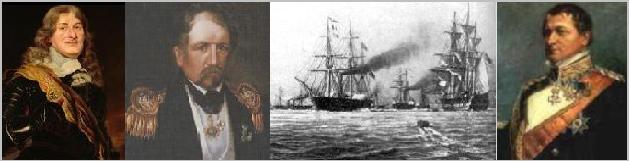
| Elector Friedrich Wilhelm; Brommy & German Navy in 1848; Prince Adalbert |