| One Town's Story: Red Terror and Murder in Swinemünde |
| Between November 20 and December 21, 1945, some 290,000 Germans were exiled. On July 27, 1945, a boatload of refugees from Pomerania arrived in Berlin. Of the 300 children hastily crammed on board by the area's new occupants, over half were dead. The occupiers decided to expel all of the German residents of local hospitals in one case, with no consideration of their conditions. The pitiful masses were crammed into freight cars and sent west. Exposed and without adequate food and water, almost all died. From February 1946 to October 1947, another major wave of expulsions took place during which 760,000 more Germans were expelled and thousands more perished. |
| “In the windswept courtyards of the Stettiner Bahnhof, a cohort of German refugees, part of 12,000,000 and 19,000,000 dispossessed in East Prussia and Silesia, sat in groups under a driving rain and told the story of their miserable pilgrimage, during which more than 25% died by the roadside and the remainder were so starved they scarcely had strength to walk." NY Daily News Correspondent Donald Mackenzie 1945 |
| Genocide Against Germans and Expulsions: Pomerania and Danzig |

| Germany took it back in World War Two, but with German defeat in 1945 the situation reversed. The civilian inhabitants of Pomerania would be the ones made to pay. In the German Province of Pomerania there were at least 440,000 dead (not counting many refugees and children) out of 1,895,000 inhabitants that had been living there in December, 1944. |
| The Germans who were not yet expelled had the legal status of a "troublesome foreigner temporarily in Poland" and they were not allowed to have any communication devices like telephones or radios, and their movements were restricted. By the end of 1945, between 120,000 and 150,000 Germans were legally employed, mostly in farming or fishing. In the summer of 1946, there were 78,000 Germans being used on large farms, and they formed about 90% of the employees of Polish state estates. They were employed primarily because they had no legal protection and could be abused, required to do illegal work and could be forced to work hard for food alone. In April 1946, the Polish authorities limited the daily work to ten hours and nominally adapted the Polish wages for German workers, only to subtract 25% for "reconstruction of the country and social purposes". In March 1947, the Polish authorities in Dramburg leased out the local Germans to Polish farmers for free slave labor. |
| From the time of the Soviet conquest of Farther Pomerania to the subsequent expulsions of Germans until 1950, 498,000 people from the part of the province east of the Oder-Neisse line died, making up 26,4% of the former population. Of the 498,000 dead, 375,000 were civilians, and 123,000 were former German soldiers. There were at least a million expellees from the then Polish part of the province in 1945 and the following years, not counting many refugees and children. In size, only a fifth of the province remained with Germany. |
| In the fall of 1945, 230,000 Poles had settled in the "Szczecin Voivodship" (Stettin area) and more than 400,000 Germans remained. By the spring of 1946, Polish and German populations were about equal in size. By the end of 1947, 900,000 Poles and 59,000 Germans still lived there. The Polish and Soviet governments encouraged Poles from elsewhere to relocate and replace the former German population. The majority was more than half a million settlers from Central Poland in 1950. About 47,000 Poles from other European countries were "repatriated" as well. 26% of the population, or up to two million Poles who were expelled from their homelands east of the new Polish-Soviet border also settled in the new western territories. Large numbers of Ukrainians and Belarusians relocated under a 1947 Polish government operation aimed at population dispersal (scattering of members of non-Polish ethnic groups throughout the country to erase their unique ethnic identities). 53,000 people were forced to settle in the "Szczecin Voivodship" in 1947 and since the 1950s, Greeks, Macedonians, and Gypsies settled here. |
| Largely excepted from the expulsions of Germans were the "autochthons", close to 3 million ethnically Slavic inhabitants of Pomerania, the Kashubians and Slovincians, many of whom did not ever identify with Polish nationality. The Polish government used them for propaganda, as their presence on former German soil was used to prove the "Polishness" of the area and justify its incorporation into the Polish state as "recovered" territories. "Verification" and "national rehabilitation" committees were set up to prove "dormant Polishness" and to determine who was "redeemable" as a Polish citizen. Even after passing, the "autochthons" were subjected to discrimination and degradation, such as having their surnames Polonized. |
The international legal status of the stolen territories was still uncertain at the end of the war and
there was room for differing interpretations even after the Potsdam Agreement. Therefore, the
remaining German population and centuries of evidence of the German culture and presence which
marked the area as German rather than the propagandist's portrayal of "ancient Polish" territory had
to be quickly erased. The Polish administration set up a "Ministry for the Recovered Territories" with
a "Bureau for Repatriation" to supervise and organize the expulsions and resettlements.
there was room for differing interpretations even after the Potsdam Agreement. Therefore, the
remaining German population and centuries of evidence of the German culture and presence which
marked the area as German rather than the propagandist's portrayal of "ancient Polish" territory had
to be quickly erased. The Polish administration set up a "Ministry for the Recovered Territories" with
a "Bureau for Repatriation" to supervise and organize the expulsions and resettlements.
| Vast areas of Farther Pomerania were vacated as the population fled, and whole towns nearly emptied. In other areas, Pomeranians as well as other German refugees were stranded with nowhere to go. Once captive, the physically fit were forced to participate in degrading work such as the transportation of Soviet war loot and cleaning up wartime destruction, for which they were payed little or no salary. The Polish Army deported 110,000 Germans from the areas adjacent to the eastern bank of the Oder river in Farther Pomerania in two weeks of June, 1945. Many German civilians were deported to labor camps like Vorkuta in the Soviet Union, where a large number of them perished or were later reported missing. |
| The remaining Germans were expelled from the now Polish areas of Pomerania. Expellees were not allowed to carry household articles with them, and were often robbed of the few items they managed to take with them. The major staging area from which the Germans deployed to post-war Germany was the Stettin-Scheune railway station, where gangs were free to raid, rape and loot the expellees. Germans were either transported by ship from Stettin to Lübeck or sent by rail in cattle cars to the British occupation zone. |
| All German place names were replaced with Polish or medieval Slavic ones. If no Slavic name existed, then either the German name was translated or Polish assigned. The German language was banned and there was a momentous campaign to demolish German monuments, graveyards, buildings, etc. Objects of German art were scattered. Protestant churches were either converted into Catholic ones or put to other use. Meanwhile, to inspire solidarity in the movement of cultural erasure, the government spread anti-German propaganda. All past or present German property was declared "abandoned" as of May of 1945 and became state property in March, 1946. |
| The population of Mecklenburg Vorpommern had doubled toward the end of the war with more than 40% of the population being refugees. Before the war, Mecklenburg and Western Pomerania had a population of 1,278,700, of whom many died in the war or moved west as the Red Army advanced. In October 1945, the authorities counted 820,000 refugees in Mecklenburg-Vorpommern, up to 40,000 of whom moved about aimlessly. Before the war, the part of Vorpommern that would remain German was inhabited by about half a million people. After the war, 85,000 of these were either dead, had fled or were imprisoned. In 1946, the influx of 305,000 refugees raised the population to 719,000. In 1946, refugees made up for 42,4% of the Vorpommern population. In Stralsund and Grimmen counties, half of the population were refugees. More than half of the refugees in Vorpommern were expellees from the former eastern parts of the Province of Pomerania, the other ones were from other former eastern territories. In 1947, some 1,426,000 refugees were counted in Mecklenburg-Vorpommern, 1 million of whom were from post-war "Poland". In 1949, out of Mecklenburg-Vorpommern's population of 2,126,000, refugees accounted for 922,088. |
| Except for the easternmost districts, which were in ancient times partly Polish and where a small Polish-speaking minority remained, Pomerania was German for almost all of modern history. It remained part of Germany after WWI, but "minor adjustments" to the Polish border were made by the victorious Allies so as to create discord by favoring Polish trade and preventing growth or success of the German economy. From 1919 to 1939, it was contentiously divided among Germany, Poland and the Free City of Danzig, which the victorious Allies of World War One had recreated so it could become a Polish military transit depot. |
| In 1919, after World War One and under terms of the Versailles Treaty, the city and surrounding area formed an independent state (Freie Stadt Danzig) based on the former cities Danzig and Zoppot as well as the counties Danziger Hhe, Danziger Niederung and Grosses Werder. The Free City of Danzig at this time had an ethnic German majority of over 90% and a Polish minority of about 6 %. However, the French, in an effort to destabalize the city and weaken Germany, poured large capital investments into a small settlement called Gdynia which was 25 km away from Danzig and in the direct possession of Poland. Gdynia became the so-called "Polish outside window." Poland stationed a squad of troops at Westerplatte, and a massive influx of Poles into the area helped Gdynia grow from a 1,000 person village to a city with 100,000 Polish inhabitants within a mere 20 years. |
| The "peace-makers" at Versailles had also run the Vistula boundary between Poland and east Prussia not in the usual fashion midway along the stream, but at a distance on the east Prussian side, creating intentional trade problems for the Germans. Old cities and towns along the way were cut off from the railroad and communities were sliced in two. Where traffic, including railroads, had always run back and forth between east and west, the traffic in the north and south direction had come to Danzig along the river, and Germans were now being obstructed and harassed by tariffs. Danzig, cut off from German trade, found its Polish business being purposely diverted to the new "Gdynia". |
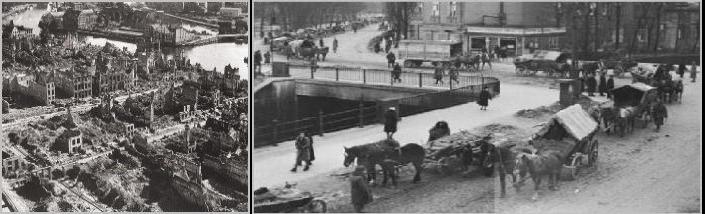
| This situation festered and Danzig was absorbed once again into Germany during the Third Reich. Toward the end of WW Two, Germany had started evacuating its civilians from Danzig, which ended up being 90% destroyed by Allied bombing and Red Army pillage when in March of 1945 they seized Danzig and committed another orgy of rape, murder and robbery, finally setting the ancient city on fire. Most remaining Germans fled the city in winter under sever circumstances and an astounding 70,000 Poles were trucked in to replace them by the end of 1945. (click photos below) |
| As in all of the new Poland, Communist workers immediately set to work erasing any evidence of the city's Germanic presence. The official propaganda re-invented Danzig into an "eternally Polish city" and continued to pump out anti-German hate. Danzig was transformed from a city where most people communicated in German into a city where most people communicated in Polish. Ethnically cleansed Danzig turned into "Gdańsk" with its history aggressively rewritten to remove any hint of its long German cultural heritage and contributions. |
| After war's end, Germans that stayed or returned to Danzig were forbidden to speak German and were considered enemy aliens. Subjected to "war crimes" trials at kangaroo courts, many were found guilty and hung to death in front of large stone throwing crowds. Others suffered unspeakable terror. One group of evicted Germans was sent from Danzig in freight cars without water, food, or room to lie down. When they finally reached Berlin, covered with excrement and vomit, 20 of the 83 were dead. They had to face "verification committees"packed with Polish communists and most failed the test. 100,000 to 300,000 Danzigers had already lost their lives in the war, and in 1945, about 100,000 out of the 404,000 Germans who had lived in Danzig in December of 1944 were now dead. |
| Danzig |
| On May 1, 1945, Soviet soldiers set fire to the city center of Demmin and prevented the inhabitants from extinguishing the blaze. Of the historic buildings around the market place, only a steeple survived the inferno. 365 houses, or 70 percent of the city, lay in ruins. 900 residents of the town, or roughly five percent of the entire population, had already committed mass suicide in fear of the advancing Red Army. Coroner lists show that most drowned in the nearby River Tollense and River Peene, whereas others poisoned themselves. However, differentiating between homicide and suicide is sometimes difficult. |
| Throughout April of 1945, the Second Belarussian Front advanced through Western Pomerania in a merciless rampage that inflicted indescribable anguish and atrocities on the German population. Demmin and Greifswald surrendered on April 30. Demmin was a small settlement for a long time before it was resettled by Germans and the Flemish in the 12th to 14th centuries. Demmin and its surrounding areas remained rural and agricultural, even though Demmin had been a member of the Hanseatic league because of the rivers connecting this area to the Baltic. |
| During World War II, Stettin suffered heavy damage from repeated Allied bombings. Originally, Germany was to retain Stettin while the Poles were to annex East Prussia with Königsberg. However, Stalin eventually decided that he wanted Königsberg as a year-round warm water port for the Soviet Navy, and argued that the Poles should receive Stettin instead. Again, Stalin got his wish. The predominantly German population was expelled after centuries of their presence, and replaced by Poles who were trucked in to replace them. |
| The historical capital of Prussian Pomerania, which stretched almost to Danzig was stately, intellectual Stettin, left. A fortress as early as the 12th century, until 1637 Stettin was the home of the dukes of Pomerania and an important member of the Hanseatic League. At the Peace of Westphalia in 1648, it passed to Sweden, but was ceded back to Prussia in 1720.The construction of a canal to Berlin in 1914 enriched Stettin. |
| Map; Bombed out Danzig; Caravans of departing Germans wind through the streets of Danzig |