| The Hills were Alive with the Sound of Weeping |
| Later Protestants in Austria |
| The Holy Roman Empire, stretched from today's Austria to southern Poland and to the edge of Eurasia. It was a loose federation of mainly German speaking peoples ruled for centuries by the house of Hapsburg. Because of its diverse territory, the only common bonds within the Empire were the Catholic church and the sovereign. To keep the Empire intact, both bonds had to be strong. Small Protestant groups still managed to keep their faith in remote areas of Austria for some time by means of secret prayer services and meetings, maintaining contact with German Protestant institutions remotely, and reducing to the absolute minimum their contact to the Catholic Church to prevent persecution. The existence of such groups who constituted the majority of the population in areas such as Ramsau am Dachstein, Gosau,and Goisern was not entirely unknown. Things were horrible for Protestants under the reigns of Emperor Karl VI., and then Empress Maria Theresa. Protestantism was a crime punishable not only by fines or prison, but by a "briefing" in a "conversion prison" created to eradicate the Protestant faith. These stations were manned by two Catholic clerics and were set up in "contaminated" areas. In pesky Protestant leaning Carinthia, for example, there were 26 such stations, all paid for with church and state money. Particularly stubborn Protestants were sent to a collective in Linz where they were faced with a choice: either to be Catholic and be allowed to keep their children, or to stay Protestant and be separated from their children (who were taken and educated in Catholic monasteries) and then be "transmigrated" to far away regions such as Siebenbürgen in Transylvania. From Carinthia alone, 1,031 people were in this manner transmigrated on ships to Transylvania, and in the years from 1752 to 1756 more than 30% of "transmigrated" Protestants died. In 1781, Emperor Joseph II issued an "Edict of Toleration" which granted freedom of worship in the realm, regardless of religion. He seized some Church holdings and used the money garnered from the sale of Church lands to benefit the state, and even took over the salaries of the Catholic clergy whose hierarchy would first be required to take an oath of allegiance to the state. He modernized Austria's domestic and foreign policies. He abolished serfdom in Austrian lands and eliminated the law stating that only the nobility could acquire estates, which resulted in changes to social structure. He reworked the antiquated criminal justice system based upon the concept of equality for all before the law, and he offered state assistance to the poor for legal expenses. He instituted a fair school system and agricultural reforms. Joseph Schaitberger's Sendbrief would, however, remained banned, and it was cleverly retitled "Devotional Book for Protestant Christians" to circumvent this ban. Despite his good intentions, he had problems in the Hungarian dominions, Italy, the Balkans and Czech and Polish lands with independence movements and fermenting nationalism. Since 1715, the Hapsburgs also governed Belgium and a portion of the Netherlands, and Belgium was now suddenly declared independent. In France, the regime of Louis XVI and Joseph's sister Marie Antoinette was unraveling in 1789. It was all too much for Joseph, and his health began to fail. By the end of the year, he was dead. Even after Emperor Joseph II adopted the toleration patent, it was not exactly easy to be Protestant and it was still far from freedom of religion. According to the patent, every Protestant had to go before a church-state Commission to explain his Protestant faith and provide detailed reasons for his objections to the Catholic religious and secular authorities. According to the new rules, in a place where 100 families (or 500 people) lived, a Protestant community could be founded and a church could be built, but off the road, without a tower and bells, without sacred elements and a cross and without continuous windows or an apse. A "pastor" could be selected, although the title "pastor" and the words "church" were only reserved for the Catholic Church and anyone who wanted to become a Protestant pastor had to undergo some compulsory training with the Roman Catholic village priest and get his approval first. After the Edict of Tolerance in 1781, Protestant groups formed small new congregations in Lower Austria and Styria, with the remaining 46 congregations in Upper Austria and Carinthia. In Vienna, privileged groups attended religious services in chapels belonging to foreign Protestant diplomatic missions and it was out of these groups that formed today's Protestant Church in Austria. |
| The Last Expulsion |
| The last Protestant expulsion from Austria took place in 1837 in Zillertaler in Tirol. Trouble began on St. Stephen's day, 1829 when men came to the priest and declared they wanted to be Lutheran, reaffirming their appearance with fist blows on the table. This was unexpected but not without precedent since there had always been many "invisible Lutherans" in the local Catholic church. If discovered, they received no Christian burial, but instead were buried outside the cemetery on the field or on a farm. This time the church was sick of it all, and 427 local Protestants called "inclinants" were forced to leave due to a loophole in the Toleration laws. Only seven of the Inklinanten returned to the Catholic faith and only eight remained in Austria. Names & Fates of the Zillertaler Exulanten Financial problems and unfavourable laws against conversion and mixed marriages kept the Protestant Church in Austria insignificantly small. Protestants could not even hold public office until 1848. It did not obtain equal legal footing with the Catholic Church until the Constitution of 1849 and the Imperial Decree on Protestantism of 1861. There was some growth in the Protestant Church after 1870, however the Reichsvolksschulgesetz of 1869 restricted Protestant schooling for a long time. It was not until 1961 that the Austrian Parliament passed the "Protestant Act," in which the Evangelical Church in Austria enjoyed all of the necessary freedoms of their faith, including the establishment of a Protestant theological faculty, an annual federal subsidy, attendance at all hospitals and prisons, military chaplains and free choice of all pastors. The decline of the Austro-Hungarian Monarchy decreased the size of the Lutheran Church, and the political circumstances of the time and German influence strengthened many Protestants´ belief in the desirability of union with Germany. After 1945, the arrival of Protestant refugees cast out of stolen German lands resulted in the creation of new congregations, and new churches strengthened the church until 1965 when it was given a stable legal basis by the Church Constitution of 1949 and the Federal Act on the External Legal Relationships of the Protestant Church. In 1968, the Church recorded (at its height) more than 425,000 members, but since then, membership has diminished. In the 2001 census of Austria, membership in major religions was as follows: Catholic 74.0 percent; Lutheran Church 4.7 percent; Islam 4.2 percent; Eastern Orthodox 2.2 percent; other Christian churches 0.9 percent; other non-Christian religious groups –0.2 percent. Atheists accounted for 12 percent; 2 percent did not indicate a religious affiliation. Somewhat higher percentages of Protestants than the national average live in the provinces of Carinthia and Burgenland, as the Counter- Reformation was less successful in those areas. The number of Muslims is higher than the national average in Vienna and the province of Vorarlberg, due to the higher number of workers from Turkey in these areas. Only about 17 percent of Austria Roman Catholics actively participate in formal religious services today. Before World War II, most Austrians considered themselves culturally "German," not a distinct ethnic identity. Today, in the aftermath of severe Allied "re-education" programs, that has become a politically incorrect notion. Polls indicate that no more than ten percent of the German-speaking Austrians see themselves as part of a larger German identity linked by blood, culture and language. |
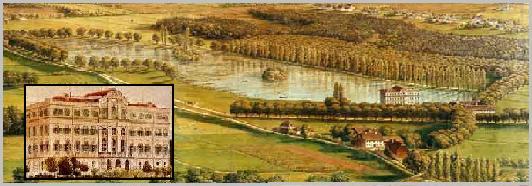
| A grand palace was erected in 1736 on the shores of a large private "pond" in the area between the palace and the Untersberg which served as a family estate. He Christened the palace Leopoldskron and filled it with expensive treasures. After the death of the Archbishop in 1744, his heart was buried in its chapel, while the rest of his body was placed in the Salzburg Cathedral. He had previously passed his palace on to his nephew Count Laktanz Firmian in May 1744, who used it to house a vast collection of over 600 valuable paintings which included works of Rubens, Rembrandt, Titian, Dürer and others. In addition, Count Laktanz was one of the first patrons of Leopold Mozart and his son Wolfgang Amadeus. After the Count's death in 1786, Laktanz’s son, who had no taste or appreciation for art, lent out some paintings from his father’s collection which were never returned. The palace remained in the possession of the Firmian family until 1837, and there were frequent changes in the palace’s ownership afterward, culminating in the loss of nearly all objects of art. The Schloss was later sold to the owner of a local shooting gallery, and it passed through various hands in the nineteenth century before ending up in the possession of Europe's most famous theater director, Max Reinhardt, who bought the Schloss in 1918 and revitalized it. In 1938, the Schloss was confiscated as a national treasure. In 1945, the Schloss was returned to the Reinhardt estate and evolved into the "Salzburg Seminar", eventually becoming a "center for intellectual exchange in the heart of Europe" which is now a " global forum". The Salzburg Seminar purchased Schloss Leopoldskron in 1959, and in 1973 purchased and renovated the adjacent Meierhof, a part of the original Firmian estate. Scenes from The Sound of Music were filmed there. |
| Shortly after Count von Firmian had enriched himself in the process of expelling the Protestants, his family’s reputation was impacted negatively, and he commissioned Scottish Benedictine monk Bernhard Stuart to design a rococo-palace as a prestigious family residence in an effort to restore the family’s social standing. Views of the "Palace built of Tears" in the shadow of Hohensalzburg, below |
| THE SALZBURG EXILES |