| After millions of Germans from East Prussia and other Baltic areas fled from the Red Army, those left behind were forcibly expelled from 1945 to 1947 in the Polish or Lithuanian areas. The entire situation produced a population of around 25,000 orphaned or abandoned. The Soviets put some of them in orphanages commanded by Soviet military officers. In the autumn of 1947, 4,700 German orphans were officially registered in Kaliningrad. The Soviet Union sent train loads of these orphans to the communist GDR, but the train rides were perilous for young children. They took more than four days and the children were without food or toilet facilities in terrible heat and many children died. In 1948, the children's village of Pinnow, called "Kinderdorf Kyritz", was opened. Some of these children were actually from the Ruhr area and had been sent to East Prussia for safety from the bombing in the West. Approximately 2,000 to 3,000 of these children were captured and sent to Russian internment camps where many soon died of starvation, exploitation and disease. Sometimes local farmers took them in, but often they were worked as slaves and poorly treated, especially in Polish areas. The Lithuanians who aided the children called them "vokietukai" (little Germans). There were about 5000 in Lithuania alone who went begging in search of food and work. The "nazi children" were strictly forbidden to speak German, lest there be repercussions against the hosting families or employers, therefore they suppressed their language and even their names and pretended to be deaf mutes or of Lithuanian nationality. At the beginning of the 1950s, a group of about 1,000 of these kids were sent to communist East Germany. Only 100 survive. In the late 1980s early 1990s, several hundred of their survivors formed the association "Edelweiss". They organized petitions and tried to bring attention to the issue in German newspapers, hoping to discover the fate of others and reunite some with long lost relatives. They organized material and financial assistance to support the now aging "wolf children" in their attempts to obtain a German passport and be recognised as German citizens. However, a simple naturalization was not possible because of legal difficulties in substantiating their claims due to their culture and language having been suppressed for so long. An often inhumane bureaucratic mess inflicted even more distress upon these victims but the group remained active and energetic, resulting in some successes. Approximately 200 of these people gained German citizenship in the 1990s and settled in Germany, some with their long lost families. By 2008, 93 known wolf children, now all in retirement age, still live in Lithuania. In 2007, a sponsorship and donation campaign raised a small supplementary pension for these former Ostpreußischen children. All attempts to obtain financial assistance from the German government have largely unsuccessful. |
| In contrast, the Swiss went beyond the call of duty helping children in distress. 35,000 Austrian children were sent to the city of to Berne alone between 1945 and 1955 through the Swiss Red Cross, and thousands more were sent to places all over Switzerland. The Swiss Red Cross in Austria struggled to gain access to the children being starved in the Soviet occupied sector of Vienna. The Swiss Red Cross also set up cafeterias and kitchens with meals and medicine supplied and sponsored adoptions for hundreds of orphaned children. They also supported children's homes, convalescent homes, baby stations, tuberculosis camps and refugee camps in Austria. Also, in 1945-1946, the Irish Red Cross organized "Operation Shamrock" where over a thousand children from bombed out or starving areas of the Continent were brought to Ireland to live with Irish families, some later to be adopted by their Irish host families. German children were among those helped by the `Save the German Children Society' which was set up in the aftermath of the razing of German cities in World War 2. The children included orphans and those children sent off to a far off land for three years by heart-sick mothers who could not feed them. In the weeks following the appeal, more than 1000 children between the ages of five and ten docked at Dublin port. They were fed a special diet to help them get used to normal food again before they were sent off to their new Irish families. Some of the children went home to their parents and some remained in Ireland. Typical of camps erected for orphaned and displaced children without families, the childrens camp called Bischofswerda was set up near Leipzig after thousands of refugees from the east poured into the city. All such children who lived in the city were registered and most went through hellish experiences, struggling to survive with inadequate food and heat. Like most refugees, those who experienced a starvation diet as children were burdened with numerous health problems as adults. Between 8,000 and 12,000 Norwegian children with a German father were born in Norway during or shortly after the war. These children and their mothers were placed in homes called Lebensborn where the mother could rest before childbirth and live with her child after. After the war, there was vicious hatred of these children, who were collectively referred to as mentally ill, and their mothers, who were called whores. The government even considered exporting the children to Australia as orphans and contacted the government of Australia to take the children, but were refused. Many were sent to Sweden as orphans and adopted by Swedish families. Some children were even fetched from Germany, where they lived with their German grandparents. But in the orphanages in Norway, many of them were mistreated and abused. No laws were in place to protect these children from abuse which was ignored, even supported, by the government and leading politicians. In 1959. West Germany offered to pay Norway for the upbringing of these children. Various politicians refused this arrangement and instead demanded that Germany pay the money to Norway and let the Norwegian politicians divide the money as they saw fit. Germany paid in total of over 60 Million DM, or 30 million US dollars, most of which went directly into the politicians' pockets. None of the money ended up supporting these children. Likewise, any alimony money sent by German men to their Norwegian girl friends and children in the 1950s usually ended up in the pockets of the local police. Norwegians abusing a child with a German father were not prosecuted. |
| The REAL German Wolfskinder |
| The "Human Problem" : The high price paid for war by the German CHILDREN |
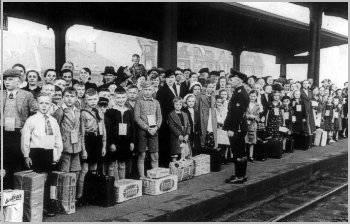
| While there are many movies and books about British children being evacuated to the countryside because of the Blitz, not much is said about the Kinderlandverschickung, or evacuation of German children. As air attacks increased, children at risk in various German cities were sent away for their safety. Initially, the evacuation of children applied only to Berlin and Hamburg, and over 200.000 small children were evacuated from Berlin alone between September and November of 1940. After the beginning of 1941, there were already up to an estimated 300,000 children evacuated. Among the host areas for the year 1941 were parts of Bavaria, Salzburg, Styria, West Prussia, Pomerania, Silesia, the Sudetenland, Slovakia, East Prussia and parts of Saxony, as well as "safe countries" such as Hungary, areas in the present day Czech Republic and Denmark. In the summer of 1943, the increased air attacks on the civilian residential area of cities, particularly in the Rhine- Ruhr area, made a mass evacuation of woman and children necessary. It was the largest inland migration in human history to date as children were evacuated from cities such as Essen, Cologne and Dusseldorf and then from Schleswig-Holstein, Lower Saxony and Westphalia.In addition to the use of requisitioned homes and rooms, a number of special evacuation camps were arranged which even contained schools and medical facilities (KLV camps). In the last years of war, some children spent more than 18 months in the camps. By the end of the war, up to 2,000,000 children aged ten to fourteen years lived at least for a time in over 2,000 camps. According to most sources, these camps were by and large as pleasant as they could be under the circumstances of war. Nor were they "indoctrination" facilities. Suddenly, after the German defeat at Stalingrad, Germany had to evacuate the more distant evacuation camps such as those which had been established in Bulgaria and Romania, and new camps were built in Bohemia and Moravia, then thought to be safe areas. Nothing would be safe for long, however. For instance, there were still 26 camps in the Czech border regions holding a total of around 850,000 children up until the end of the war. Both the Soviet and the western Allied forces overran many of the KLV camps in the last months of the war. Because of heavy Allied bombing, many children from the Ruhr were sent to Thuringia for safety. But some of them ended up being trapped there later when the Red Army began its violent sweep. In such areas, some children went along with other frantic refugees, but the fates of many others is unknown. This is another area, like German civilian bombing fatalities, in which the numbers of victims are consistently revised downward in recent time in an almost hostile refusal to acknowledge any German suffering. If one "googles" 'starving German children' or 'German war orphans', very little pops up, as if there were no such thing. Yet, apart from a very low estimate of 75,000 German children killed or maimed by violent Allied terror bombing, thousands of others found themselves abandoned, orphaned, lost and even stolen. Posters of missing children were put up all over Germany and Austria. At war's end, there were approximately 53,000 orphans, many roaming the devastated countryside, living wherever they could find shelter: in holes in the ground or hollows of trees, in boxes, old barns and sheds and bomb-damaged buildings. The long term physical and intellectual effects of war on the ravaged children of Germany were severe, and the Allied bombing campaign had significant, long-lasting detrimental effects. The destruction of schools, the absence of teachers, malnutrition and the destruction of health facilities and hospitals all played a part. Germans who were at school-age during WWII had 0.4 fewer years of schooling on average in adulthood, with those in the most hard-hit cities 1.2 fewer years. These children were also about half inches shorter and had lower self-reported health satisfaction in adulthood than children in generations prior. The devastation in terms of adult health outcomes was also borne disproportionately by children from disadvantageous families, and by those residing in most destroyed cities. |
| The death rate in 1945 had reached a similar level to the Thirty Years War nearly 300 years earlier, at one point taking 4,000 people a day in places such as Berlin. Victims of unchecked disease, untreated injuries, illness and starvation, many children were left to starve or fend for themselves at the mercy of the elements or predators. Thousands never saw their homes, friends, parents or relatives again and the fates of many thousands of children was never learned. Allied leaders had vetoed efforts of the Famine Relief Committee, formed in 1942, to send food to the hard- pressed civilians of occupied Europe. Allied leaders, above all Roosevelt and Churchill, were obdurate in their refusal to cooperate with the Famine Relief Committee and the Red Cross. These actions were later transformed into an American and British military ban on all private and church humanitarian aid to about 85,000,000 Germans. Millions were intentionally starved to death.International charitable aid to Germany immediately after the war was banned for a year then restricted for more than another year, resulting in widespread starvation. When it was permitted, it came too late for millions of people, thousands of whom were children. For months in parts of Germany, the ration set by the occupying Allies was 400 calories per day; in much of Germany it was often around 1,000, and officially for more than two years it was never more than 1,550. The number of murdered Germans, mostly: women, infants and children, was a minimum of 9,300,000 and a maximum of 15,700,000. In one horrible situation, some ten thousand German children under five died in Danish camps after "liberation." In the final weeks of the war, between February 11 and May 5, about 250,000 German women, children and elderly refugees from East Prussia, Pomerania and the Baltic provinces fled from the Red Army across the Baltic Sea. A third of them were younger than 15 years old. They were interned as enemies in hundreds of camps in Denmark, placed behind barbed wire and guarded by heavily armed overseers. The largest camp was located in Oksboll, and had 37,000 detainees. Nutrition was poor and medical care absent. In 1945 alone, more than 13,000 people needlessly died, among them some 7,000 children under five. The Danish Association of Doctors had decided in March 1945 that German refugees would not receive any medical care. That same month their Red Cross refused to take any action because public sentiment was "against the Germans." 80% of the small children that landed in Denmark did not survive the ordeal. They starved or were unable to fight infections due to extreme malnutrition. |
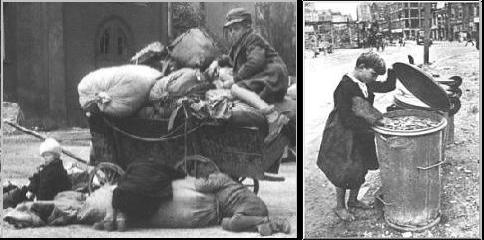
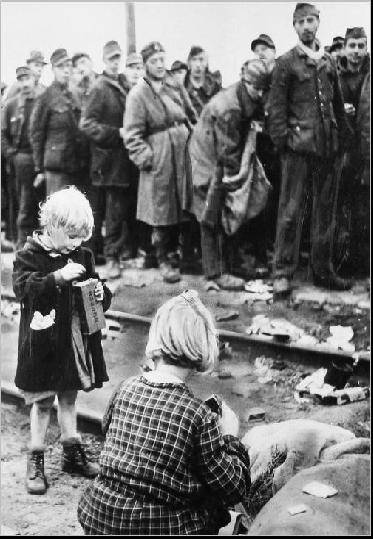
| Above left: Sympathetic prisoners watch as children in Berlin forage for scraps (wire photo 11-1945). Little girls in Berlin had more to fear than hunger. Other children sometimes roved in gangs for comfort, support and mutual survival throughout East Prussia and eastern Poland. Today, they are referred to as "Wolfskinder" or Wolf children, images on right. |
| “. . . a large barge is slowly being towed across the Oder River. In it, lying on straw, are 300 children ranging from 2 to 14 years of age. There is hardly a sign of life in the whole group. Their hollow eyes, their swollen bellies, knees and feet are telltale signs of starvation. These are merely the vanguard of hundreds of thousands, no, millions of homeless, shattered, hungry, sick, helpless, hopeless human beings fleeing westwards.." Dr. Lawrence Meyer, executive secretary of the Lutheran Church, Missouri Synod, traveling through devastated post war Germany |
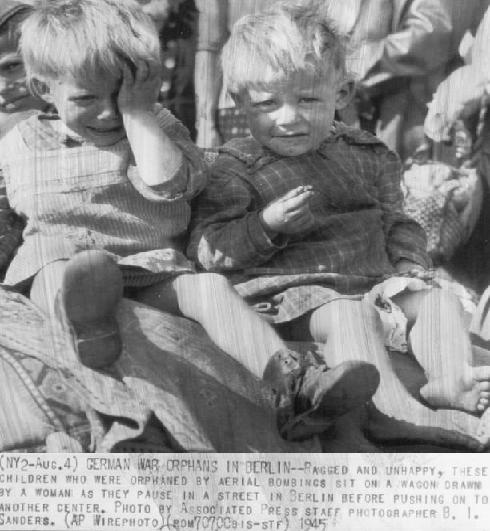
click
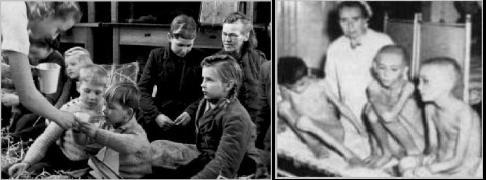
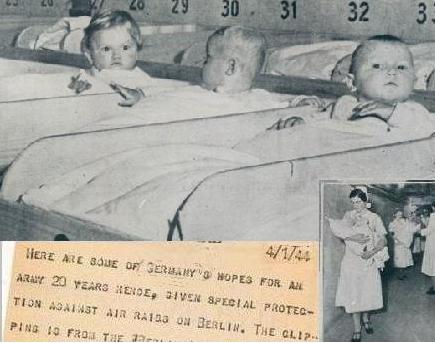
| The US wire photo above left displays contempt, not compassion for innocent German babies in air raid shelters as it smirks: "Here are some of Germany's hopes for an army 20 years hence." On the right is the public image of the generous Danish orphanages |
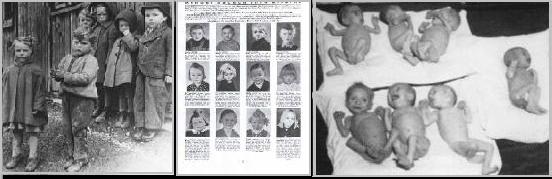
| Below: Orphans, poster and starving babies in Berlin in 1947. On the right is a press photo of Berlin children being returned to their shattered home in 1946, many having been evacuated as far back as 1941, and many with no living family left to welcome them. |