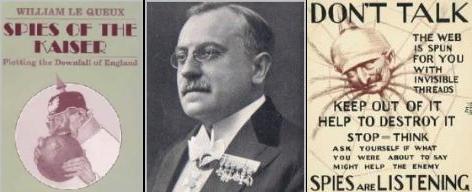
| "Spies of the Kaiser: Plotting the Downfall of England" detailed fictional German spy activities which Le Queux asserted were factual, claiming he had files of documents as proof. His only "documents" were thousands of letters sent to him by panicked readers who claimed they sighted spy rings or suspicious Germanic neighbors, teachers and corner grocers. Le Queux turned the "proof" over to government officials, who eventually used them to exemplify the need of a better intelligence organization in Britain. Out of this activity, the modern British Secret Service was born. However, when war finally came in 1914, the government only found twenty-one alleged German agents to arrest, and of these, only one was ever brought to trial. Hundreds of innocent Germans had meanwhile been bullied and chased from their jobs and homes. Ardent Anglophile William Le Queux was born in London in 1864 to French-English parents with whom he spent his childhood on the road, becoming fluent in several languages. He studied art before turning to journalism, later becoming foreign editor of the Globe and a war correspondent for the Daily Mail. By 1893, he retired to devote all of his time to writing books, publishing nearly two hundred. Le Queux was obsessed with the idea of a German invasion. He forwarded crates of "reports" and German spy sightings from his readers to the Foreign Office and the War Office with wild, unsubstantiated claims of having personal knowledge of the Kaiser's vast spy network, but he could never provide proof. Rather, he always claimed that the evidence was stolen or destroyed. In one case, he boasted that he had intimate knowledge of a secret speech the Kaiser gave to the German military concerning the conquest of Britain, complete with maps, plans, diagrams and even model weapons. But, alas, Le Queux could not provide the evidence because it had been stolen from his publisher’s office by the Germans spies. Around 1905, Le Queux even went so far as to name members of Parliament, well-known authors, and government officials as spies for Germany. After a time, British authorities ignored his reports, so Le Queux developed new strategy. He buddied up to a fellow belligerent, national hero and object of Rudyard Kipling's adoration, Field Marshal Lord Roberts, rightfully assuming that with Roberts on his ticket, his fantasies would be taken seriously. In 1906, Lord Roberts and Le Queux, with help from British military experts, hammered out a fictionalized account of a German invasion of England in 1911. Lord Northcliffe financed the project in return for exclusive rights to serialize the story in his newspaper prior to its release as a novel. It was finished a year later it, but not to Lord Northcliffe's liking because the route of the "invasion" took the invading Huns through areas that had poor newspaper circulation. Le Queux remedied this by repositioning the German attack so that the fat, ugly, evil Huns only sacked those towns which had good Daily Mail’s circulation, and he listed those districts as in the direct pathway of the iron Prussian boot. Northcliff's Daily Mail workers advertised the serial by parading up and down the street in Prussian uniforms, wearing spiked helmets. In spite of some criticism in the House of Commons, it was an amazing success, and with their bloated heads, Harmsworth and Le Queux formed a "voluntary Secret Service Department" of fellow conspiracy theory junkies who banded together and set to work ferreting out spies. Once again, Le Queux flooded the War Office with German spy reports, and this time when they seemed too unresponsive, he received financial backing from a Scottish newspaper mogul and traipsed around Scotland looking for German spies. He found 5,000 of them and published his productive new adventure in Thomson’s Weekly News, later editing the articles to form the base of "Spies of the Kaiser: Plotting the Downfall of England" in 1909. Le Queux was convinced that the Germans were out to get him for exposing their wicked schemes and he was in a perpetual struggle with his local police force and the Metropolitan Police to receive special protection from the invisible German agents. The authorities regarded him as "not a person to be taken seriously" and saw no need to fulfill his request. Many other ridiculous claims were made by Le Queux in his long career that also wormed their way into his novels. In one case, he claimed he saw a French manuscript written by Rasputin stating that Jack the Ripper was a Russian doctor named Alexander Pedachenko who committed the murders just to make a fool out of Scotland Yard. Soon after the publication of this fiction, reports flooded in. Every German in England seemed to have suddenly turned into a spy and Le Queux trotted off every single rant as "proof of Germany’s malicious intent" to the British government by way of Lieutenant Colonel James Edmonds, director of military operations counter-intelligence. The public soon begged for government protection and Edmonds was their hope. Although he had never found a German spy, he took Le Queux's “conclusions” to the British secretary of state for war, who in March 1909 directed the Committee of Imperial Defence to examine foreign espionage. Chaired by Lord Haldane, the membership included First Lord of the Admiralty, the Home Secretary, the permanent undersecretaries of the Treasury and the Foreign Office, the Commissioner of Metropolitan Police, the Director of Military Operations, and the Director of Naval Intelligence. On March 30,1909 the committee held a secret session to discuss foreign espionage, and their first witness was Colonel Edmonds who informed them of the danger he believed Britain faced from German spies. Edmonds presented Le Queux's fabricated and fantastic "evidence" to the subcommittee claiming that the Germans possessed an elaborate spy system which divided England into sections, each under an officer who had under him a number of spies, many of whom were respectable citizens in Britian. These "German agents" went about their normal jobs as professors and doctors, all the while gathering reconnaissance of railways, piers, bridges and telegraph lines. Edmonds convinced the committee that an extensive German spy system was already in place in Britain. The Committee of Imperial Defence decided that there was indeed "sufficient evidence" to issue a report: "The evidence which was produced left no doubt in the minds of the committee that an extensive system of German espionage exists in this country, and that we have no organization for keeping in touch with that espionage and for accurately determining its extent or objectives." Thus out of Le Queux's paranoid fantasies, the British Secret Service was established in 1909. No proof of any kind was presented, nor any factual basis provided to suggest any German conspiracy to invade England. Instead, Britain was invaded by second rate, fear mongering British writers. |
| Spies and Lies |
| A Devil gets his Due? |
| After the blood letting of war ended, Lord Northcliffe turned his attention to Zionism and Zionist ambitions in the Middle East. This would prove lethal for the old newspaper hack. In 1920, he publicized the infamous "Protocols of Zion", suggesting an investigation into its veracity, and in 1922, Northcliffe asked Wickham Steed, the editor of The Times, to travel to Palestine to do thorough journalistic research of the full nature of the Zionist project there, since it involved Britain directly. Steed had been a Paris correspondent for the New York World appointed by Joseph Pulitzer, and he later joined The Times as a foreign correspondent, later to become editor from 1919 until 1922. Steed refused to go to the Middle East, and in 1922, Lord Northcliffe visited Palestine himself, accompanied by another journalist. Upon his return, on March 2, 1922, he harshly criticized Steed at an editorial conference, suggesting he resign. But Steed not only did not resign, he went on the offensive to bring about Nothcliffe's demise. He spread rumors that Lord Northcliffe was acting irrationally and was probably insane. Ironically, Steed himself was a rabid German hater and also strongly anti-Zionist, and both he and Northcliffe had taken similar jingoistic postures toward war with Germany. His actions in this matter seem to indicate more of a play for power than something born of ideological differences with Nothcliffe. When Northcliffe met Steed again in June, he informed Steed that he was assuming editorship of The Times, as he was still its primary owner. Steed agreed to meet Northcliffe the following day on a train bound for Switzerland. Unbeknownst to Northcliffe, Steed has furtively planted two forever-to- be-unnamed doctors, one aboard the train and another at their destination, who promptly declared Northcliffe "insane." Steed ordered The Times to disregard any and all communications from Northcliffe and Northcliffe was taken back in London in custody on June 18, and forbidden all communication. Even his telephone lines were cut, and police were posted at the doors of The Times to prevent him from entering should he try. Lord Northcliffe died quickly and mysteriously under very suspicious circumstances a very short time later, on August 14, 1922, and the story of his alleged insanity or confinement was kept from the public. During the war, Steed had befriended and championed anti-Habsburg émigrés such as Edvard Beneš, Ante Trumbić, Tomáš Masaryk and Roman Dmowski and advised the British government to seek the liquidation of Austria-Hungary as an aim of war. He was an especially strong advocate of uniting all of the South Slavic peoples such as the Croats, the Serbs, the Slovenes, etc into a federation to be called Yugoslavia. After the war, Steed strongly disapproved of the Bolshevik regime in Russia which had been greatly strengthened. |