| A Case for the Bayonet: Trenton |
| Near Christmastime, 1776, George Washington made headquarters in a large stone house on the west side of the Delaware River. Twenty four hundred or so men were shivering and feeling that their cause might be all but lost. The closest village to Washington was Trenton, with an outpost of 1,600 Hessians strong under the command of Colonel Johann Gottlieb Rall, a heavy drinking gambler whose troops had engendered a reputation fierce enough to inspire the local population in New Jersey to form ragged militia bands to ambush their patrols. This led a Hessian officer to complain, "We have not slept one night in peace since we came to this place." All the same, misinformation and over confidence in Washington's hopeless condition caused the Hessians no pressing worry about major attack. Washington decided, however, that an attack on Trenton was an absolutely necessity, and plans were laid to surprise the Hessians when they least expected it. Washington gave his officers their marching orders and at three o'clock on the afternoon of Christmas Day, with every man carrying three days' rations and forty rounds, his troops boarded the boats guided by a rugged ship captain from Marblehead, Massachusetts and crossed the freezing Delaware River in what turned out to be a grueling 14 hour trek through frozen chunks of ice and blasting winds: men, horses, heavy artillery, all in a painful movement to meet a fate unknown. Over in Trenton, Colonel Rall had eaten a superb meal, played a few games of cards and was pleasantly inebriated when a messenger knocked on the door with a warning. Rall stuck the note in his pocket unread and, refusing to be bothered, toddled off to sleep. In the still dark morning, Washington's troops were now on land and began their excruciating ten mile march to Trenton. The troops split into two divisions at Birmingham: Nathanael Greene led one to the east while John Sullivan's men headed straight for the main Hessian barracks. Their gunpowder was wet and useless, and the men had to rely on bayonets when, at 8:00 a.m., Sullivan's men rushed the Hessian barracks. Almost simultaneously Washington's men stormed the town, rousting the Hessians out of the houses. There was pandemonium as some Hessians tried to form ranks but were cut down by canon. * It was about an hour after daylight, and Lieutenant Wiederhold had drawn in his outer pickets. It had been a severe night with snow and sleet, but the enemy had not been seen. The little command huddled into a hut that served as a guard-house. Wiederhold happened to step to the door and look out. Suddenly the Americans were before him. He called to arms, and shots were exchanged. "The outguards made but small opposition," says Washington, "though, for their numbers, they behaved very well, keeping up a constant retreating fire from behind houses. We presently saw their main body formed; but, from their motions, they seemed undetermined how to act." Drums and bugles sounded in the streets of Trenton. Rall was still in bed, and sleepy in his cups. Lieutenant Biel, acting as Brigade Adjutant, was at first "afraid" to rouse him ("Scheut sich" (Marburg Archives), but hastened off to the main guard and despatched another lieutenant and forty men to support the pickets. As he returned to headquarters Rall was hanging out of the window in his night-shirt and crying, "What's the matter?" The adjutant, in reply, asked if he had not heard the firing. Rall said he would be down at once, and presently he was dressed and at the door. Rall emerged from his sleep, jumped on his horse and raced toward his regiment who were being pelted with shot. As he screamed, "Lord, Lord, what is it, what is it?" in German, he was hit twice and taken into the Methodist Church. The unread note in his pocket warned "the American army is marching on Trenton." *A part of Rall's regiment presently succeeded in forming, and after a while Rall himself appeared, on horseback. Lieutenant Wiederhold reported to him, saying that the enemy was in force, and not only above the town but also upon the right and the left. Rall asked how strong the enemy was. Wiederhold answered that he could not say, but that he had seen four or five battalions come out of the woods and that three of them had fired at him before he fell back. Rall called out to advance, but seemed dazed, and unable to form a plan. His forces were still in disorder. Rall struck off to the right into an apple orchard east of the town, and tried to obtain command of the Princeton road. He was turned back by Hand's Pennsylvania regiment. He then determined to force his way into the town again with his own and the Lossberg regiments; at least, with as much of them as had been brought together. This he is said to have attempted in order to bring off his baggage, and the plunder of the preceding weeks. He was received, however, by a shower of lead from windows and doorways and from behind trees and walls. The Hessian ammunition was wet by the driving storm. The Americans charged again, and the Hessians were driven farther than they had come. Rall was mortally wounded by a bullet, and the two German regiments, thrown into confusion, laid down their arms. The remaining Hessian officers surrendered and the Battle of Trenton was over. The Americans lost four men and took 948 Hessian prisoners.* They took another twelve hours to cross the Delaware again and most had gone two days without food and sleep and had marched 25 miles. *Washington, in his first report to Congress, gives the number of those who surrendered at twenty- three officers and eight hundred and eighty-six men. A few more afterwards found in Trenton raised this number to about one thousand. "Colonel Rahl [sic], the commanding officer, and seven others," he writes, "were found wounded in the town. I do not exactly know how many were killed; but I fancy not above twenty or thirty; as they never made any regular stand. Our loss is very trifling indeed, only two officers and one or two privates wounded." (Washington, vol. iv. P. 247. Bancroft gives the numbers as seventeen Hessians killed and seventy-eight wounded.) *Excerpts From CHAPTER VIII. TRENTON, DECEMBER 26, 1776. THE HESSIANS and the other GERMAN AUXILIARIES OF GREAT BRITAIN IN THE REVOLUTIONARY WAR by Edward J. Lowell; Harper and Brothers Publishers New York 1884 While here at Valley Forge, Steuben formed a life-long friendship with English born Captain Benjamin Walker. Walker, fluent in French and English, was a Captain in the Second New York Regiment when Steuben arrived. Upon seeing the general's frustration over language difficulties, Walker had come forward on the drill-ground and offered his services as an interpreter. He became Steuben’s aide-de-camp and managed his correspondence as well. Walker would tend to the general's affairs even after the war. During the winter of 1778-1779, Steuben prepared "Regulations for the Order and Discipline of the Troops of the United States" complete with eight engraved illustrations by Pierre Charles L'Enfant. It was also known as the "Blue Book" since it was at first covered with the blue paper which was available when high-quality printing paper being scarce during wartime. On March 29, Congress endorsed it, ordering its use throughout the Army. State militias also took it up. From 1779 until 1809, nearly 80 successive printings were issued. After the war was over, Washington pushed through the Uniform Militia Act, which included Steuben's Regulations as required use. Drum calls regulated the soldier's day in von Steuben's time, and since his regulation did not allow verbal commands, each man had to learn to respond instantly to the drum. Therefore, Chapter 21 of von Steuben's regulation was entitled "Of the Different Beats of the Drum" and it standardized drum calls and their functions into two categories: beats and signals. Beats were calls directed to an entire encampment or sounded at specific times, while signals were calls directed to only a portion of the encampment. Until 1781, when the Army needed more fighting men, musicians enlisted solely as musicians and were exempt from soldiering and were mostly young boys from the ages 9 to 14. But drummers and fifers were from then picked from the ranks of enlisted personnel. Von Steuben's service was exemplary throughout the war. He was remarkable for the generosity and fineness of his nature, spending his entire income beyond what was essential to his own needs in purchasing clothing and rations for his men. He concluded his war service as commander of one of the three divisions of Washington's troops in the siege-trenches surrounding the British at Yorktown. It was he who ordered the American flag to be flown above the surrendered British works at Yorktown on October 19, 1781. His personal finances were so bad at that point that he had to sell his favorite horse and a set of silver tableware in order to host a victory party for Allied commanders after their success at Yorktown. Washington loaned Steuben enough cash to depart, but his purse was nearly empty. He later helped Washington demobilize the army in 1783 and aided in the new national defense plan. Steuben became an American citizen by act of Pennsylvania legislature in March, 1784, and later by the New York authorities in July, 1786. He was honorarily discharged from the military on March 24, 1784. Steuben had taken up residency in New York where he hoped to be honorably recompensed for his invaluable services, but he would have a long, long wait and it was not until June of 1790 when he was granted a yearly pension of $2,500 and by then he was deeply in debt. His financial problems temporarily abated when Alexander Hamilton and other friends helped him obtain a "friendly" mortgage on property he was given in New York, but for years there were various snags with deeds and paperwork. Even so, he remained charitably minded and he was a regent of New York University and one of the organizers of the Deutsche Gesellschaft, a charitable organization in New York State for the benefit of German immigrants. He remained its president from 1785 to his death. In 1794, the Baron von Steuben died in poverty while living in a primitive log-house built in the midst of an untamed wilderness in the 16,000 acres the New York legislature had granted to Steuben at the close of the Revolutionary War, just west of what is today Remsen, New York. He never married, but he adopted one of his former aides, William North, and Benjamin Walker was also like a son to him. Both North and Walker were heirs and executors of Steuben's will when he died at age 64. He was buried in a plain pine coffin in an unmarked grave, wrapped in his military cloak and attended by his old friend and aide-de-camp, Ben Walker. A few years after his death, the townsfolk decided to run a road directly over Steuben's grave, and managed to hack off part of the exposed coffin when Ben Walker had the remains transferred to what is now known as the "Sacred Grove." On a boulder near his grave in Steuben Memorial Park, Oneida County, N.Y., is an inscription that reads, "His Services Were Indispensable to the Achievement of American Independence." |
| Friedrich Wilhelm Augustus von Steuben was born in 1730 to a Swabian father serving in the corps of engineers of the Prussian military. He spent most of his early youth in Poland, in the Crimea and at Kronstadt on the Gulf of Finland, and at age ten, when the family returned to Germany, he was sent to Breslau for an education. By age 17, he was enlisted in a Prussian infantry unit and he soon became a staff officer in the Seven Years War. Steuben was one of thirteen staff officers personally selected for special training in military science by King Friedrich the Great. The year after Steuben was discharged as a captain from the army at age 33 in 1763, he received the title of Baron through the noble patronage of Prince Heinrich and others and he served as Grand Marshall in the household guard of the bankrupt Catholic prince of Hohenzollern-Hechingen. Hoping to improve his finances and relieve his many debts, he explored various prospects, including possible marriage, for securing a more lucrative appointment or position, but none seemed forthcoming. Upon finding out that Benjmin Franklin was in Paris, Steuben traveled there in the summer of 1777. He was recommended for service in Washington's army by the French Minister of War and introduced by means of a letter from Franklin as a "Lieutenant General in the King of Prussia's service", thus he found future employment. Facing storms, mutiny and fire aboard his gunpowder-laden transport, he reached Portsmouth, New Hampshire in September of 1777. Steuben proceeded to Boston where he met Samuel and John Adams and presented his letters of introduction and recommendation to John Hancock. Congress gladly accepted his offer, and on January 9, 1778, General Washington replied to Steuben, asking him to proceed to York, Pennsylvania, and John Hancock furnished him a sleigh and horses for the tedious journey to Pennsylvania. Steuben, who did not speak English, reported for duty to General Washington at Valley Forge. Steuben, however, communicated in French with some of the officers and Alexander Hamilton and Nathanael Greene helped him draft a training program for soldiers which Washington approved. Steuben, with his knowledge and his forceful, engaging personality, turned the ragged troops at Valley Forge into an army. He began by constructing a "model company," a group of 100 chosen men he personally trained wearing his full military dress, and they in turn successively worked outward into each brigade. Within two weeks, through his exceptional work, Steuben was appointed Inspector General of the Continental Army by Washington. Besides being a supreme drill master, Von Steuben also introduced a system of progressive training and established a standard of sanitation and camp layouts. Perhaps Steuben's biggest contribution to the American Revolution, however, was training in the use of the bayonet which the Americans until then used mostly as a skewer over the campfire rather than a fighting instrument. Steuben's introduction of effective bayonet charges became critical and paid off in the Battle of Stony Point, when American soldiers attacked with unloaded rifles and won the battle solely because of Steuben's bayonet training. |
| How King of Prussia, Pennsylvania got its name is a mystery. Historical marker signs point to a tavern as its namesake, the old King Of Prussia Inn in Montgomery County, Pennsylvania. When the inn was first built in 1719, Pennsylvania was still a British colony, and the inn began life as a simple farmhouse, later growing into a prosperous tavern and the heart of the hamlet. As early as 1770, the tavern was apparently referred to as “the Sign of Charles Frederick Augustus, King of Prussia” but nobody seems to have a valid explanation why the Rees family, who owned a poor tavern in the middle of a Quaker village called Reesville named a tavern for a German king. The inn's manager at the time of the Revolution, James Berry, was an officer in the militia. One explanation for the name is that when Von Steuben's German contingent of men arrived at miserable Valley Forge, they wanted a warm place to go to and have a good beer, and Berry's Tavern, with its sign coincidently hung up in German, beer and 6 fireplaces was only a half mile away. Some others claim it was actually named for King Friedrich the Creat for his support of Washington during the American Revolutionary War, Yet another explanation for the name seems to cast a more secretive origin. In 1777, when General Howe and 15,000 British troops captured Philadelphia after defeating George Washington's army at the Battle of Brandywine, the Continental Army camped at Valley Forge, which was very close to the Inn. Masonic lodge meetings, presided over by Washington, are said to have taken place at the Inn. Today, the Inn is described as "the site where Lafayette became a member of General Washington’s Military Masonic Lodge and where Major Alexander Hamilton arranged for the exchange of prisoners with the British High Command on March 10, 1778." Probably the most remarkable thing about King of Prussia is that the name survived anti-German hysteria. Many towns have been named after Steuben, notably in New York, Michigan, Wisconsin and Maine. There are Steubenvilles in both Ohio and Kentucky. The National German American Alliance sponsored the von Steuben monument in Valley Forge, which was dedicated in 1915, as well as other monuments. The Alliance was founded on October 6, 1901, to promote and preserve German culture in America. At its height, the organization had 2.5 million members. Given a Congressional Charter in 1907, it promoted German language instruction in school and the foundation of educational and historical societies and literary journals. It was led by Dr. Charles J. Hexamer from its beginning until 1917, when in a fit of anti-German hysteria its charter was revoked. Sculptor Jakob Otto Schweizer was a native of Zurich, Switzerland and educated in both Zurich and Dresden before moving to Florence in 1889. moved to the United States in 1894 and was a member in the German Society of Pennsylvania, also led by Charles Hexamer. Schweizer's first commission was to create a monument of Peter Muhlenberg, now located at the Philadelphia Museum of Art. Some of Schweizer's other monuments include two other von Steuben monuments in Utica, New York and Milwaukee, the Abraham Lincoln statue at the Pennsylvania Memorial in Gettysburg, Pennsylvania and others. The Steuben memorial was unveiled on October 9, 1915 and Dr. Hexamer was the main speaker of the day. He spoke poignantly and emotionally, and admonished the media for its vicious attacks upon Germany and German-Americans during the World War One hysteria, claiming the attacks did “shame and discredit to our nation.” The press called his emotional speech a "rant", and claimed the monuments were nothing more than "Hun propaganda". Von Steuben is still under attack, but now by "modern historians" who seem to have dredged up rumors that he was a pedophile, a felon and any number of things other than a true patriot and hero. But actions speak louder than words, and perhaps those actions of George Washington speak best for von Steuben's character: "I wish, to make use, of this last Moment of my public Life, to Signify in the strongest terms, my entire Approbation of your Conduct, and to express my Sense of the Obligations the public is under to you for your faithful, and Meritorious Services." George Washington wrote these words in a letter to his friend Baron Von Steuben on December 23, 1783. It was the last letter he ever wrote as commander of the American forces and it was written on the day he resigned his commission as Commander in Chief to the Congress of the Confederation. The letter is at its home in Hohenzollern Castle in Germany. |
| Steuben's elusive Ghost in America |
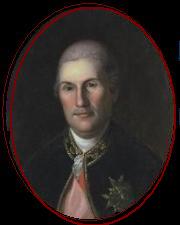
| Steuben by Peale, 1781-82 |
| The Elusive Baron Von Steuben |