The Grand Master went to Venice after the fall of Acre in 1291, and then,
after conquering Pomerelia in 1309, to Marienburg in Prussia, absorbing the
Sword-Brethren in Livonia whose expansion had taken place further east. The
knights administered their lands from Marienburg and granted considerable
freedom to the cities, many of which joined the Hanseatic League. The Order
was defeated in 1410 at Tannenberg by Poland and Lithuania, and after a
revolt in its own territories it became a vassal of Poland. Königsberg became
the center of the order in 1457.
In 1525, the Hochmeister Albrecht of Brandenburg-Anspach became Lutheran and secularized the
Order's Prussian holdings into the duchy of Prussia. He resigned from the order and gave homage for
the duchy to the Polish king. In Livonia, the Ordenmeister Livlands Gotthard von Ketteler followed
suit in 1561 and turned the order's remaining estates into the duchy of Kurland. When the
Deutschmeister became Grand Master in 1530, the seat of the Order was transferred from
Marienburg to Mergentheim. The Habsburg dynasty reformed the order in 1606, enabling its
survival for use in the Habsburgs' wars against the Turks, while stripping it of its last remnants of
independence. It hobbled along until 1809 when the Order was expelled from most German states,
and survived only in Austria, where it was reorganized by the Austrian emperor as a Catholic
charitable institution. By 1839, it was reduced to four knights. Knights of honor (1866) and Marianer
(1871) were created to attract financial support, while the knights themselves were essentially noble
Austrian officers. The order lost its last possessions with the end of the Habsburg monarchy after
World War I. Archduke Eugen resigned as Grand Master and in 1929, the Pope reorganized the
order as a purely religious order of priests. The last knight was Friedrich Graf Belrupt- Tissac who
died in 1970.
During World War Two, the order was abolished in
Austria and Czechoslovakia, but it survived in Italy
and sre-emerged after 1945 in Austria andGermany.
Today's order has 87 brethren, 294 sisters, 12
honorary knights and 613 Marianer or associates.
The Hochmeister resides in Vienna.
Marienburg Castle, left, before and after 1945
Most of the old Teutonic Order castles were in German lands given away by the Allies after World
War Two to the communist countries. One at least somewhat authentic Teutonic Order castle
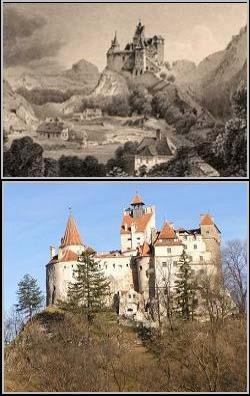
remains intact with a colorful history: Transylvania's Bran Castle, previously known as Dietrichstein,
was one of the fortresses built by the Knights of the Teutonic Order in the year 1212.
The Teutonic Knights had sent a contingent into the unsettled
region to build a series of wood and earth forts, and peasants
were brought in from Germany to farm the land and provide the
taxes and labor necessary to build more fortifications and
buildings and to harvest the crops that fed the garrisons. At the
end of the 13th century, the castle was taken over by the
Transylvanian Saxons in the region in order to protect the City
of Brasov, an important trade center.
The castle is the most famous of 15 citadels and fortresses in the area built by German peasants to
keep out marauding Turk and Tartar armies. In modern time, the castle was owned by the late
Queen Marie, a descendant of the Hapsburg dynasty which ruled Romania for a period starting in the
late 17th century, and it was bequeathed to her daughter Princess Ileana in 1938. During World War
II, the royal family operated and worked at a local hospital and they later hid some of the tens of
thousands of ethnic Germans during the Soviet occupation when they were being deported from
Transylvania to labor camps in the Soviet Union. The castle was confiscated by communists in 1948
and fell into disrepair.
Dominic von Hapsburg, a New York architect, inherited the
castle from Princess Ileana decades after the communists seized
it. More than 60 years after it was seized by communists after
World War Two, the Romanian government handed back the
Castle to its former and rightful owner, Dominic von Hapsburg.
The castle is worth approximately $25 million. Romania has
begun returning some property to its former owners and
establish a "property fund" to pay damages for assets that
cannot be returned. The fund includes stock in state-owned
companies that are being privatized.
Castles of the Teutonic Order (click)
They were in Hungary by 1211-25. After 50 years of war, the knights had subdued the pagan
Prussians, who had risen in revolt repeatedly and were now reduced to serfdom. The order allied
themselves with the Polish dukes of Masovia and Silesia to both subjugate the Prussians and fight
against Novgorod. By 1220, the Knights had erected castles at a distance of 20 miles from one
another in Prussia, and the Order founded numerous towns and fortresses including Königsberg. In
the 13th century, more German emigrants arrived to settle the Prussian lands, and he Order was now
an independently formed, noble political entity, and in 1243 and in 1263, the pope allowed the
knights to monopolize the grain trade.


All across East Prussia, the landscape was dotted by old castles of the Teutonic
Knights. Who were they? During the siege of Acre in 1190, the Teutonic Order
began as a hospital brotherhood to care for the many sick German crusaders who
were denied medical care from others. It was turned into a military-monastic order
in 1198, reflecting the involvement of the Hohenstaufen dynasty in the Holy Land.
The order conquered territory in the Holy Land, and then, under grandmaster
Hermann von Salza, Eastern Europe, where they rose to prominence.