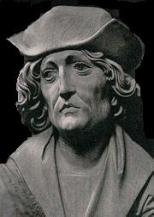
| Tilman Riemenschneider and Veit Stoss |
He could no longer work and passed away on July 07, 1531. Two of his sons, Jörg and Hans, were
sculptors, and two others, Bartholomeus (a pupil of Dürer) and Tilman, were painters. Allied bombs
in World War Two destroyed some of Riemenschneider's masterpieces, as well as those of Stoss.
sculptors, and two others, Bartholomeus (a pupil of Dürer) and Tilman, were painters. Allied bombs
in World War Two destroyed some of Riemenschneider's masterpieces, as well as those of Stoss.
Artistically ahead of his time, he used light and the natural beauty of wood, eliminating the application
of color, and he also worked in stone. His workshop had as many as eighteen apprentices carving for
him. His first documented work was the altar for the Münnerstadt parish church (1490–92), which
was later dismantled. He had a continuous flow of commissions; his major work, the “Altar of the
Virgin” (c. 1505–10) in Herrgotts Church at Creglingen was a 32 foot high wood altar depicting the
life of Mary. He employed assistants on the massive monument, but he executed the figures himself.
of color, and he also worked in stone. His workshop had as many as eighteen apprentices carving for
him. His first documented work was the altar for the Münnerstadt parish church (1490–92), which
was later dismantled. He had a continuous flow of commissions; his major work, the “Altar of the
Virgin” (c. 1505–10) in Herrgotts Church at Creglingen was a 32 foot high wood altar depicting the
life of Mary. He employed assistants on the massive monument, but he executed the figures himself.
Tilman Riemenschneider, outstanding German late Gothic sculptor, was born around 1460 in
Heiligenstadt. His father was Master of the Mint in Osterode am Harz. He cut metal to make dies
and translated designs into three dimensional form which later translated into sculpture. In 1483,
young Riemanschneider entered a Würzburg workshop as a journeyman and was soon admitted into
Saint Luke's brotherhood where he became a full fledged figural artist. In 1485, he married and was
made a citizen of Würzburg and became a master. In contrast to the idealized forms of the past, he
chose to represent men and women as the eye naturally sees them. self portrait, above
Heiligenstadt. His father was Master of the Mint in Osterode am Harz. He cut metal to make dies
and translated designs into three dimensional form which later translated into sculpture. In 1483,
young Riemanschneider entered a Würzburg workshop as a journeyman and was soon admitted into
Saint Luke's brotherhood where he became a full fledged figural artist. In 1485, he married and was
made a citizen of Würzburg and became a master. In contrast to the idealized forms of the past, he
chose to represent men and women as the eye naturally sees them. self portrait, above
Riemenschneider was successful and popular, unlike his contemporary Veit Stoss, a rebellious
German artist often in trouble with the law. Stoss, brilliant sculptor, engraver and painter, was one of
the first artists from Northern Europe who was compared with Italian Renaissance artists. His
dramatic work reflected his dramatic life. Stoss moved from Nürnberg to various places including
Cracow in 1477 and lived there until his return in 1496 with his wife and eight children. In Nürnberg,
he worked on wood carved altars, groups and figures. In 1503, it is said that he violated some law
and was by some accounts sentenced to death, but his sentence was commuted at the last moment
because of his amazing skill, and instead he was branded on both cheeks with a red-hot poker.
Among other pursuits, he painted works by Tilman Riemenschneider. In 1506, he was apparently
arrested again but pardoned by the Emperor.
German artist often in trouble with the law. Stoss, brilliant sculptor, engraver and painter, was one of
the first artists from Northern Europe who was compared with Italian Renaissance artists. His
dramatic work reflected his dramatic life. Stoss moved from Nürnberg to various places including
Cracow in 1477 and lived there until his return in 1496 with his wife and eight children. In Nürnberg,
he worked on wood carved altars, groups and figures. In 1503, it is said that he violated some law
and was by some accounts sentenced to death, but his sentence was commuted at the last moment
because of his amazing skill, and instead he was branded on both cheeks with a red-hot poker.
Among other pursuits, he painted works by Tilman Riemenschneider. In 1506, he was apparently
arrested again but pardoned by the Emperor.
Other major works are “Adam and Eve”, stone figures from the Würzburg Lady Chapel, the “Altar
of the Holy Blood” (1501–05) in St. Jakob, Rothenburg and the “Tomb of Henry II and Kunigunde”
(1499–1513) in Bamberg Cathedral. His finest masterpieces were the altars in Muennerstadt,
Rothenburg and Creglingen. His figures were for the most part meant to be seen from below by
worshipers so that what appears to be disproportion was actually done with that uplooking
perspective in mind, much in the way that the heads of Greek sculptures were deliberately enlarged in
order that they look normal when the statue is displayed on columns. He carved for the enjoyment of
ordinary people.
of the Holy Blood” (1501–05) in St. Jakob, Rothenburg and the “Tomb of Henry II and Kunigunde”
(1499–1513) in Bamberg Cathedral. His finest masterpieces were the altars in Muennerstadt,
Rothenburg and Creglingen. His figures were for the most part meant to be seen from below by
worshipers so that what appears to be disproportion was actually done with that uplooking
perspective in mind, much in the way that the heads of Greek sculptures were deliberately enlarged in
order that they look normal when the statue is displayed on columns. He carved for the enjoyment of
ordinary people.
Riemenschneider was, in contrast, a pillar of the community and he became Mayor and Alderman of
Würzburg, but during the unsuccessful peasant revolt of 1525, as one of the councilmen who refused
to support the use of force against the rebels, he was seen as siding with the peasants against the
Prince-Bishop and he was imprisoned and tortured. When eventually released, his hands were said to
have been hopelessly injured and his spirit broken.
Würzburg, but during the unsuccessful peasant revolt of 1525, as one of the councilmen who refused
to support the use of force against the rebels, he was seen as siding with the peasants against the
Prince-Bishop and he was imprisoned and tortured. When eventually released, his hands were said to
have been hopelessly injured and his spirit broken.