| The Filthy Weed |
| By the mid-17th century, the use of tobacco had spread throughout central Europe, where its addictive nature was obvious. Its popularity increased during the Thirty Years War. In 1650, Austrians lit up for the first time, and by 1677 it was noted: "For although tobacco be not necessary for the sustenance of man, yet have matters gone so far that many are of a mind that they would rather lack bread than tobacco". In 1661 Nürnberg it was said: "Many a one becomes so used to the stuff that he cannot be parted from it neither day nor night." The vice of smoking had emerged as an accompaniment to the vice of beer. By the early 18th century, one could be fined or jailed for the careless use of pipes after the danger of fire they posed became apparent. A law was enacted by the Duke of Braunschweig- Lunneburg in 1719 making it compulsory for pipes to have a so-called Kapsel, a cap or lid made of metal or wire. But it wasn't a pipe that would burn down Braunschweig. That event would be reserved for the British in 1944. Pope Innocent V was obligated to issue a Papal Bull against smoking in St Peter's. The kings of Prussia, Friedrich I and Friedrich Wilhelm I, were both great pipe smokers. In 1735, Frederick William I and his best friend Stanislaus, the ex-King of Poland, often smoked over 30 pipes between them within a 12 hour period. The "soldier king“ king turned the "Tobacco College" into a regular part of life at the Prussian court in Berlin. The king enjoyed smoking a clay or meerschaum pipe in the company of friends and guests, including the clergy, military officers, nobles and scientists, while discussing current events and other topics, as well as playing games. He enjoyed keeping abreast of the latest "guard-room jokes." A so-called Tobacco College was popular not only with the King of Prussia, but with almost every German sovereign of that era. |
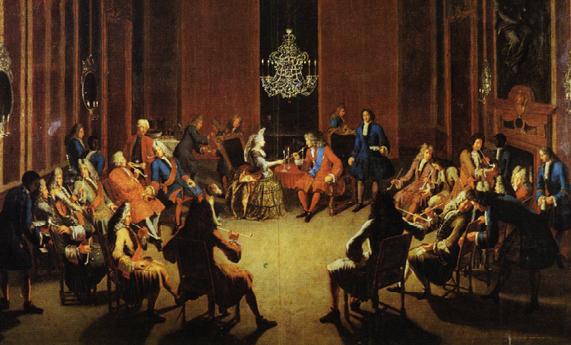
| "Tobacco College at the Court of King Friedrich I. of Prussia in the Red Chamber" Paul Carl Leygebe, c.1710 |
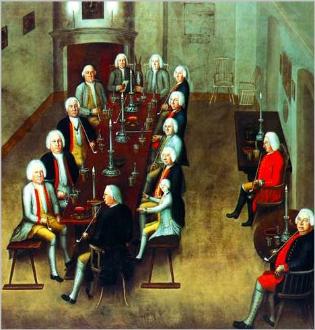
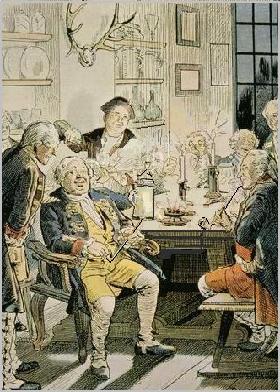
| The King's tobacco college, the picture on the right a less reverent depiction |
| THE SALZBURGERS: EAST PRUSSIA |