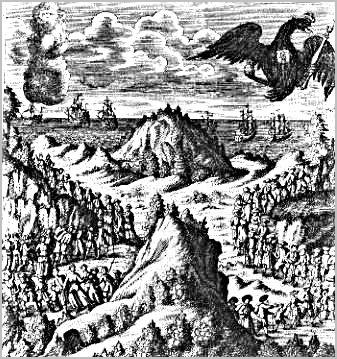
| Trails of Tears: Where doest thou wander? |
| Thousands of Salzburger journeyed very far, some to reunite with distant relatives forced out in earlier times, or to far away colonies where new settlers were welcome. Some simply vanished from history. From their mountain homes in a small area of an ancient archbishopric, where through the decades they had preserved a unique culture, they were suddenly dispersed across the map and forced to venture into unknown territories, different climates and even foreign cultures. Friedrichstadt, Glückstadt, Herrnhut, Johanngeorgenstadt, Karlshafen, Klingenthal im Vogtland, Markneukirchen, Neu-Isenburg, Babelsberg and Potsdam are some of the German regions where the Exulanten fled to, and they usually substantially contributed to the regional prosperity. An example are the musical instrument makers in Vogtland and Bohemia and wooden toy makers in areas such as Johanngeorgenstadt. A strong Exulanten presence occupied the Rhineland city of Neuwied. Devastated by the Thirty Years War, in 1662 a new municipal law guaranteed numerous liberties, above all, Freedom of religion, beginning a tradition of religious tolerance. The Exulanten brought several new branches of industry and talents to Neuwied, which fostered an economical boom for the city. By the 18th century, there were seven religious communities in Neuwied at work making furniture and clocks or working in metallurgy or in mills. Other Exulanten faced a far more dismal future. In 1733 on the eastern side of the Salzburg emigration route, around 1,200 declared Protestants were ordered to be faithful to the Catholic religion or depart from Austria, even though forbidden from doing so! In 1738, in Kremsmünster, a great number of Protestants in the Traun district were refused the right to emigrate and then jailed in the cold without food. Many died immediately of exposure. Even in 1740, the Count von Seckau banished 800 men but retained their wives and children and forced Catholicism upon them. Two hundred "rebels" were put to the rack at Werfen in 1743. Copies of the Prussian colonization patent had formerly been seized and banned in these areas, but soon the hierarchy of the Austrian lands was taking a clue from the immigration policies of Prussia and Hannover: it was decided it would be better to use the pesky Protestants to populate their own distant borders, especially in lands facing the Turkish threat such as Transylvania and the mid- Danube and on into Hungary. There, they would not only be useful as cannon fodder, they might rejuvenate arid and barren lands and make some money for the empire. In the Salzkammergut in 1733, over 1,200 local Protestants were carried off by soldiers to Transylvania with another 300 following in 1736. From 1734-1776, under the reigns of Karl VI and Maria Theresia, 4,000 Protestants from Upper Austria, Carinthia and Styria were forced to resettle in Transylvania and Hungarian regions. The first Transylvanian Germans, the "Sasi", had come to Romania in the 12th Century as colonists from northern Saxony. They settled in the central part of Transylvania where they built cities, developed guilds and determined the subsequent economic and cultural evolution of the region. They faced savage invasions from the descendants of Genghis Khan's Mongol warriers, the feared Tatars, so they protected their towns by strong walls and tall gates. Even their churches became fortresses, and families usually kept a small room where they could find shelter during attacks. Hermannstadt (Sibiu) in the 12th century was on the trade route through the Olt valley. This is the site of the Roman city of Caedonia and the first reference to the German settlement refers to Praepositum Cibin (Hungarian is Nagyszeben). It was the most important city of the Transylvanian Saxons during the middle ages. The center of the medieval town is still mostly intact including many of the walls, bastions, houses and narrow alleys. A window in a Hermannstadt Church commemorates Austrian Protestant exiles. The medieval upper town of Sighisoara is one of the few citadels of Europe still inhabited and probably it is the most beautiful example of Saxon heritage of Transylvania. The town of Sighisoara was called the "Pearl of Transylvania." It was settled in 1280 by Dominican monks. The city is still surrounded by medieval ramparts, and the winding streets are lined with old buildings. It is one of the seven major Saxon cities that gave Transylvania its German name, Siebenbürgen. Some Lutheran refugees reached a region that in ancient times was known as Dacia, but later was named after the Romanian prince Basarab, from which the name Bessarabia was created. A fairly large country which in 1814 became part of Romania, the German settlers in this region left behind German place names such Gnadenfeld, Leipzig, Katzbach or Dennewitz. After a turbulent history, the region is known today as Moldova, sandwiched between Romania and a small piece of southern Ukraine, bounded by the Dniestr river to the north and east, the Prut to the west, and the lower Danube and the Black Sea to the south. After a trickle of colonists, full scale German colonization of Bessarabia began in 1812 when Russian Tsar Alexander I. issued an invitation to more Germans to settle in this still comparatively empty region. There were two million Germans living in Hungary by the end of the 19th century. During the 18th century, the Habsburg monarchy had either forced or enticed Germans to emigrate to the unsettled lands of Southern Hungary, which had been devastated by over 150 difficult years of Turkish occupation. From 1711 to 1750, about 800 villages were founded in Hungary by German settlers. The Banat was one of the primary areas of settlement. Although most were Swabian Catholics, there were soon also exiled Lutherans from Austria. In the larger cities, where people were craftsmen and shopkeepers, a German middle-class and cultural life developed with German schools, newspapers and churches. The hard working settlers cultivated the once barren land and turned it into an agricultural paradise. Six "Donauschwaben" regions of the Austro Hungarian Empire: Swabian Turkey, Banat, Batschka, Syrmia, Slavonia and the Bosniathe northwestern chunk of Romania had been a haven for ethnic Germans for some eight centuries. The German presence in Bohemia and Moravia (current Czech Republic) also dates back to the 12th century. In pre-War Czechoslovakia, German towns dotted the Sudeten region where many Salzburgers had migrated to. Germans had lived in modern day Czech territory well before Slavic tribes arrived around 500 AD. Modern German settlement in the Sudeten actually began during the reign of King Premysl Otakar II in the 13th century when the area was largely uninhabited. "Sudeten" refers to a mountain range 200 miles long and 20 to 40 miles wide, covering the north of Bohemia and Moravia as well as part of Sudeten Silesia. Between the 11th and the 16th centuries, German became the most prevalent language in south Bohemia and Moravia, as well as in parts of north Moravia and northeast Bohemia. There were also majority German populations in Prague, Brünn, Karlsbad, Krumau, Znaim and Reichenberg. Germans maintained their language and culture for centuries, becoming a third of the population of Bohemia and Moravia. They once spoke, in dialects which are now extinct, Saxon in north Bohemia, Frankish-Egerlandish in west Bohemia, Silesian German in Silesia and north Moravia, and Bavarian- Austrian in south Bohemia and Moravia. When the Czech protestant aristocracy was defeated in the Thirty Years War, German language and culture became dominate for three centuries under the Habsburg Empire. Czech and German-speaking inhabitants generally lived peacefully together until the twentieth century. At one point, 3.5 million Sudeten Germans formed the majority population in west, north and south Bohemia, as well as in parts of north and south Moravia. Many Salzburgers wandered into German Silesia, which was bounded by Brandenburg, Posen, Russian Poland, Galicia, Austrian Silesia, Moravia, Bohemia and Saxony. Besides the bulk of the old duchy of Silesia, it comprised Glatz, a fragment of the Neumark and. later, part of Upper Lusatia. The province was the largest in Prussia, was divided into three governmental districts, those of Liegnitz and Breslau comprising lower Silesia, and of Oppeln taking in the greater part of hilly Silesia. Full of rivers, streams, hills and low mountains, Silesia was also comprised of fertile pastures and meadows and forests abundant with deer and game, tremendous fisheries and mineral wealth. About a third of the land was in the hands of large estates. The original population of Silesia was probably Celtic, and about the year 1138, Silesia was first transferred to the Germans. The independent dynasty was drawn up under the influence of Barbarossa and two princes who in 1163 divided the sovereignty among themselves as dukes of Upper and Lower Silesia. The whole of sparsely populated rural Silesia was covered with German settlements by the 12th century. The capital was Breslau, the largest and most important town which was refounded about 1250 as a German town. By the end of the 13th century, Silesia had virtually become a German land . From 1550, Silesia passed almost completely under foreign administration, first under the Habsburgs, which united the kingship of Bohemia with Austria and the imperial crown. The Thirty Years War, however, brought most of Silesia to almost total ruin. It was estimated that 75% of the population perished, and commerce and industry were at a standstill. A greater measure of religious liberty was secured for the Silesians by representatives of King Karl XII of Sweden, and effective measures were taken by the emperor Karl VI to stimulate trade between Silesia and Austria, but Silesia stayed in poverty until 1740 after Silesia went under Prussian rule. Friedrich the Great brilliantly managed to bring devastated and poor Silesia back to normalcy and then on to prosperity. German settlements in Carpathia (today divided between Slovakia and Ukraine)go back to the 11th century, mainly in the Zips region & the city of Pressburg. These Germans are called Carpathian Germans. They lived mainly in the northern part of the Carpathian mountain arc, not in the Southern part of the great Carpathian arc where the Transylvanian Saxons settled (and who are also called Carpathian Germans occasionally). Picturesque Preßburg on the left bank of the Danube at the base of the spurs of the Little Carpathians was settled between the1st and 5th century with many Roman and Germanic settlements. Germans lived here for centuries and built up the region, becoming the driving force behind the city's growth and prosperity. As Pressburg developed, it became a trade center and a free Imperial town in 1291, and a university was founded there in 1467. The city was the Hungarian capital from 1541– 1784 and the Hungarian kings continued to be crowned there until 1835. It was the meeting place of the Hungarian diet until 1848. Pressburg and its environs were considered a continuation of Bavarian-Austrian settlement areas fairly close to Vienna. By the middle of the 19th century, ethnic Germans formed over 74.6% of the population of the city of Pressburg and Hungarians formed 17.9%. The Zips is the best-known German settlement area in today's Slovakia. The first German settlers arrived in the 12th century mainly from the Lower Rhine, Saxony, and Silesia. In the early period, the Zips was one continuous region stretching from the northern border with Poland to the present day Slovak-Hungarian border, but the Zips eventually divided into two regions, Upper and Lower Zips: Oberzips and Unterzips. Most Upper Zips towns were chartered from the king of Hungary and they elected their own governing officials. The original Zipser Bund towns were Bela, Deutschendorf Dirn, Donnersmarkt, Duerelsdorf, Eisdorf, Eulenbach, Felka, Georgenberg, Hunsdorf, Großlomnitz, Kabsdorf, Kaesmark, Kirchdrauf , Kunzendorf, Leibitz, Neudorf, Leutschau, Menhardsdorf, Muehlenbach, Palmsdorf, Rießdorf / Riessdorf, Schwabsdorf and Sperndorf. Hauerland in Central Slovakia was also full of German towns, many old mining communities, the best known and earliest of which were Karpfen, Koenigsberg, Pukanz, Schemnitz, Dilln, Kremnitz, Neusohl and Libethen. The center of this region was Kremnitz, an important medieval gold-mining city. Later, in the 18th century, coal was discovered in Krickerhau and a number of villages spread out into the hilly areas, all with a highly developed German subculture. Five small villages were founded in the Theresiental Valley in the Carpatho-Ukraine regions during the Austria-Hungarian empire by Austrian immigrants who had been recruited in the Salzkammergut to work in the large woods. 100 skilled lumberjacks were recruited from the Trauntal and in 1776 they founded Deutsch-Mokra. They soon created new settlements. While these settlers were mostly Catholic, as the hamlets grew, some Lutherans migrated there. In July of 1763, Catherine the Great of Russia, herself a German, enticed more than 30,000 Western Europeans, mainly Germans, to migrate to Russia and establish 104 colonies on the banks of the Volga between 1764 and 1772. They left Germany to avoid religious persecution, high taxes and the devastation of their farmland following the Seven Years War, which thrust them into extreme poverty. 76% of these Germans were Protestant Lutherans. Some were those affected by the exile from Austria who a mere 30 years after their expulsion had never put down firm family roots. Starting in the 1760s, Germans colonists settled in the area around the city of Saratov, which was founded in 1590 as a defensive fortress following the Russian conquest of the Tatar khanates of Kazan and Astrakhan. In the next three centuries Saratov grew from a small fort into one of the biggest cities of the Russian Empire, becoming an important center for industry, trade, and culture, agricultural products, fishing, salt industries, as well as for manufacturing and metal processing. Their settlement in Russia was restricted to the Volga Region and they were expected to become farmers and establish villages. Each colony was authorized to have a church paid for by the government and repaid by the colonists. The church was the center of their intellectual world for the religious colonists and it sustained their language and ethnicity. There were 1,790,439 Germans settled in Russia by 1897. The settlements thrived. Houses, schools and churches were erected with zeal in the countryside. Their new villages dotted the landscape. They had well established patterns of trade and commerce and this continued for almost 150 years. Again, as in East Prussia, desolate lands were turned into thriving villages and verdant farms. Some Salzburgers ended up in England. After the Great Fire of London in 1666, craftsmen were urgently needed to rebuild the city and Germans were recruited by fellow German King George I who spoke no English. In 1669, he agreed to certain rights and privileges for the English Lutheran Church, and German servants, tradesmen and artisans flocked in to the city. There were 2000 members in the German Lutheran Churches in 1700, and 4,000 by 1750. This included some Salzburgers who found a home in German speaking neighborhoods. In both the 18th and 19th century, Lutheran clergy in London played a significant role in the movement of emigrants to America. General Ogelthorpe, founder and first governor of the Colony of Georgia, was urged to give refuge to the exiled Salzburg Lutherans. Some Salzburger descendants even ended up in Canada. German soldiers were employed in England's North American conflicts as early as 1711. A German settlement, Waldoburg, was established on Cape Breton Island in 1745. The first permanent settlement began with the arrival of over 2000 Protestant German who settled in Lunenburg and Halifax starting in 1750. From 1752, twelve ship loads of Germans arrived. Over the next thirty-five years others followed, including some Hessian soldiers who descended from Salzburgers, who chose to accept land grants in North America after their service to Britain. In South Africa, about 4000 mostly male Germans emigrated to the Cape during the Dutch period, forming villages such as Wartburg, Kirchdorf, Harburg, Lillienthal, New Hanover, Schroeders and Hermannsburg. It was in 1850 that cotton planter families founded New Hanover, and in 1854 members of the Hermannsberg Mission settled in what became known as Hermannsberg. Relatives and friends, mostly from the Hanover district, where some Exulanten had fled to, followed. With new settlements, Lutheran churches and schools were built. The German presence in Australia goes back almost as far as Tasman's discovery of Van Diemen's Land. The first Germans came with the South Australian Company in 1836 and most settled at Kingscote on Kangaroo Island. In November 1838, a Pastor Kavel brought a large group of German Lutheran immigrants to South Australia and settled them at Klemzig . Other German Lutheran immigrants formed settlements such as Hahndorf, Lobethal and Bethany. During the early 1850s, more than two thousand German miners migrated from the Harz Mountains, where long before some Salzburger miners had emigrated to, and found work in South Australia's copper mines and smelters and became strongly associated with the Barossa Valley where they established the towns of Bethany, Langmeil, Ebenezer, Hoffnungsthal and several others. They also settled in the Adelaide Hills, naming their towns Blumberg, Lobethal, South Rhine and Grunthal, and they helped open up the Northern lands. By 1900, almost 10% of the population of South Australia was Germanic. |
| This just touches on some of the areas where the Salzburgers made new homes. The Salzburger emigration to America and to Holland is related on other pages. |
| Note: Ethnic Germans were expelled from nearly all of Eastern Europe in the violent aftermath of World War Two. By then, over one million ethnic Germans had already perished in Russia from persecutions beginning with the Bolsheviks in 1914. Elsewhere, at least 15 million ethnic Germans were mercilessly driven out of their homes in central and eastern Europea. The vengeful driving out of the East German and the Sudeten Germans was the biggest mass exile in human history, and nothing else of comparison equals the genocide and crimes against humanity as this event. Germans were expelled not only from those lands, but completely out of the east, central east and southeast of Europe. At the very minimum, 3 million died, and more likely up to 6 million German civilians were killed directly in the process of expulsion, millions as a result, and a large proportion of others from Allied bombing attacks concentrated on cities they fled to in desperation. |
| THE SALZBURG EXILES |