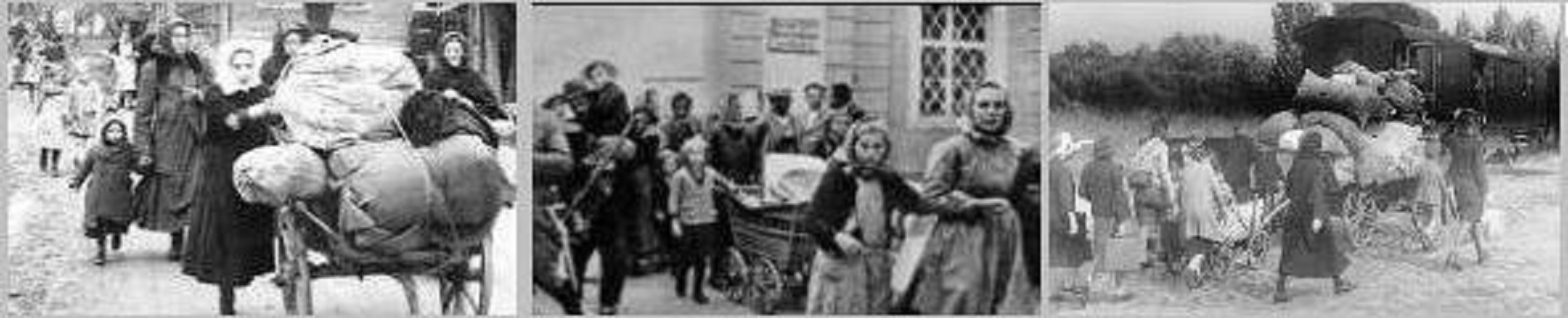
| While the expulsions in Eastern Europe are more common knowledge, there were some other cases of ethnic cleansing, although on a much smaller scale. After war's end, for example, the Dutch decided to expel 25,000 Germans living in the Netherlands, many married to Dutch spouses, labeling them 'hostile subjects'. Operation Black Tulip was an operation which lasted from 1946 to 1948 under Dutch minister of Justice Kolfschoten to evict all Germans. They were branded as 'hostile subjects' (vijandelijke onderdanen) and evicted in three groups, in reverse order of entry. Those who came after the start of the war (mostly factory workers) were the first to leave, and next were those who came after 1932 (including political refugees). Some of the rest were economic refugees from the 1920s. The operation started on September 10, 1946 in Amsterdam. Germans and their families were pulled from their homes in the middle of the night and given one hour to collect only the allotted fifty kilogrammes of luggage. They were allowed to take only one hundred Guilders. The rest of their possessions were confiscated by the state. They were taken to concentration camps near the German border, the biggest of which was Mariënbosch near Nijmegen. In total, about 3,691 Germans were expelled. The operation ended in 1948, but it was not until 1951 that the "state of war" with Germany officially ended and the Germans were no longer regarded as state enemies. Left: Ethnic German civilians forced to flee Holland France was an old hand at expulsions. With the end of World War I, when Alsace-Lorraine was taken from Germany and given to France, it was divided into the provinces of Alsace and Lorraine. Lorraine re-adapted rather easily to French rule again because there were comparatively few ethnic Germans there. Almost 90% percent of the population was German in Alsace (1,634,260 out of a population of 1,874,014) and Strassburg was almost exclusively German speaking as well. Yet they were not offered the plebiscite granted to some of the eastern German territories. France began an intimidating campaign of political investigation and crackdowns against Alsatian Germans. Officially, only 'hostile' Germans and immigrants from Germany after 1871 were to be affected, and the 300,000 or so people who had immigrated to Elsaß-Lothringen from 1871-1918 and become a significant part of the community was targeted for compulsory expulsion. Soon enough, the French expulsion plan also targeted local Alsatians whose families had lived in the region for centuries. Thousands of German workers in Alsatian factories, industries, mines and railways were fired and immediately displaced. Military police courts in Alsace rounded up Alsatian German 'undesirables'. 11,500 German civil servants and civilian employees were fired and German stores throughout the region were plundered by French soldiers. France even refused to extend to Srassburg the same rights.as they gave other French cities in regards to separation of church and state. German teachers were expelled and German language was banned from all political and public gatherings. An intense campaign of Francification began to eradicate German culture and regional history. By the thousands, they were marched to the border of war torn, starving Germany, where there were no jobs. The expulsions officially lasted from 1918 to 1920. Over 100,000 German civilians were documented as expelled from Lorraine and at least 150,000 to 200,000 from Alsace. Most of the expellees were forced to forfeit their homes and property, and were only allowed to keep whatever possessions they could carry before being marched to the border of French-occupied Germany. Those expelled from Stassburg were only allowed only to take a few small handbags and left amid jeering, rock-throwing French mobs crying, “death to the boches” while French soldiers stood by and laughed. An estimated 200,000-250,000 Germans were expelled until the signing of the Treaty of Versailles, and only about half were allowed to return, and then only after pressure on the French by the USA who ironically feared that such expulsions would set an example which could cause massive upheaval and unrest if other nations were allowed to do the same. Some inhabitants of the village of Kehl were also expelled following German defeat in World War One. The gateway to Strassburg, the German village was first mentioned 1038. In 1338, the first permanent bridge between Kehl and Strassburg was completed. In 1678 the city was taken by France and the village was transformed into a fortress. After several changes of sovereigns, the city was finally returned to Germany in 1815 and the fortress was dismantled. After the First World War, according to the Treaty of Versailles, the harbor of Kehl was placed under French administration for seven years and many Germans here were also expelled. After the Second World War, a similar scene occurred in both Alsace Lorraine and Kehl, where the expulsions continued until 1953 when Kehl was returned to the Federal Republic of Germany and the refugees were allowed to return. France continued to suppress German language and culture. In 1999, only some 548,000 adults still spoke Alsatian out of a population of nearly 2 million, and only 1 in 4 youths can speak it. The few schools that do offer German are required to teach 13 hours of German and 13 hours of French and at least 25% of all documents and academia must be in French. There do exist some German- language newspapers, but they are also required to include the French language. Many German Canadians interned in Camp Petawawa were from a nineteenth-century migration in 1876 who founded a farm villages called Germanicus in Ontario. Their original farm homesteads were expropriated by the federal government with no compensation and they were imprisoned behind barbed wire in the camp. The Foymount Air Force Base near Cormac and Eganville was built on this expropriated land. Notable was that not one of these homesteaders from 1876 or their grandchildren had ever visited Germany again after 1876, yet they were accused of being "German Nazi agents". |
| The Long March of the Innocents |
| Ethnic Germans had a long, substantial and peaceful presence in Russian lands for many generations. Most were farmers drawn to the area long ago in the days of Czars. Background By 1914, there were 2,416,290 German civilians in Russia. A wave of hostility occurred after the Laws of Liquidation passed in 1915, and after the Bolshevik Revolution of October 25, 1917, ethnic Germans of the former czarist empire were subjected to an organized campaign of terror, rape, torture, mutilations, being burned alive and mass shootings. Many "Vistula Germans" had already fled, but the religious Volga-Germans were severely persecuted. By 1918, there were barely 1,621,000 Germans alive in Russia and by 1919, their pastors were sent to slave camps. The requisitions of 1917-1921 threatened the existence of the Ukrainian-German villages. In Kandel, Großliebental, Franzfeld, Josephtal and Landua, hundreds died from rampant starvation caused by the Bolsheviks' fiendishly crafted man-made famine. Between 1921 and 1923, this famine created so much emigration and death that the population of Germans decreased by another fourth. During this time, approximately 10,000 Volga-German children were forcibly taken from their parents with promises of food when in truth they were removed and sent alone to their painful deaths. 350,000 Germans in Russia and Ukraine perished in the next arranged famine of 1932-1933. More The Treaty of Versailles at the end of World War One had already set the stage for violence which gravely impacted minority German communities in Eastern Europe. Even before the war was over, nationalities within Habsburg Lands were eager for independence, and France, Britain and the USA began investing money into those schemes and instigating dissension. With Allied victory, Eastern Europe was carved up with the primary goal of destroying any possible future German prosperity and growth, and to prevent Germany and Austria from ever becoming too powerful again. This gravely impacted ethnic German minorities within the former realm. Background Hungary and Romania initially sided with Germany then changed sides. Thousands of Germans fled as the Soviets were taking control. German owned land in Hungary was seized and "non- Magyarized" Germans were executed or expelled. Full persecution of the German minority began on December 22, 1944, when the Soviet Commander-in-Chief ordered deportations. 20,000 Germans had already been evacuated to Austria, but many of them had futilely returned to their homes the next spring. In January 1945, the Soviet Army collected 32,000 ethnic Germans and deported them to the Soviet Union for slave labor. By the summer of 1945, the removal of the Danube Swabians in Hungary was performed under direct Allied observation. Although the Soviets had orchestrated the conversion of Hungary into the Communist world, the de facto controllers of Hungary during this time of the expulsions were the USA and the Soviet Union. |
| The expulsion programs were carried out by the cooperation between the Americans, the Soviets and a small Hungarian Communist government. On December 29, 1945, the new Hungarian Government ordered the deportation of every person who had declared themselves German in the census of 1941. Mass arrests and deportations began swiftly before the expellees had time to take their valuables. The first wagon departed from Wudersch on January 19, 1946 with 5,788 people. Until July, 1945, between 185,000 and 200,000 German-speaking Hungarian citizens were deprived of their rights, forced to forfeit all their possessions, and deported to W. Germany, a "homeland" they never knew. The Soviets ordered the expulsion of Germans from Romania early in 1945. Their deportation for forced labor was the Soviet idea of "German war reparations" according to the 1944 secret Soviet Order 7161 issued on January 6, 1945 to the last non-communist government of Romania under Nicolae Rădescu. The order applied to all males between the ages of 17 and 45 and women between 18 and 30. Only pregnant women, women with children less than a year old and persons unable to work were excluded. On January 13, 1945, arrests had already begun in Bucharest and Braşov. On the surface, the Rădescu government protested and even raised concerns regarding the fate of those women and children left behind. In truth, they knew about the plan well in advance and even assisted the Soviets. Weeks in advance, the state railway had begun to prepare cattle wagons to transport the expellees. This nasty mission was accomplished with the Romanian authorities' assistance, as well as by Red Army units and GRU agents. The Bessarabian Germans It is estimated that around 75,000 to 100,000 Transylvanian Germans were deported to the Soviet Union, and 12% were outside of the age limits stipulated in the order. 90% of expellees went to the Ukrainian SSR (the areas of Dnipropetrovsk, Stalino and Voroshilovgrad) and the rest to the Urals. They were sent to 85 separate camps where, regardless of their previous occupations or professions, one third worked in mines, a fourth in construction and the rest in industry, agriculture or camp administration. 10% died in the either the camps during the inhumane transports. 12% of expellees, mostly males, died while in the USSR many from abuse, the highest number being in 1947. Some of those who were unsuitable for work were returned to Transylvania at the end of 1945, and between 1946 and 1947 about 5,100 people were sent to the Soviet occupation zone of Germany. When they were freed, a quarter of deportees were sent to Germany, of whom just one seventh returned to Transylvania. In 1948, about half of those remaining in camps were freed and in October 1949, the camps were shut down. The last third of the expellees returned to Transylvania. Of those brought to the Soviet occupation zone in East Germany, a few remained and around half received permission to return home. Some moved elsewhere, mostly to West Germany. 202 more expellees were allowed to return home in 1950-52. From a population of 298,000 Siebenbürgen Germans in 1941, 50,000 simply vanished during the ethnic cleansing. But during the 1950s, more grim hardship awaited Romania's ethnic Germans, this time mainly Banat Swabians: a large-scale action of penal transportation, undertaken by the Romanian Communist regime. Their aim was to forcibly relocate individuals who lived within approximately 25 km of the Yugoslav border so as to "purifify the Banat". The plan targeted farmers with large holdings, wealthy landowners, business people, Bessarabian and Macedonian refugees, former members of the Wehrmacht, foreigners, relatives of other refugees, wartime collaborators of Germany, Romanian Army employees, fired civil servants, relatives of counter-revolutionaries, political and civic rights activists and leaders of the ethnic German community. During the night of June 18, 1951, 45,000 people were taken from their homes by gunpoint, loaded unto wagons under military guard and deported to the Bărăgan area, an underdeveloped, sparsely populated area. After two weeks of grueling travel, they were dumped there and left to build houses of mud or adobe covered with straws or reed in eighteen localities. The victims included Romanians, Germans (mostly Banat Swabians), Serbs, Bulgarians, Romanian and some Ukrainian refugees from Bessarabia and Northern Bukovina, and Aromanians.The majority of the deportees were kept in the settlements for five years until 1956, while others remained permanently. In 1956, a change in government policy allowed most of the deportees to return home, but some remained in the Bărăgan. The greatest slave trade in European history took place later when Romanian dictator Ciausescu "sold" his ethnic Germans to the Bonn Government for 8,000 to 14,000 Deutsche Marks each, a slave trade which ended when Ciausescu was overthrown and killed. Of the 350,000 Danube Swabians in Romania after the war, only about 25,000 remain today, mostly the very aged or ill. Interestingly, it was not only ethnic Germans who were expelled from the historically German-settled Banat. Some exiled families from the region descended from French- speaking settlers from Lorraine who had maintained the French language for many generations. They were later labelled as Banat French, Français du Banat, and their survivors were resettled in France around 1950. Virtually all of the half million Germans in Yugoslavia fled, were murdered or expelled in 1945, and thousands were sent to slave camps. Violence against Germans here was probably more ruthless than in any other country. Whole villages were burned down, and the Germans butchered. In total, there were over 40 camps that held some 200,000 German civilians (nearly the entire ethnic group) until 1948. Some of the most salient camps in Yugoslavia for Germans were located in Gakovo, Sremska Mitrovica, Svilara, Valpovo (Croatia), Molin, Jarak, Kruševlje, and Hesna. Hungry children escaped through barbed wire and often begged for foods on the streets. Some documents assert a 50% death rate in some Yugoslav camps. The Teletschka fields outside of the expansive prisoner camp at Rudolfsgnad (Knićanin) contain mass graves that are believed to hold from 9,000 to 12,500 buried prisoners. When rivers flood in heavy rain seasons, bodies and body parts unearthed from the mass graves show up in nearby villages. In the Yugoslavian camp Gakova in Batschka, of 17,000 German civilians who were imprisoned in April 1945, 9.000 perished horribly and ended up in mass graves. Both the first and second 'Yugoslavia' were the creation of the victorious Allies in 1919. In the first Yugoslav state of 1919-1941, approximately half a million ethnic Germans lived among 14 million people. The problems for the German population here began as elsewhere, largely with the issues of class and money. Most Germans lived in the northern region of the Serbian Banat and Vojvodina. Yugoslavia inherited a disproportionately large, wealthy, German high-class minority and a poor Slavic peasant majority from the Habsburg Empire. Even after the Yugoslav government began confiscating the Germans' estates, the small Swabian German minority continued to exert powerful influence in early Yugoslavia. In the Vojvodina, where most Germans and Hungarians resided, Germans were only a quarter of the population, but dominated over 50% of the economy, and 80% of products and material exported out of the region originated from traditionally owned ethnic German businesses. They had a thriving culture complete with German language newspapers, businesses, schools and social organizations. Following Yugoslavia's break-up in April 1941, approximately 200,000 ethnic Germans became citizens of the newly established state of Croatia while most of the remaining approximately 300,000 ethnic Germans in other areas came under the jurisdiction of Hungary (see above). During the final months of World War II, especially after the founding of the second Yugoslavia, the lives of the ethnic Germans under Josip Broz Tito's Communist state became perilous. The leading proponents of fascism were executed outright. Then, one of Tito's first acts was to confiscate all property of all ethnic Germans without compensation, declaring those of German origin as “enemies of the people” with no civil rights. Next, their Yugoslav citizenship was cancelled. German authorities had evacuated 220,000 ethnic Yugoslav Germans to Germany and Austria by the end of the war, but for those remaining, very few found safety. Even after having been driven out on foot and by train, Allied- occupied Germany and Austria denied them asylum and turned them back to the communists who herded them up at gunpoint and sent themback to communist slave camps. After Christmas of 1944, between 27,000 to 30,000 ethnic Germans were sent to the USSR from Yugoslavia. Most were sent to labor camps such as the ones at Knićanin and Molinin or in the Donbass where 16% of them died. Some 63,635 more Yugoslav ethnic German civilians perished under the brutal Yugoslav reign of terror between 1945 and 1950, most as a result of slave labor, in ethnic purges or from disease and severe malnutrition. The Yugoslav Communists confiscated what would today translate into twelve billion US dollars of German property (97,490 farms, stores, factories) and one million acres of German land. Of Danubian ethnic Germans who served in the German military (many had no choice), over half perished after the end of the war in Yugoslav camps, including about 150,000 of the troops who had surrendered to British military authorities in the armistice of May 8, 1945 and were turned over to Communist Yugoslav partisans! More than 7,000 captured German troops died in Communist- ordered 800 mile “atonement marches" or "Marches of Shame" from Austria's southern border to the northern border of Greece and many German soldiers in captivity in late summer of 1945 were thrown alive into large pits and executed, victims of mass shooting and torture. Lastly, in the ten years following 1945, an additional 50,000 perished from malnutrition and exhaustion, worked to death as Yugoslavia's slaves. After 1986, a report appeared showing that out of about 194,000 prisoners, at least 80,000, probably even 100,000, died or were murdered. Thousands of German and Croat soldiers captured in the final days of the War were coldly executed and buried in mass graves recently found in western Croatia. Human Rights workers found one mass grave that holds the bodies of 4,500 soldiers, including 450 German army officers separated from their soldiers and probably tortured then executed last. There are at least nine other mass graves in northwestern Croatia being investigated, three of them located and six still not found. According to reports, along with German and Croat troops, the graves are believed to hold "many civilians". It is estimated that of other remaining mass graves, 600 are in Slovenia, 840 in Croatia and 90 in Bosnia. Prior to World War Two, approximately 1.5 million "Danube Swabians" lived peacefully in Hungary, Romania and Yugoslavia. The result of war deaths, expulsions, murder, deaths in labor camps and emigration meant a total loss of 98.5% of the Danube Swabian community from the Balkans. Two centuries of settlement almost entirely disappeared. Yugoslavia fell from having some 500,000 ethnic Germans before the war, and at least 200,000 immediately after the war, to nearly none now. There was a small German presence in Bulgaria since the middle ages when Catholic miners from Saxony established a community in north-western Bulgaria, and in the 13th-14th century, German miners from the Upper Harz and Westphalia settled in and around modern northwestern Bulgaria before most of them left following the Ottoman invasion. Those who stayed married Bulgarian women and merged with the local population by the mid-15th century. Following the restoration of Bulgaria as a sovereign monarchy in 1878, all four Bulgarian monarchs were of German descent and German intellectuals arrived in Bulgaria to foster its cultural development. Until World War II, there also existed a small but notable rural German population in several villages scattered in northern Bulgaria. "Banat Germans" began to settle in some other rural villages and there was also a German community of colonists from present-day Ukraine. Germans also settled in Bulgaria's larger cities as part of the group of the so-called "Lower Danubian Levantines", the Western and Central Europeans in the vibrant port and merchant cities of northern Bulgaria. Stripped of their land and rights, 2,150 ethnic German Bulgarian citizens were deported from the country in 1943 and resettled within Germany. Only a handful of Bulgaria's rural German population remained because they had married local Bulgarians. |