| Würzburg was a university town and capital of Lower Frankonia in Bavaria situated on the Main River at the junction of main lines to Bamberg and Nürnberg. The bishopric was probably founded in 741, but the town probably existed in the previous century. The University once granted Alexander Graham Bell an honorary Ph.D. for his pioneering scientific work. Among other great artisians, painter Grünewald (Mathis Gothart Niethart) was born here. There was the Julius hospital, founded in 1576 and the old Rathaus, in part dating from 1456, and the buildings of government, offices, courts, theater, plus the Maxschule, observatory and the various university buildings founded by Bishop Julius in 1582. Here in lovely antique Wurzburg, surrounded by its rolling vineyards, Wilhelm Conrad Roentgen discovered X- rays in 1895 while a professor in Würzburg. The medieval university had a library containing 300,000 volumes. The University at Wurzburg had 462,000 volumes just prior to the beginning of the Second World War. The War was a major catastrophe for the city of Würzburg and also for the university library. On March 16, 1945, the city was pulverised by Allied air raids which murdered a third of Würzburg's inhabitants and utterly decimated significant sections of the city, destroying the University library and almost 80 percent of all holdings not been stored offsite. The University of Erfurt was founded in 1392 and for some time it was the largest university in Germany. Martin Luther received his bachelor's degree here in 1502. When Erfurt became part of Prussia in 1816, the university closed. The main building was over 700 years in 1945 when it was destroyed by Allied bombs. Only parts of the portal and the window boxes survived. The University of Vienna was opened by Duke Rudolph IV and his brothers Albert III and Leopold III in 1365 and it is also one of the oldest universities in Europe. It is the second oldest university in Central Europe and the oldest university in the German- peaking world. In 1945, the University of Vienna lay in debris and ash. On April 10, 1945, the first Soviet soldiers reached the University district in Vienna and the abandoned university building was requisitioned by the Soviet troops as a horse stable. Soon however, "approved" faculty were hired and the University of Vienna re-opened for study amid food shortages, rubble, the recovery and censorship, the reconstruction of demolished buildings and "de-nazification" of the teaching body. In 1547, Elector Johann Friedrich the Magnanimous of Saxony conceived the founding a University at Jena, which was later established by his three sons in 1558. In the middle of the 18th century, such greats as Fichte, Hegel, Schelling, Schlegel and Schiller were on its teaching staff.By the end of the 18th and the beginning of the 19th century, the democratic movement in German lands took root here. It eventually maintained a library with 200,000 volumes, an observatory, a meteorological institute, a botanical garden, seminaries of theology, philology and education, and clinical, anatomical and physical institutes along with veterinary and agricultural colleges connected with the university. |
| Ernst Moritz Arndt University of Greifswald is located in the town of Greifswald between the Islands Rügen and Usedom. It was founded in 1456, and for a time was also the oldest institution of higher education in Sweden and, later, Prussia. Before the Second World War, the University of Greifswald was among the wealthiest universities in Germany. In 1604, the university introduced the first centralised university library of Germany. In the years of the DDR, the city itself lost almost half of its historic buildings and the University was restructured along communist doctrine. When the elector of Saxony exiled the Pietists in the late 1600s, Prussia welcomed them at the new University of Halle, established by the Elector of Brandenburg Friedrich III (later King Friedrich I of Prussia) in 1694). In only 25 years, Halle had a large student body and was soon the most prestigious university in Germany. It was ideologically restructured towards Communism at war's end. The spacious, Gothic University of Breslau was built from 1728-1736 as a college by the Jesuits on the site of the former imperial castle. It contained a magnificent, richly decorated and ornamented hall capable of holding 1200 persons. When the Red Army took Breslau in 1945, burning and sacking the city, they also burned the fine collections of the university library and the first communist Polish team of academics arrived to take control of the school. The university buildings were 70% destroyed. The University of Kiel (Christian-Albrechts-Universität zu Kiel ) was founded in 1665 as the Academia Holsatorum Chiloniensis by duke Christian Albrecht of Holstein-Gottorp and was the most northern university in the Holy Roman Empire. The university was horribly damaged during Allied bombing. The school was rebuilt at a different site with only a very few of the older buildings still stand. The University of Rostock was founded in 1419 and is the oldest and largest university in continental northern Europe and the Baltic Sea area as well as the second oldest in northern Europe. It was damaged by air raids and ideologically restructured. Georg-august-universität Zu Göttingen was founded in Göttingen in 1737 by George II of England in his capacity as Elector of Hanover. In the late 18th century it was the center of the Göttinger Hain, a circle of poets who were forerunners of German Romanticism. In 1837, seven professors, including the brothers Grimm, were fired for protesting against the revocation by King Ernest Augustus I of Hanover of the liberal constitution of 1833. Otto von Bismarck studied in Göttingen in 1833 and had to live in a small separate house because his rowdiness had caused him to be banned from living within the city walls. Göttingen went under communist slavery in the DDR |
| The Albertina was the name of the University of Koenigsburg created 1544 by duke Albrecht. One of the most well-known professors at the Albertina was the philosopher Immanuel Kant, and one of its many students was Peter the Great of Russia. Between 1811-1813, an observatory was established by Friedrich William Bessel. On August 17, 1944, the Albertina celebrated its 400th year of existence. A mere 11 nights later, British air raids began over Koenigsburg to help the Red Army, and in three days they managed to utterly destroy not only the University but the whole historic city which was given to the USSR. The Archbishop of Mainz approved the first University of Mainz under Prince-elector and Reichserzkanzler Adolf II von Nassau. The university, however, was first opened in 1477 by Adolf's successor to the bishopric, Diether von Isenburg. On April 6,1798, the Mainz university, together with the universities of Cologne, Trier and Bonn, were closed by the French administration. The old Mainz University was destroyed by Allied bombs in August of 1942. Today's Johannes Gutenberg University of Mainz was founded in 1946 by the French occupying powers. The University of Bonn was originally the nonsectarian Kurkölnische Akademie Bonn, founded in 1777 by Maximilian Friedrich of Königsegg-Rothenfels, the prince-elector of Cologne. The academy had schools for theology, law, pharmacy and general studies. In 1784, Emperor Joseph II turned the academy into a university. It was closed in 1798 after the left bank of the Rhine was occupied by France. When the Rhineland became a part of Prussia in 1815, Prussian king Friedrich Wilhelm III (to whom Beethoven composed the Ode to Joy) combined it with the Roman-catholic University of Cologne and the Protestant University of Duisburg, forming one university, Rhein-Universität. Pope Benedict XVI, Karl Marx and Friedrich Nietzsche all attended here. It was the sixth Prussian University, founded after Greifswald, Berlin, Königsberg, Halle and Breslau. During the War the university suffered heavy damage. Bombing on October 18, 1944 destroyed the main building. |
| The Enemy: Ancient German Schools |
| The ancient University of Cologne was established in 1388 as the fourth university in the Holy Roman Empire. The university began teaching on January 6, 1389. In 1798, the university was closed by the French, who invaded in 1794. In the course of the 19th century, attempts by the city and citizens to reopen the university failed. Finally, the Prussian government reopened it in 1919. An air raid destroyed more than 70% of the building on March 2, 1945. King Ludwig I. founded a university in Fünfkirchen in 1367 and it was to become the first university in what today is Hungary. Fünfkirchen went through many stages, at one point in history being occupied by invading Ottoman armies from 1543 until 1686 when Ludwig the Bavarian saved the city and the Ottomans fled. Slowly the city started to prosper again, and by 1688 other German settlers arrived. Only about one quarter of the city's population was Hungarian, with the others mainly Germans. Because Hungarians were only a minority, Fünfkirchen didn't support the revolution against Habsburg rule led by Rákóczi, and his armies pillaged the city in 1704. Fünfkirchen was once even occupied by Croatian armies until it was again freed by Habsburg armies in January, 1849. After World War One, life became difficult for the Germans in the newly renamed town of Pecs, and after World War Two, the Germans were largely either murdered, sent to slave camps or expelled. The ancient University of Funfkirchen is now the University of Pecs. In the 19th century, a Munich University Institute collection counted 42,000 different rare copies of the Quran including various Islamic manuscripts and printed texts covering a period of 1,300 years. Research on these rare texts was carried out for over half a century. Both the Institute and the entire collection were destroyed by Allied bombing. Munich's oldest church, St. Peter's Church from 1169, and the Cuvilliés Theatre at the Residenz, a grand theatre built for the Wittelsbach court between 1746 and 1777 were gone. The Bavarian State Library, or Bayerische Staatsbibliothek, in Munich was one of the largest libraries in the German- speaking world, founded in 1558 by the Wittelsbach Duke Albrecht V. It also housed collections of coins and medals, jewels and items of silver and gold, Greek and Roman statues, paintings, works of art, items of natural history and other things of interest. A large part of the Library’s stock next came from around 150 Southern German monasteries and seminaries with collections dating back a thousand years or more. It was once customary for princely libraries to also house such collections of coins and medals, jewels and items of silver and gold, Greek and Roman statues, paintings, works of art, items of natural history and other things of interest to the aristocratic families whose members were permitted in Munich to view the Duke's treasures provided they had the personal permission of the Duke. |
| The Allied bombing raids carried out to help the Red Army near war's end in 1945 killed 153 civilians and destroyed most of Jena's historic center. At least the University's History Department, which had been housed with its valuable library in the main University building since 1936, was somehow spared. The books were not necessarily safe, however, as the communist government embarked on a path of ideological cleansing. There was political pressure against its "bourgeois" precepts, and in 1953 the old History Department was amalgamated with the Marxist Department of Modern History to create the "Historical Institute". Emphasis was placed on contemporary history and the history of the workers' movement, massive ideological uniformity, standardization and indoctrination of teachers, and a re-writing of Thuringian state history. |
| The Ebstorfer map of the world was the largest surviving "mappamundi" of the Middle Ages. It was destroyed in the Allied bomb destruction of Hanover in 1943. |
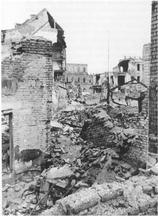
| By 1789, the Bavarian Court and State Library opened to the public, well ahead of most other libraries in Europe. Visitors to the library from outside Germany grew in number as well. A large part of the Library’s stock next came from around 150 Southern German monasteries and seminaries with collections dating back a thousand years or more, half of which had been acquired during secularization under Napoleon. The library, in ruins left, also contained manuscripts and incunabula out of the library of Hartmann Schedel, one of the most important humanistic private libraries north of the alps. On the night of March 9, 1943, an incendiary Allied bombing attack hit the library, incinerating half a million volumes: a full one quarter of the entire library, including what had been the world's largest Bible collection. The losses would have been far greater had not the director of the manuscript collection distributed 1400 large wooden crates of books and other treasures to safer places. |
| Allied bombing damaged or destroyed nearly every major university, library and museum in Germany. Below are just some of the most ancient and venerable educational institutions affected. Millions of German books were destroyed in the hysteria of both World Wars and approximately 25,000,000 books in Germany were destroyed by Allied bombs in World War Two. Then there was unfettered plunder and looting of surviving libraries and schools followed by rabid re-education policies under both Soviet and Allied occupational governments which resulted in massive book burnings. The University of Leipzig, or Universität Leipzig, is one of the oldest universities in Europe, founded in 1409, and it has provided almost 600 years of uninterrupted teaching and research. Its church, Petrikirche, was somewhat of a shrine to German culture and connected to the most important names in German cultural history. It was one of seven Leipzig churches under Bach's musical direction. The church's organ was built by Johann Scheibe and beloved by Bach, who claimed that it alone in all of Leipzig met his standards. The Universität Leipzig was badly damaged by World War Two Allied bombing, then restructured under the communist government to re-educate its students in communist ideology. As an example of how the Soviets appreciated German cultural meccas, Walter Ulbricht, the East German party leader and creator of the Berlin Wall, detested his Leipzig hometown's "bourgeois academic and Christian heritage" and ordered the destruction of virtually every symbol of these traditions. On May 30, 1968, thousands of weeping Leipzigers filled the Augustusplatz, renamed Karl Marx Platz, watching dynamite lift the late-Gothic Universitaetskirche, University Church, including Bach's favorite organ, off the ground until it collapsed into a heap of rubble. More than three quarters of the historic printing district with its printing and publishing houses, bookshops and book and the book museum, were wholly obliterated. The city famous for its book arts lay in ruins. Over 50,000 books and rare manuscripts burned. On April 18, 1945, units of the US army took over and "liberated" the city just long enough to hand it over to the Soviets. Until the Allies abolished Prussia and its history, Humboldt-Universität, was known as Friedrich-Wilhelms- Universität. The university was home to many of Germany's greatest thinkers of the past two centuries. When the university reopened under communist control in 1949, its libraries had been purged of any and all books of a "nationalistic" slant and its faculty and student body was cleansed of all who didn't conform to Communist teachings and ideology. Part of Humboldt-Universität is the Museum für Naturkunde, the first national museum in the world, with a massive collection of more than 25 million zoological, paleontological, and minerological specimens, including the largest mounted dinosaur in the world and the best preserved specimen of the earliest known bird. Established in 1810, its priceless collections contain objects from three major fields, paleontology, mineralogy, and zoology. The priceless mineral collections represented 75% of the minerals in the world and attracted researchers from around the world. The collections were horribly damaged by the Allied bombing of Berlin and much of it was then lost to plunder. The eastern wing was severely damaged and has never been entirely rebuilt. Berlin's Ethnological Museum lost rare manuscripts, works of art and artifacts from Chinese Turkestan's high Buddhist civilization. Although some of its extensive collection had been moved for protection against bombing, 28 of the largest paintings had been cemented to the museum walls and could not be removed and were therefore pulverized and burned. Prehistoric antiquities from the collections of the Prussian kings were housed at their Monbijou Palace which opened as a museum for the public under the name "Museum Vaterländischer Altertümer" (Museum for Antiquities of the Fatherland) beginning in 1830. By the twentieth century, Berlin's Museum for Pre-and Early History ranked among the three most significant collections in the world. It was flattened. The University of Freiburg was founded by Archduke Albrecht IV of Austria in 1457 and originally consisted of four faculties: Law, Theology, Medicine, and Philosophy. It was almost 500 years old when Freiburg was devastated in 25 minutes by a 25 minute air raid on November 27, 1944. A firestorm was created which swallowed much of the university, particularly the natural science institutes and the libraries filled with ancient books which were completely destroyed, their valuable collections reduced to flame and rubble. |

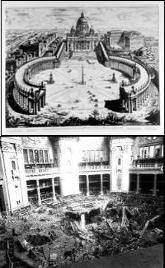
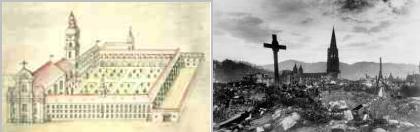

| Universities of Koenigsburg. Mainz and Bonn |
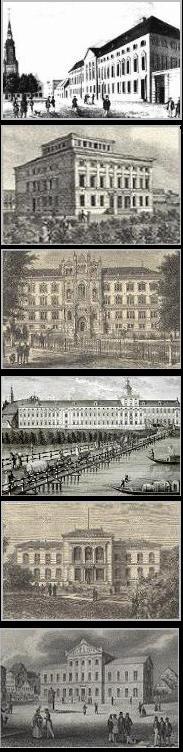
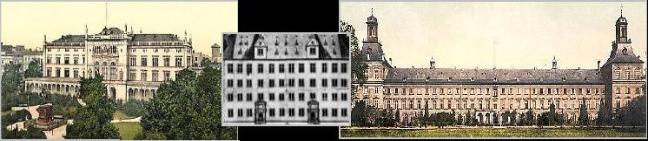
| Top: The University of Leipzig; Right: Humboldt-Universität; Bottom: The University of Freiburg |