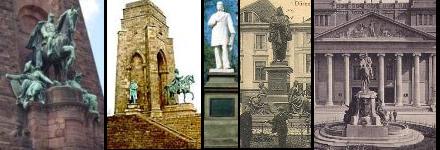
From 1867 to 1918, more than 1,000 memorials to WilhelmI were constructed. Here are a few.
| Above: Frankfurt, Wiesbaden, Koln, Nürnberg, Koblenz and Stettin |
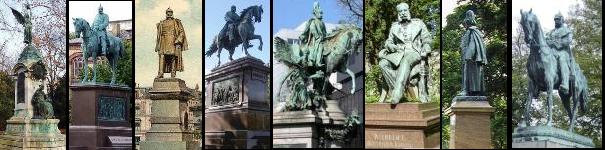
| Above: Heilbronn, Kiel, Elbing, Karlsruhe, Düsseldorf, Dortmund, Arolson, Hamburg |
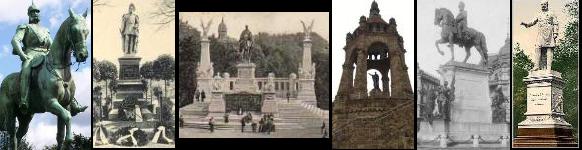
| Kyffhaeuser, Hohensyberg, Baden, Düren, Aachen |
| Lübeck, Pomerania, Breslau, Minden, Stettin, Hesse-Nassau |
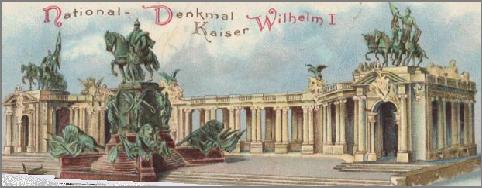
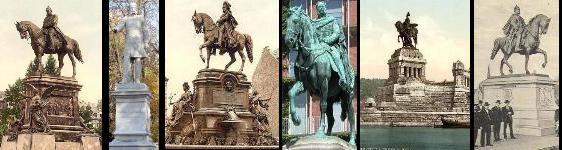
| There were monuments to Kaiser Wilhelm I of Prussia all over the land. In March, 1888, fifteen days after the death of the Kaiser Wilhelm I of Prussia, who was proclaimed German Emperor in Versailles in 1871, the Imperial Diet unanimously voted to erect a memorial to the memory of the much respected and beloved founder of the German empire. In June of 1894, construction began at a cost of four million gold marks. The number of animals on the monument prompted many contemporary jokes. It included a menagerie of 157 animals: 21 horses, 2 oxen, 8 sheep, 4 lions, 16 bats, 6 mice, 10 pigeons, 2 ravens, 2 eagles, 16 owls,1 Kingfisher, 32 lizards, 18 snakes, 1 carp, 1 frog and 16 crabs. The center of the magnificent 21-meter high monument was the 9-meter-high equestrian statue of the Emperor accompanied by a female god of peace. Victory goddesses floated on the four corners of the bronze pedestal and the floor of the hall was covered with a beautiful mosaic floor. On the ledge of the front, four characters groups sculpted by various artists embodied the kingdoms of Prussia, Bavaria, Saxony and Wuerttemberg. The four groups on the reverse side were trade and shipping, art, science and agriculture and commercial diligence. Ceremonies took place all over Germany in March of 1897. Later, on March 22,1900, Kaiser Wilhelm II, his wife, and rulers or representatives of all the German States dedicated the new monument in Berlin. There was immense popular enthusiasm. The monument was built with a throne and red carpeted staircases, complete with a magnificent canopy edged in golden braids which was reserved for the dowager Empress ( the daughter of Queen Victoria of England and mother to Kaiser Wilhelm II ), the Prussian princesses and German rulers. A hundred Prussian and imperial deputies stood on the platform of the memorial among brilliantly uniformed officers. The Kaiser and his aides-de-camp and generals rode along of the troop line in the Unter den Linden to the tunes of military marches. When the empresses appeared in the imperial pavilion, the Kaiser gave the command for the drums and trumpets to play and for the singing of the favorite hymn of Wilhelm II: "Wir treten zum Beten von Gott dem Gerechten" (We are going to pray God the Just). A Lutheran pastor issued a prayer of consecration for the sixty-five foot monument and when he was finished the Kaiser drew his sword, made troops present arms, and cut the veil covering the statue while they all saluted. The statue, in bronze, represented Wilhelm I in full Prussian dress with a spiked-helmet. "To Wilhelm the Great, King of Prussia, 1861-1888 " was inscribed upon the monument along with: "Acknowledgement and faithful affection - the German people". The Kaiser remained on horseback for a time after the veil had been removed, while drums were beating, troops were cheering and military music playing "Heil dir im Siegerkranz". At the same time, a hundred and one cannon-shots was fired and all city bells rang out in pride. Afterward, there was a lush banquet where Kaiser Wilhelm II made a speech praising his father and recalling the suffering of Germany beforehand while under the French yoke. |
| Monuments to a Beloved Kaiser |