| Love and Music and War. A Prussian Princess and an Adventurer |
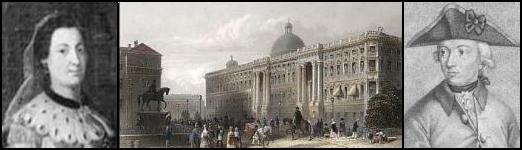
| Anna Amalia's namesake and aunt, Princess of Prussia Anna Amalia, was born in the Hohenzollern Royal castle in Berlin in 1723, one of the eight surviving children of Friedrich Wilhelm 1 and Sophie Dorothea von Hannover. Her brother Friedrich (the Great), taught her how to play the violin, flute and harpsichord. Music would comfort her throughout her future misfortunes. |
| In 1794, Trenck was arrested as a spy in Paris, France. He was thrown in prison and placed on trial in front of the Tribunal, where he was sentenced to death as an Austrian spy. He was sent to the guillotine on July 25, 1794. In Charles Dickens's "Tale of Two Cities", the author seems to describe Trenck's execution, which was among the last twenty or so to take place. The assembled crowd was supposedly emboldened by Trenck's last words and marched off to drag Robspierre to his own doom: "People of France, we die innocent. Our deaths will be avenged by you. Set up liberty once more by making an end of the monsters who are desecrating her name!" |
| In 1795, King Friedrich Wilhelm II posthumously awarded Trenck the title of Count which could be inherited by his heirs. Anna Amalie, the "Abbess of Quedlinburg", spent most of her time in Berlin where she devoted herself to music. Only a few of her works have survived. She and Trenck are said to have corresponded in later years. |
| Two Prussian Anna Amelies and their Impact on German Culture |
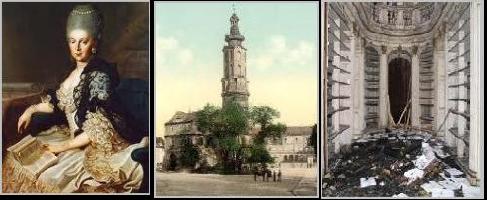
| Weimar's Anna Amalia (1739-1807), niece of Friedrich the Great and Princess Anna Amalia, was Duchess of Saxe-Weimar and Saxe-Eisenach. Talented Anna Amalia was an influential cultural force in Weimar and regent of the states of Saxe-Weimar and Saxe-Eisenach from 1759-1775 after her husband, Duke Ernst August, died in 1758. She was regent for their infant son, Karl August, and she did a fine job administering the duchy and strengthening its resources in the midst of the Seven Year's War. As a patron of the arts and literature, she brought together in Weimar many of the most eminent men in Germany, including Herder, Goethe and Schiller. |
| The Duchess, seeking a tutor for her son, hired poet and noted translator of Shakespeare, Christopher Wieland. Wieland's Shakespeare volumes formed the core of her literary collection. Weimar only had 6,000 residents in the early 19th century, but it was a great intellectual center, an Athens of the day and home to Goethe, Schiller, Liszt, Carl Maria von Weber and Nietsche for at least part of their lives. Here, Johann Sebastian Bach had once composed, played the organ and acted as music director, and German opera later came into being here under Anna Amalia's encouragement. |
| In 1763, almost ten years later, Maria Theresa secured Trenck's release and would later knight him. By 1780, he owned two estates and wrote his autobiography which was a success and translated into several languages. He would wed his second love and have eight children. He travelled in Europe extensively, visiting France and England in 1774-7, and then Paris where he was very popular in Paris society: "Wherever I dined or supped all the friends and relatives of the family were invited that they might have a sight of me; and after meals the company immediately crowded round me with the same view." Two plays were written about him, and he was presented at the Court at Versailles. He then retired to his estates, but unwisely returned again to Paris in 1791. |
| He engraved a small group of objects with old nails while imprisoned. Trenck gave an account of these items in his autobiography "The Life and Surprising Adventures of Friedrich Baron Trenck". One beaker shows him sitting in a chair chained to the wall with a collar symbolically weighing '68 lbs.' Speaking of General Borch, the prison commander, Trenck wrote: "This cruel man came immediately to my prison, but like a hangman about to take charge of his victim. He was accompanied by locksmiths, carrying a weighty collar, which they put round my neck and a strong chain that was joined to that I had already at my feet; and to these were added two additional ones, so that I was really chained like a savage beast." |
| Von Trenck managed to escape in 1746 and while making his way to Vienna in the hope of finding a job with his cousin, he met a Russian general who took him into the Russian service. Trenck's next adventures occurred as a Captain of the Russian Army Calvary and as an appointed Gentleman of the Chamber by Empress Elizabeth. He met and became friends with the future Catherine II "The Great" of Russia. In 1754, when Trenck sneaked home to Prussia to attend his mother's funeral, he was captured by agents of the king who threw him in prison once again, this time in a cell specially built for him in the prison in Magdeburg where he lived for nine years and five months. He said: "When I lay in the Bastille of Magdeburg, the mighty Friedrich the Great said: Whilst my name is Friedrich, Trenck shall never see day." After Trenck made several attempts to escape and was chained to the wall. |
| Anna Amalia apparently entered into a secret union with Prussian Baron Friedrich von der Trenck in 1743. Trenck had a distinguished academic career at the university when he was presented at age nineteen to Anna Amalia's brother Friedrich of Prussia as one of the elite Life-Guards, a Prussian cavalry regiment. An expert duellist as well as an intellectual, he was appointed an orderly officer on Friedrich the Great's own staff. The story goes that when the King discovered that his sister was pregnant, he had her whisked off to the Abbey of Quedlinburg. As for Trenck, after his famous Austrian cousin Franz gave him a horse and began corresponding with him, he was arrested as a spy and confined in Glatz fortress. Anna Amalie was rumored to have been delivered of twins in 1744. |
| Although she was a devoted patron, she didn't begin composing herself until she was 44. She wrote 'Du, dessen Augen flossen' for Ramler's Passion Cantata 'Der Tod Jesu' which was set as a chorale by Kühnau and appeared in many hymnals as a setting for Neander's poem 'Christ, alles, was dich kränket'. Her compositions include chamber music and even regimental marches. She is best remembered for her music library, a Bibliothek which still exists. Johann Kirnberger, when in her services, founded the Bibliothek, begun by preserving over 600 volumes of works she collected of notables Handel, Telemann and Bach, and becoming an important repository of Bach manuscripts. |
| In World War Two, most of Anna Amalia's collection was hidden elsewhere to preserve it from Allied bombs and the library became a public research library for literature and art history with the main focus being German literature from the Classical and the late Romantic eras. Sadly, the cultural destruction continues to oblitterate German cultural history. In 2004, a tragic fire of undetermined origin destroyed 30,000 rare, irreplaceable volumes, with another 20,000 severely damaged. Some 6,000 historical works were saved by being passed hand by hand out of the building by townsfolk and workers. |
| Anna Amalia was also a notable composer, her largest surviving piece a Singspiel 'Erwin und Elmire' written in 1776 and set in a text by Goethe. Anna had the main building, the Grünes Schloss, built between 1562 and 1565, converted into a library in 1761. Goethe was one of the library's famous patrons, working there from 1797 to 1832. Goethe's memorial work to her is titled "Zum Andenken der Fürstin Anna-Amalia". The library included the world's largest Faust collection, and it held her aunt's significant 13,000-volume music collection as well. In 1775, Anna retired into private life. Her son became an influential German leader. |
| Music publishing was a thriving, competitive trade during the latter part of the 18th century and publishers looked for gimmicks to bring new customers into their music shops. One idea was to publish systems that would allow amateurs unfamiliar with the techniques or rules of composition compose music on their own. Many of these schemes involved using dice to select musical fragments from an array of choices. Kirnberger suggested the use of dice for this purpose in his book 'The Ever-ready Composer of Polonaises and Minuets', published in 1757. Austrian composer Maximilian Stadler later put a set of musical bars and tables together for generating minuets and trios using dice. The idea being to cut and paste pre-written measures of music together at random by a dice roll, creating a piece of music. The sum of the thrown numbers is looked up in a scoring table to determine which measure to play. Mozart's 'Musikalisches Würfelspiel' became a famous game, and was first published in 1793, two years after Mozart's death. Even today, if one listens closely to some modern "original" composers, one detects a system similar to this in play in their works. |
| Although he wrote keyboard and chamber music, songs and a small amount of church music, Kirnberger should be respected for his best achievement: he regarded J.S. Bach as the greatest of all composers and applied exhaustive effort to get Bach's largely unpublished chorale preludes preserved in print at a time when Bach was in danger of being forgotten. Kirnberger also developed theories of music that would carry on Bach's musical thinking. |
| His widely published theoretical works so inspired subsequent generations to study Bach's technique and form that many later composers studied Bach's music and brought him back to his exalted place. Young Kirnberger was introduced to Bach around 1738, and he quickly relocated to Leipzig to study with the master. From 1741 to 1751, Kirnberger lived in Poland and worked for various noblemen. Upon his return to Germany in 1751, he became one of Friedrich the Great's violinists. Later, in the service of the Princess Anna Amalia, he founded the Amailien-Bibliothek which became an important repository of Bach manuscripts. He kept this job for life. |
| Johann Philipp Kirnberger, 1721-1783, was among the leading theorists and commentators on music of the 18th century, but as a composer is at best unknown and, at worst, considered rather boring. |