| Tilsit, Tirol, Torgau, Treuenbrietzen, Trier, Ulm, Vienna, Waldenburg, Weimar, Weisweiler, Wesel, Wetzlar and Wiesbaden |
| Tilsit |
| Small, peaceful Tilsit evolved around a Teutonic knights' castle founded in 1288. On the left bank of the Niemen between Memel and Konigsberg, the German city of Tilsit once had a lively sea trade. A request for its incorporation into the newly formed Republic of Lithuania was signed here by Lithuanian leaders in 1918. However, while the general Memelland region was made into part of Lithuania, Tilsit continued as part of Germany. Tilsit was hit by 14 British air strikes. The worst attack was on July 26 /27, 1944 when the historic old town center was completely burned out and 25,000 dwellings were lost. Many people who had not already fled left now, only to join thousands of other frantic refugees facing a grim and uncertain future. Tilsit then sank into oblivion as part of the "Kalingrad Oblast". |
| Trier |
| Trier was one of the oldest cities in Germany it and played an important role since Roman times. Founded by Augustus in 15 BC, the city was made the capital of the Roman province of Belgica and later became the capital of the prefecture of Gaul in the third century. It became a major commercial center with an active trade. The city was made an Episcopal See in the 4th century, and an then an Archbishopric around 815. In 1455, a university was established. During the War of Palatinate Succession in 1688, many cities in the electorate were systematically destroyed by the French. Nearly all castles were blown up and the only bridge across the Moselle at Trier was burnt. As the French Army retreated in 1698, it left a starving city without its ancient walls and with only 2,500 inhabitants left alive. Abused and coveted by France, Trier managed to eventually recover. The Allied Destruction of Ancient Trier |
| Ulm |
| Ulm was already an ancient city when the cornerstone for its cathedral was laid in 1377.The spire of the Ulm Münster (cathedral) was among the tallest in the world at 536 feet. The sparrow, Der Spatz, is Ulm's mascot. In the late 1800s, the city adopted a story of a sparrow helping build the Münster, but as early as 1530, a bird sculpture perched on the roof of the Münster and was probably there since 1471. The ancient German Cathedral cities seemed to have been favorite targets of the Allied bombers. Ulm was, for its size, the most heavily bombed city in southern Germany, especially toward the end of the war when it lay defenseless. Water-filled bomb craters covered blocks where parks, factories and houses once stood, and the rubble was so thick that walking was almost impossible. Above this, the 500 year old Gothic cathedral stood weeping, towering above the grey hulk of yet one more city which had stood from before the middle ages until the madness of Allied bombing. The heaviest bombs fell upon Ulm on December 17, 1944, causing a lethal firestorm which killed almost 800 people and hideously injured scores more. Approximately 25,000 humans lost their homes. After the war, the priceless old city center was 81% destroyed, and only 1,763 out of 12,756 buildings were left intact. 4,400 Ulmers died in the war. |
| Vienna |
| For 600 years, Vienna was the beautiful core of the Habsburg Empire and played a vital role in the defense of European culture. An old soldier Prinz Eugen In 1900, Vienna's 2.25 million people made it the world's fifth-largest city after New York, London, Paris, and Berlin. Vienna was a mecca for musicians of all types from as early as the 12th century, and the Habsburg emperors of the 17th and 18th centuries not only generously supported music, many were fine musicians themselves such as Empress Maria Theresa, who played the double bass. Haydn and Mozart, Beethoven, Brahms and Schubert lived in Vienna and gave it lasting glory. Construction of elegant Schwarzenberg Palace began in 1697 and the building was finally completed in 1723. It remained in the same family since and was filled with great works of art. Vienna Before and After |
| Weimar |
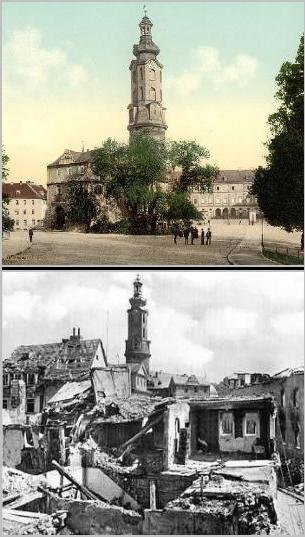
| The oldest record of the intellectual city of Weimar dates from the year 899. It was once the capital of the Duchy of Sachsen-Weimar. The town only had 6,000 residents by the early 19th century, but it was a great intellectual center and home to Goethe, Schiller, Liszt, Carl Maria von Weber and Nietzsche for at least part of their lives. Johann Sebastian Bach composed and was a music director here and German opera came into being here, thanks to Prussian Princess Anna Amalia, who amassed a music library. In bomb attacks aimed at cultural landmarks by the U.S. on February 9, 27 and March 10, 1945, the city was hit with 965 tons of bombs. In the first attack, 300 residents lost their lives. All of the buildings on the north side of the market square were lost. 325 historic buildings were destroyed, including the National Museum and the National Theater. A further 210 were severely damaged, including the 18th century homes of Goethe and Schiller and the Royal Palace. All of the historic buildings on the north side of the main town square were destroyed. On July 3, 1945, Weimar was given to the Communists and it languished as part of East Germany until reunification. |
| Wesel |
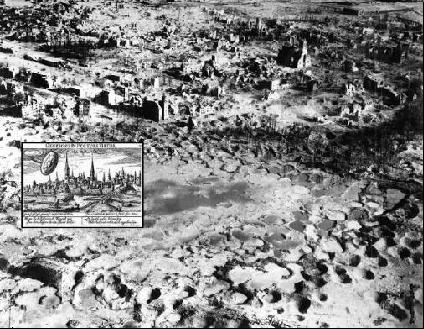
| Although the area was settled 2,000 years ago, neighboring Wesel developed around the time of Charlemagne. From that place there were several battles against the Saxons and Danes for several years. The early settlement sunk in a flood. By the 8th century A.D., churches were present, and the name "Wesel“ is mentioned for the first time in a document of 1065 where King Heinrich IV confirmed the return of the church and the possessions of the "villa wesele“ to the monastery of Echternach. At the beginning of the 12th century, Wesel finally was given to the Dukes of Kleve as a marriage dowry. Wesel was by then a hub of shipping from the Rhine. In 1407, Wesel joined the Hanseatic League and, next to Cologne, Wesel became the second most important transport and shipping center for goods being imported from the Netherlands, Westphalia and other distant places. Wesel was one of the best examples of the late Gothic period and home to master builders, carvers, painters and goldsmiths of the late Middle Ages. Wesel's history was Germany's history, encompassing the Reformation and the Thirty Years War. From 1540 on, Wesel was a Lutheran town, attracting many religious refugees from the Netherlands which were occupied by the Spanish. The willingness of the city to protect the persecuted was rewarded by its secondary name “Vesalia Hospitalis”. Shortly before end of the Second World War, the town of Wesel was wholly obliterated. From 1940, it experienced many air raids, but they grew to almost daily attacks from the beginning of the year 1945.On February 16, 17 and 18 of 1945 the devastating, ultimate destruction of Wesel finally arrived. 100 bombers, each with a 6,000 kg.load attacked on the 16th. On the 18th and 19th, 328 bombers dropped their deadly load. The once proud Hanseatic city had its guts ripped out. 7693 dwellings, 8 schools and 3 churches were gone. However, this was not the end. On February 23,1945 the Americans joined in. On the afternoon March 23,1945, in operation"Plunder," an enormous artillery bombardment on the ruins of Wesel commenced, and another 200 bombers battered Wesel with 1,100 tons of bombs and aerial mines. Another city that had stood since the Middle Ages was 98% pulverized, thousands were dead, leaving 2.1 million cubic meters of rubble. |

| Wiesbaden was a favorite visiting place for Goethe and other people of culture. About twenty miles from Frankfurt am Main, Wiesbaden was discovered as early as 2000 years ago, when the Romans found springs that carried hot thermal water to the surface. They found the effects of the waters to be miraculous for themselves and their horses and set up the first bath houses. After the Roman defeat by the Teutons in 407 A.D., the "Wisibada" of the Germanic tribes became popular as a trading post along the Rhine. Between 1200 and 1243, the Dukes of Nassau set up a number of castles and fortresses, remains of which can still be viewed in the suburbs of Wiesbaden. The Nassau rulers also helped this settlement to flourish. Under Prussian rule in 1866, the city was revived with elegant villas, expansive green spaces, parks as well as generous boulevards and magnificent new buildings. Aside from its airfield, Wiesbaden was not heavily bombed in World War Two. In the one and only RAF raid on Wiesbaden, 495 Lancasters and 12 Mosquitos were sent but accomplished little besides having three of their Lancasters crash in France. Important war industries along the Rhine were left untouched and the railway station was slightly damaged. The Merians |
| Wiesbaden |
| Wetzlar |
| Wetzlar is a medieval town in Hesse on the Lahn river with steep, narrow streets. The Romanesque cathedral of St. Mary was commenced in the 12th century. Barbarossa created an Imperial Bailiwick here. In 1285, his impostor Tile Kolup, came to Wetzlar. When King, Rudolph I heard of this, the city leaders seized Kolup and he was sentenced as a warlock and a blasphemer and was burned at the stake. After the Congress of Vienna, the area passed to Prussia in 1815. The outskirts of the town became industrialized in the 20th century and therefore became a bombing target. Although the historic district was mostly spared, the old cathedral suffered heavy damage. At war's end, the town's population doubled from the huge numbers of refugees flooding into the town from the east. |

| Waldenburg |
| Waldenburg in Baden-Württemberg was first mentioned as the home of a castle, a fief of the noble family Hohenlohe, in the year 1253, and it was designated as a city in 1330. In the 16th century, the old castle was converted into a residence of the Prince of the Dukes of Württemberg. In 1679, the castle stood unoccupied as the line of Hohenlohe-Waldenburg was extinct, but in the 19th Century, it was extensively renovated by a line of Hohenlohe-Waldenburg. In April, 1945, Americans pounded the old castle and its small village to rubble, reducing it by 80% because they thought it might be a hiding place for soldiers. In the aftermath of their carnage, the GIs lit numerous fires and destroyed a valuable art collection which had been taken there for safe keeping. |
| Torgau |
| Torgau in the northern district of Saxony in Saxony was first documented in the year 973. A 16th century saying was "Wittenberg is the mother and Torgau is the wet nurse of the Reformation". Among the reason for its importance is its claim to have the first Protestant church as well as being the place where Martin Luther's wife Katy Bora is buried. Shortly before American and Soviet troops linked up at Torgau on the Elbe in their historic April, 1945 meeting, an event which hastened the close of war and the defeat of Germany, Torgau's vicinity was hit simultaneously in a strike by over 100 US bombers. A monument was built in Torgau to honor the "liberation", but no monument was built to commemorate the plundered of the Hohner accordion and harmonica factory by the Red Army or the prison camps it opened there after Torgau was sentenced to decades of communist slavery. |
| Treuenbrietzen |
| Treuenbrietzen, a small town in southwest Brandenburg, has existed since the Middle Ages and was mentioned in writing in 1217. On April 20, 1945, the British sent 42 bombers to bomb the town, and the next day it fell to the Red Army, and a horrific massacre of civilians took place. Massacre |
| Weisweiler ( see under Aachen ) |
| Tirol (see under Innsbruck) |