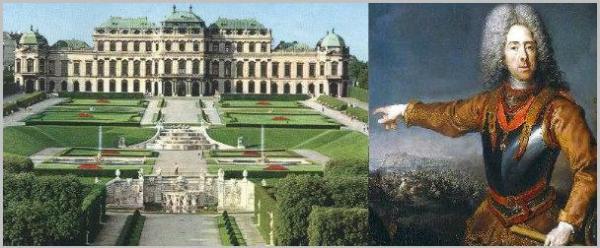
| Prinz Eugen von Savoyen: der edle Ritter |
| The Ottoman Empire began expanding westward into Europe in the middle of the 14th century like an uncontrollable grass fire, its first significant opponent being the young Serbian Empire, which had been weakened by a series of battles. The Ottomans then proceeded to conquer the lands of the Second Bulgarian Empire. The Ottoman gains in Catholic Europe slowed for 70 years following their defeat in 1456 at the Siege of Belgrade until the Kingdom of Hungary, which included the area from Croatia in the west to Transylvania in the east, finally collapsed with the Battle of Mohács of 1526, placing most of the Kingdom under an 150 year long Ottoman Occupation (with parts of the Hungarian Kingdom occupied from 1421 and until 1718). In 1529, the Ottomans mounted their first major attack on the Austrian Monarchy trying to conquer the province of Styria and laying waste to the country. The Ottoman threat was met head on by several intrepid military men from a host of European nations bound together by a common enemy. Prinz Eugen von Savoyen (1663-1736) headed for Austria under Count Ludwig of Baden. He would become one of the greatest generals to serve the Habsburgs. After winning the Battle of Vienna, the Holy League gained the upper hand, and conducted the re-conquest of Hungary ending with the Treaty of Karlowitz in 1699. Prince Eugene remained the most important Austrian commander. After the victorious Battle of Vienna of 1683, Austria enjoyed great success. Eugene's valor lead to his promotion as Major-General in 1685 and he was wounded twice in the eventual capture of Buda the following year. By 1688, the Habsburgs occupied Belgrade and most of the Pannonian Plain. But as the war with the French demanded more troops, and the Ottoman Army was strengthened and renewed by the new grand vizier, Belgrade was recaptured by the Ottomans in 1690. Austrian war effort increased in 1697, led by Eugene in his first independent command. He was made commander in chief of the Army in the Kingdom of Hungary on July 5, 1697. Out of his 70,000 man army, only 35,000 were battle ready, and he had to borrow money in order to pay wages and to create a medical service. When news arrived that the Sultan and his army were in Belgrade, Eugene concentrated all available troops, numbering about 50,000 to 55,000 from Upper Hungary and Transylvania, and began moving them toward Peterwardein. After the Sultan abandoned the idea of a seige of Szeged, he planned to return to winter quarters near Timişoara. Eugene learned of these movements and decided to force a battle. The Imperial army surprised the Ottomans as they were in the process of fording the river Tisza near Senta. After an intense artillery bombardment, Imperial Dragoon regiments dismounted, encircling the Ottoman camp. Ottoman troops from behind the entrenchments ran back to the bridge in confusion where they were slaughtered. Inside the camp, the battle was just as horrific and barely a thousand of the Ottomans escaped. More then ten thousand of their troops drowned in the Tisza river and up to twenty thousand Ottoman soldiers were killed on the battlefield. Austria lost only 500 men to the Ottomans' 30,000, including the 10,000 or so that drowned. They captured 87 cannon, the sultan's harem, the royal treasure chest and the Ottoman Empire's state seal. The main Ottoman army was scattered. This victory was decisive and lead to the Treaty of Karlowitz 1699, in which the Hapsburgs gained all of Hungary and Transylvania. Eugene’s reputation was exulted across Europe. Except for the Banat region of Temesvar, Sultan Mustafa II was forced to cede Transylvania and the Ottoman occupied areas of Buda, Eger and Kanizsa, which were later transformed or integrated into the Habsburg realm as the Principality of Transylvania, Kingdom of Hungary, Kingdom of Slavonia, and the Military Frontier. After another war with Austria and Venice began in 1714, Austria conquered the remaining areas of the former Kingdom of Hungary. In 1716, 150,000 Ottomans under Grand Vizier Damad Ali began to gather at Belgrade. They crossed the Sava at Zemun at the end of July and moved on the right bank of the Danube towards Sremski Karlovci. On the morning of August 5, Prince Eugene began his offensive. He soon had the Ottomans completely encircled. After he wiped out the Ottoman forces here, he led his troops against the encampment of the Grand Vizier. The battle was won by two o'clock, with the Grand Vizier himself among the dead. Barely 50,000 Ottomans returned to Belgrade. Austrians lost over 3,000 men and the Ottomans more than double that number. Hungary was liberated from the Ottomans and the Stronghold of Belgrade was soon captured by Eugene at the victory of Peterwardein (a town later ripped away from Austria at the Peace of Versailles). His monumental victory is embodied in the traditional song "Prinz Eugen, der edle Ritter" (Prince Eugene, the noble knight) and commemorated with the founding of the Timişoreana brewery. By June, 1717, Belgrade and its 30,000 man Ottoman garrison commanded by Mustapha Pasha was encircled by Imperial forces. Additional mercenary troops, Bavarians and 45 princely German volunteers of 100,000 besieged Belgrade. The Ottoman relief army, allegedly 200,000 strong under the command of the Grand Vizier Halil Pasha, encircled and bombarded the Imperial besiegers from high ground and it was brought near collapse. On August 16, 1717, Eugene, with weakened forces numbering around 60,000, decided to break out with his men and in the early hours they advanced. The Ottomans lost 20,000 men and the Austrians suffered over 5,000 casualties. Two days later the Fortress caved and the victory was celebrated across Europe. After a few skirmishes, all sides were ready for peace by 1718. The Treaty of Passarowitz in May of 1718 added northern Serbia and the Bosnian bank of the Sava river to the Austrians and finally and forever ended the Turkish threats to Vienna. Eugene’s Balkan campaigns had halted Ottoman expansion for good. In 1714, Eugene began construction of the Belvedere, a baroque palace in Vienna. Construction of various parts of the palace complex continued until 1723. Eugene never married, but he had a relationship with the beautiful and much younger Hungarian Countess Eleonora Batthyány (daughter of Count Theodor von Strattman) during the last 20 years of his life, and although they lived apart, most of his associates referred to her as his mistress and they were constant companions almost every day until his death. There is a story that he and the countess always played Whist at her place, and one evening he stayed so long that his coachman was sleeping when he finally came out. Eugen let him sleep, for the evening ritual was so familiar to the horses that they knew their way back to the Belvedere on their own. Before Elenora there have also been references to another woman in Eugen's life, Countess Maria Thürheim. |