| Siegen, Soest, Solingen, Sonneberg, Sonthofen, Staubling, Stettin, Stralsund, Stuttgart and Swinemuende |
| The painter Peter Paul Rubens was born in Siegen in 1577. The city was first recorded in 1224. Siegen was later the capital of a principality belonging to the house of Nassau, and from 1606 to 1743, it gave its name to the junior branch of Nassau-Siegen. Napoleon incorporated Siegen into the grand-duchy of Berg in 1806, and in 1815, the Congress of Vienna assigned it to Prussia. There is nothing much left of Siegen's historic past. It was 80%, or almost totally destroyed from the 3,770 tons of Allied bombs dumped on it during the Second World War. |
| Siegen |
| Soest |
| Another ancient Hanseatic city with over a thousand years of history was Soest, and in the Middle Ages it was the second or third largest city in Germany. Mentioned in documents for the first time in the year 836, Soest belonged to an old chain of settlements existing from 600 AD. The town had a fruitful landscape, plentiful water and an existing salt spring which it profited from. A medieval Arab envoy reported in 972 of a populated place named "Shushet" where salt was made. In the 15th century, Soest came under the protection of Duke of Kleve Johann I., and it secured a great amount of independence. After the death of the last duke of Kleve in the year 1609, Soest was awarded to the House of Brandenburg as part of the Kleve inheritance. Soest suffered under the Thrirty Years War and by 1756 only had about 3,600 inhabitants. It lost the right of coining money in 1742, and languished since then. In the Second World War, Soest was the goal of 30 allied bomb attacks because of nearby train yards and a factory in town. A third of the city was completely destroyed, especially the old churches. 60% of the houses were damaged or destroyed. The ancient Patrokli cathedral, built between 954 and 1166, whose tower was once called the “tower of Westphalia” because it stood nearly 100 meters high, was bombed in a 1945 Good Friday attack and all but totally destroyed. |
| Solingen |
| Solingen was first mentioned in the year 1067, and for centuries it was a tiny Rhineland village. From 1347 to 1352, the plague devastated the population. Engelbert II, Archbishop of Cologne, who was eventually assassinated, had many enemies and built a castle in Solingen which was used until 1386 as a residence by the Counts of Berg who had been elevated to Dukedom. Solingen became a city in the early 15th century with city rights granted by the Dukes of Jülich. In the year of 1600, Solingen consisted of 188 houses with about 1200 inhabitants and it was already famous for its sword-blades. The 30 Years War put an end to Solingen's prominence and it was 100 years before it fully recovered. The old castle was put back into temporary use as a fortress for a while during the 30 Years War and not conquered by the invading Swedes. Afterwards, it was basically levelled. In the latter part of the 17th century, a group of disgruntled Lutheran swordsmiths from Solingen broke their guild oaths and took their sword-making skills and formulas with them to Shotley Bridge, then a remote village in England, where they set up shop. Shotley had rich iron deposits in the area and, because of the fast flowing waters of the River Derwent, was ideal for tempering swords. The little English town therefore became the heart of Britain's swordmaking industry. Solingen passed to Prussia in 1815. Bierstadt On November 4, 1944, 174 both American and British bombers dumped 4,921 tons of high explosives bombs and mines and 138 tons of incendiary bombs on it, igniting 900 fires. Although it destroyed the hospital and broke the water, electric and telephone lines, no historical buildings were yet hit. The second attack took place, the following day when there was no capacity to fight fires or save the town. In a 26 minute raid, 165 British bombers dropped 783 tons of high explosives bombs and 150 tons of incendiary bombs on Solingen, this time destroying the densely populated, ancient town center. 1,200 fires raged and the town was in rubble. 1,609 homes were totally destroyed, and 20,000 persons became shelterless. On November 5th, the English broadcast stated: “It is announced that Solingen, which is the heart of the German steel goods industry, is a dead city.” Also dead were 1,040 civilian. |
| Staubling |
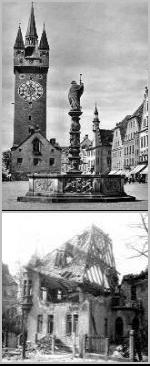
| Historically, the little Catholic town of Straubing in Bavaria lazes quietly on the right bank of the Danube, crossed by two bridges and crowned by a tall square tower with five pointed turrets dating from 1208. Today, the town has eight Catholic churches, one of which is St Peter's which houses the tomb of one Agnes Bernauer, a poor girl accused of withcraft long ago. Pretty, ancient Straubing was founded as a city in 1218 by Louis I Wittelsbach, Bavarian Duke. Straubingers heard their first alarm in 1941. Starting from 1943, it sounded almost daily. The first heavy air raid came on November 4, 1944 at noon, hitting the train station and railway tracks. More heavy attacks took place on December 20 and February 5, 1945. The worst day in Straubing history is considered April 18, 1945 at the tail end of the war. The bombing lasted 42 seconds, with 480.8 tons of high explosive bombs and 33.8 tons of incendiary bombs dropped to make it easy for the Americans who were poised to take the city. The town took 2 days to fight the fires and save people buried in cellars. Over 300 people perished, with many more later succumbing to injuries sustained from the attack. In 1952, the last broken down cellar was dug out, and 30 more bodies were found. There were at least 500 civilian fatalities as a result of the bombings. A quarter of all houses and buildings in the old part of town were completely destroyed or severely damaged. The town was in ninth place in degree of destruction in Bavaria, with Munich at eighth place. |
| Stettin |
| Stralsund |
| Stralsund, the wonderful, medieval city by the sea, was founded in 1234 by settlers from Rügen, and grew with the arrival of German traders a short time later. After an attack by their shipping rival Lübeck in 1249, the town was rebuilt with a massive city walls, gates and watch towers. Stralsund became a member of the Hanseatic League, and 300 of her ships sailed the Baltic by the 14th century. At the Treaty of Westphalia, she was handed to Sweden. Stralsund remained under Swedish control until 1815, when it became a part of Prussia. In WW Two, although Stralsund had alarms and minor bombings, they were not too worried since they had no military targets. This meant they had no real defenses either. On October 6, 1944, the US 381st bomber Group had orders to attack targets near Stettin to assist the Red Army, but because of bad weather, the 110 airplanes turned around and directed their machines at their secondary target, the old Hanseatic sea side city itself. First they hit the power station and the water supply. Next, they hit the port area. Then they honed in on the unsuspecting city center and the residential area.A second attack wave arrived at 1:00 o'clock, and again hit the city center and the suburbs. The third wave was directed at civilian targets as well. The bombers dropped 1,500 high explosive and incendiary bombs with individual weights between 100 and 1.000 kilograms, altogether 247.5 tons. The first victims were workers at a sugar factory, whose shelter received a direct hit with the first attack wave. In total, between 785 and 1,000 civilians were killed. 8,000 dwellings were gone, leaving 12.000 and 14.000 homeless. 385 of the 2,285 buildings of the medieval city center, 133 businesses, and the marketplace were gone as well. The centuries old Johanniskirche, the cloisters, the ancient gates, the old palace and the antique shipping houses were obliterated. The high explosives bombs had destroyed the roads and the incendiary bombs set the city aflame. Fire fighters could not use the public water to put out the fires, and rescue workers couldn't reach the people because of the rubble. 16 fishing ships were sunken as well. On October 12th and 16th, 1944, mass funerals were held. Then it was turned over to the communists. The town is now again part of Germany. |
| Swinemuende |
| The river Swina ran to the Prussian Baltic coast between two small fishing villages, East and West Swina, and when the river was dredged and widened for larger ships at the beginning of the 17th century, Swinemünde was founded on the site of old West Swina. Friedrich the Great granted the town its privileges in 1765, and it served as the outer port of Stettin. The quaint town, with its Hansa style houses, grew up with fishing and the shipping industry, and its fortified entrance to the harbor was protected by two long breakwaters with the lighthouse on tiny Wolin Island protecting sailors of old. In 1897, the Kaiserfahrt canal was opened, with the waterway deepened between the Stettin harbor and the Baltic, and Swinemünde no longer had much strategic importance. Instead, it became a resort. The Ruination of Swinemünde |
| Stuttgart |
| In the old Duchy of Württenberg, the ancient German city and the capital of today's state of Baden-Württenberg is Stuttgart, founded around 950A.D. as the residence of the counts of Wurttemberg. The name of the royal family of Württenberg and of the state originates from a steep Stuttgart hill, formerly known as Wirtemberg. After Napoleon dissolved the Holy Roman Empire, the dukes of Württemberg earned the title of kings and Stuttgart became a royal residence. Swabia was the birthplace of Kepler and Schiller, and home to hundreds of priceless architectural gems such as the old castle of the Dukes of Württemberg and the Stiftskirche, a Gothic cathedral from 1495 and It was also the burial place of nobles. Mergenthaler Duke Eberhard Götz Stuttgart is another city totally flattened by continuous Allied bombing, the worst raid taking place April 22, 1945. Stuttgart was bombed 53 times by the Allies, killing thousands of people. Although an important industrial and rail center, most targets were non-military, and purely cultural sites earmaked beforehand for destruction. Bombing attacks leveled 60% of Stuttgart's buildings and left 52.972 million cubic feet of rubble. None of its landmarks or historic structures survived intact. The lovely city was now nothing but rubble and death. Under initial French occupation, there was a violent spree of violence against German women and girls, with almost 2,000 rapes reported. |


| The historical capital of Prussian Pomerania, which stretched almost to Danzig was stately, intellectual Stettin, left. A fortress as early as the 12th century, until 1637 Stettin was the residence of the dukes of Pomerania and an important member of the Hanseatic League. At the Peace of Westphalia in 1648, it passed to Sweden, but was ceded back to Prussia in 1720. The construction of a canal to Berlin in 1914 enriched Stettin as a port with extensive installations. During World War II, Stettin suffered heavy damage from repeated bombings. On the night of April 20, 1943, following six previous attacks, Stettin was bombed with an area of a 100 acres devastated and 40,000 people left homeless. Massive combined Allied forces bombed it again in 1945 in a more murderous assault in the heart of the city, killing and injuring thousands. Although 80% of Stettin, including the old section, is on the left or western bank of the Oder, and the Potsdam agreement of 1945 only transferred Pomerania "east of the Oder" to Poland, this was later "reinterpreted" to include old German Stettin. The predominantly German population was expelled and replaced by Poles who were trucked in to the city. About 500,000 humans died or remained missing when Eastern Pomerania and Stettin were subordinated in 1945 under Polish communist administration. Western Pomerania (without Stettin) was combined with Mecklenburg and fell under communist East German rule. |
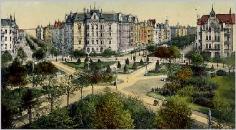

| Sonthofen (see under Allgäu) |
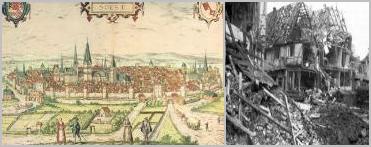


| Sonneberg (see under Meiningen) |