| Ottmar Mergenthaler's invention of the linotype composing machine is regarded as the greatest advance in printing since the development of moveable type 400 years earlier. Mergenthaler's new machine enabled one operator to be machinist, typesetter, justifier, typefounder and type-distributor. His machine revolutionized the art of printing and allowed an operator to automatically set brass matrix. Before Mergenthaler's invention of the Linotype in 1884, no newspaper in the world had more than eight pages. The machine was first used in 1886 by the New York Tribune, and Thomas Edison called it the Eighth Wonder of the World. It was widely used for over a century. Ottmar Mergenthaler (May 11, 1854 – October 28, 1899) was born in Hachtel, Baden-Württemberg to a poor village school teacher. He was apprenticed to a watchmaker in Bietigheim before moving to Baltimore, Maryland in 1872 where he became a member of the Liederkranz Society and of the German Turnverein. In 1878, he became a naturalized citizen of the US. Called the "second Gutenberg", he invented the Linotype machine in 1886, the first device that could easily and quickly set complete lines of type for use in printing presses. Mergenthaler reportedly got the idea for the brass matrices that would serve as molds for the letters from the wooden molds he had carved as a child for German "Springerle" cookies. He died of tuberculosis in Baltimore in 1899. |
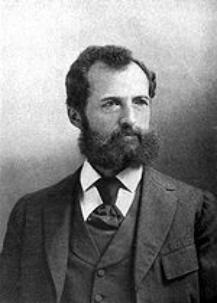
| The Second Gutenberg: Ottmar Mergenthaler |