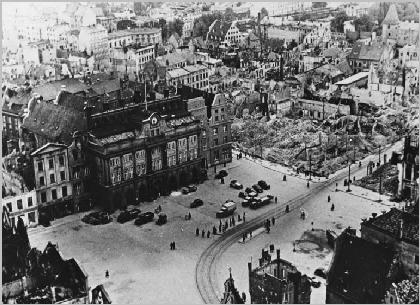
| Potsdam, Prenzlau, Prüm, Rathenow, Recklinghausen, Regensburg, Remscheid, Reutlingen, Ronsdorf, Rositz, Rostock, Rothenburg, Saarbrücken, Saarlautern, Salzburg, Schmalkalden, Schwandorf, Schwäbisch Hall, Schweinfurt |
| Regensburg |
| Regensburg, also known as Ratisbon, is one of the oldest German cities and a cultural center with historic monuments dating back to Celtic times. It was an important Roman outpost. An abbey was founded there in the mid 7th century, and St. Boniface established an Episcopal See in 739. From 1532, Regensburg was often the meeting place of the Imperial Diet, and it became the permanent seat of the Perpetual Diet or 'Immerwährender Reichstag', around 1663, around the time its commerce had declined. Unlike the 190 other medieval German cities completely flattened by Allied bombing, many of Regensburg's ancient buildings amazingly survived, including the famous cathedral. However, it was not for lack of trying. Regensburg suffered from 20 British bomb attacks and 8 American air assaults from 1943-1945. In 1943, an RAF attack killed 402 civilians. In total, 3,000 civilians here were killed by Allied bombing, including many prisoners of war. The Romanesque 9th century church of Obermünster was completely destroyed at the tail end of the War by a violent, senseless bombing in March of 1945. Only the belfry still stood. The church could not be rebuilt. |
| Remscheid (see Lennep) |
| Remscheid-Lennep was the birthplace of Wilhelm Röntgen . Remscheid was founded in the 12th century, but remained a small village until the 19th century, as did Lennep, a delightful medieval village of small squares and narrow, crooked streets with an old church as its architectural centerpiece. Lennep, Roentgen's actual birthplace, was damaged by fire in 1746 and rebuilt by its stubborn citizens, who insisted on rebuilding it according to the original ancient plans. In 1929, Lennep merged with the town of Remscheid, and its official name today is Remscheid - Lennep. On July 31, 1943, Remscheid-Lennep was almost completely destroyed during a British bombing which caused a horrible firestorm that killed 1,220 people. Today, a fifth of its inhabitants are foreign. |
| Rostock |
| Saarbrücken |
| Celts and Franks were the earliest known inhabitants of the eastern Frankish area which became part of Charlemagne's and Barbarossa's empire. By the Middle Ages, the Saar consisted of several little territories, the largest of which was the city of Saarbrücken. The counts of Nassau- Saarbrücken ruled from 1381 to 1793 and although the area was German, after the Thirty Years War it would be influenced by France. The Saar became a French province in 1684, but in 1697, France was forced to surrender all of the Saar except the town of Saarlouis. Then, from 1792 to until the final defeat of Napoleon in 1815, France again occupied the Saar, together with the entire west bank of the Rhine. France was forced to cede most of the Saar to Prussia and Alsace-Lorraine was given back to the German empire in 1871. After World War I, France was awarded the Saar coal mines and the Saarland was placed under the administration of the League of Nations. At the end of 15 years, a plebiscite was held on Jan. 13, 1935, giving the inhabitants the choice between being part of France or Germany, and more than 90 percent of the inhabitants of the Saar voted for its return to Germany. War came early to the Saar, when 185 people were killed by bombing in July, 1942. Since then, the British and Americans both hammered the Saar. A heavy daylight attack of the American "flying fortresses", supposedly aimed at the railway facilities, but of course just happened to hit residential areas and killed over 200 civilians. Twelve bomb attacks in three months would be the prelude to a series of another twelve attacks in three months, killing over 400 more civilians. While rubble of the last attack blocked the roads, another attack would commence, and the destruction grew larger and larger with each attack. In September of 1944, a new threat came from the air. Fighter bombers dive bombed the city, shooting at buildings and humans. From October 5th, Britain's "Butcher" Harris planned a solid double impact against the city: The first wave applied to the railway facilities, the second to the whole city. Old Saarbruecken went down, its residential areas foremost. A federation of 325 Lancaster bombers aimed at Saarbruecken in three waves, dumping approximately 2,500 high-explosive bombs as well as over 350,000 staff incendiary bombs in about a half hour. In the closely settled quarters of old Saarbruecken, the incendiary bombs released an enormous fire tower. Many Saarbrueckers who couldn't reach shelters tried to survive the attack in their cellars, and hundreds died of suffocation or burned in their houses. 45,000 people became shelterless. Saarbruecken's landscape was death and devastation. Authorities ordered the evacuation of the city. Even more attacks followed, and the British shifted to the use of sporadically released mines. When it was over, 1,334 more people were dead. After World War II, France again occupied the coveted Saar until 1957. |
| Salzburg |
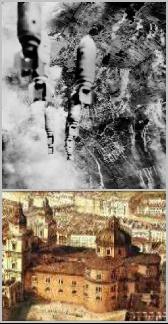
| The land south of the Danube was occupied by the Romans and they marked out roads, founded towns and the territory belonged to the province of Noricum. Christianity was introduced early, but vanished when the area was then devastated by barbarians until the emergence of Archbishops as sovereigns in 700AD. Salzburg grew wealthy from salt. Although Salzburg had cleverly escaped the ravages of the Thirty Years War and the Turkish invasion, Salzburg was bombed in World War Two as a cultural target. Allied bombing destroyed 7,600 houses and killed 550 inhabitants. A total of 15 strikes destroyed 46 percent of the city's buildings, especially around Salzburg train station. The town's historic bridges and the dome of the ancient cathedral were demolished when on October 14, 1944, 900 American bombers took the city by complete surprise and unloaded more than 9,000 high-explosive bombs on the historic city center, aiming for the cathedral dome and causing its collapse. Bombs falling on Salzburg, above |
| Schwandorf |
| Although Celts distilled salt at "Schwäbisch" Hall from the fifth century BC., Schwäbisch Hall is first mentioned in 1156, and the settlement was ruled by the Counts of Comburg-Rothenburg, followed by the Hohenstaufens around 1116. Barbarossa founded the imperial mint here, and Schwäbisch Hall produced salt and coins. After the fall of the house of Hohenstaufen, Habsburg king Rudolph 1 granted it rights of a free Imperial city in 1280 under the Holy Roman Empire. Louis IV the Bavarian granted a constitution in 1340. Schwäbisch Hall steadily acquired territory from the 14th to the 16th century from noble families and the Comburg monastery and its prosperity grew. Fires destroyed much of the city in 1680 and 1728, giving way to Baroque architecture. On February 23, 1945, 24 "Liberator"bombers hit an air base near Schwäbisch Hall. American air raids aimed for the town center, and on February 25, 1945 nearly destroyed it. 53 civilians died. Again, on April 17, 1945, at the very tail end of the war, the age old Rathaus was hit with incendiary bombs, leaving it in smoking rubble. |
| Schweinfurt |


| Rothenburg au Tauber |
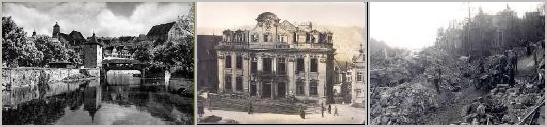
| A high light on the heavily touristed "romantic road", Rothenburg au Tauber has been so cleverly rebuilt that it is often described as having avoided the brutal Allied bombing. At the end of the second World War, there was a rush to destroy as many remaining towns as possible to insure the ground was cleared for "liberation" without any real struggles. March 31, 1945, the day before Easter, an allied bombardment destroyed the east of the old town and 40% of the original city. But, who would know? Old Rathaus 1945, above |
| Potsdam |
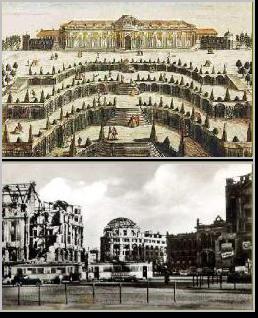
| For more than 3 centuries the rulers of Brandenburg hired the very best artists of their time to build and enhance the Royal buildings in and around Berlin with elaborate palaces and gardens. Sans Souci, in Potsdam, was built by George Wenzeslaus von Knobelsdorff, army officer turned architect, on the orders of Friedrich the Great, who assisted in the design. Churches of Kings Potsdam is a former fishing village on the Havel River only 16 miles from Berlin, and it held more than 20 glorious palaces, 19 lakes, fountains and verdant parks. The small town dates from 993, but its real growth accelerated in 1713, under Friedrich and his father. Rococo palace Sans Souci, surrounded by terraced vineyards, stands majestically on a hill in the middle of a 725 acre park. The Humboldts In April of 1945, Potsdam was horribly bombarded by 512 RAF bombers. 7,000 civilians died as a result of bombings, and most historic buildings and palaces were either gravely damaged, destroyed or extensively and joyfully looted by marauding troops. Even the bones of the great king were moved, and Potsdam was turned over to the communists as earlier agreed upon by the Allies. |
| Prenzlau is a city in Brandenburg first mentioned in a document at the close of the 2nd century, and it received its municipal charter in 1235. As the capital of the old Uckermark, it was a frequent object of dispute between Pomerania and Brandenburg until incorporated with the latter about 1480. On April 25, 1945, almost the entire city of Prenzlau was destroyed by American bombers On the day before there were about 1,850 houses and two days late only 870 still stood. The population fell in the same period from 28, 500 to 15, 700. |
| Prenzlau |
| Rathenow in Brandenburg is known for its bricks made of the clay of the Havel, and for its spectacles and optical instruments. Its Protestant church of St Mary and St Andrew, originally a basilica, was transformed to the Gothic style in 1517-1589. On April 18, 1944, Rathenow was attacked by U.S. bombers on their way to Berlin. Forced to turn around because of violent anti-aircraft fire, they dumped part of their lethal cargo on Rathenow. Between that and the destruction from Soviet troops, more than 75 percent of the city was destroyed. |
| Rathenow |
| Rositz |
| Rositz in Thuringia, dating from 1181, was one of the largest industrial communities in Germany with its coal mining and chemical industry. Many farmers were also settled there because of the fertile farmlands, and wheat and sugar beets were among the main crops. There are deep traces of the destruction, suffering and grief left behind from the war in Rositz even today. Although two major bomb attacks initially aimed at industrial targets in August 1944 and on February 14, 1945, many homes were also destroyed and 49 civilians killed. |
| Saarlautern or Saarlouis is a city in the Saarland which was built as a fortress in 1680 and named after Louis XIV of France after he took it from Germany. There were several violent Allied bomb attacks on the city. |
| Saarlautern |
| Ronsdorf (see under Wuppertal) |
| Prüm (see under Trier) |
| Schwäbisch Hall |
| Schwandorf, first mentioned in 1006, is a town in the Upper Palatinate in Eastern Bavaria on the Naab river. There were many prehistoric finds in the area, and later in Roman times, the Naab was an important trade route from south to north, both by land and by water. Salt and iron were among the main trade goods, and the salted fish of the Naab were traded. In 1299, the market received a municipal constitution. From 1505 until 1777 when it joined Bavaria, the city belonged to the duchy of Palatinate-Neuburg. In a 15 minute bomb attack on April 17, 1945 by Canadian and British bombers, 1250 civilians were killed, the railway station and immediate area were fully destroyed as well as two large residential districts including historic Kreuzberg. Around 1000 buildings, including 862 houses, were lost and 75% of the city was totally or partially lost, requiring ten years of reconstruction. A Baroque pilgrimage Catholic church and convent, Our Lady of Kreuzberg, which had stood since the 1600s, was among the victims and almost completely destroyed. It contained an alter by Lucas Cranach. Schwandorf became home to many displaced expellees from the Sudetenland. |
| Recklinghausen |
| Recklinghausen is a city in the Ruhr Area and borders the more rural Münsterland. The first settlements in the area are believed to date from the 4th or 5th century. The north of Recklinghausen is characterized by large fields and farms, the southern parts of the city are dominated by industry. On November 5, 1943, 374 USAAF bombers attacked the synthetic oil plant and marshalling yards near Recklinghausen. On the 19th another attack followed by 160 USAAF bombers. In the process, 12 churches and about 50% of the residential houses were destroyed. |
| Reutlingen, first mentioned around 1089–90, became an Imperial City of the Holy Roman Empire, free from allegiance to the Duke of Württemberg Some time around 1030, Count Egino started to build a castle on top of the Achalm mountain. During World War II, the city became the target of several allied bombing raids and there were three massive bomb attacks in Reutlingen 1945. It belonged to the ten most affected cities in the territory of present-day Baden- Wuerttemberg. |
| Reutlingen |
| The Danish king Valdemar I set a settlement here aflame in 1161, but the place was resettled by German traders. In the 14th century it was a powerful seaport town with 12,000 inhabitants and the biggest city of Mecklenburg. The rise of the city came with its membership in the Hanseatic League, of which it became an important part. Ships for plying the Baltic Sea were constructed here. In 1419 the oldest university in Northern Europe, the University of Rostock, was founded. Rostock evacuated 80,000 people during the war. Large parts of the historic city center city were destroyed by Allied bombing in 1942 and 1945. It was then sentenced to communist slavery for decades. Germans living on German soil that had been given to Poland were subjected to a policy of terror and/or deportation. Freed after reunification, only the western part remained part of Germany. |
| Schmalkalden (see under Meiningen) |